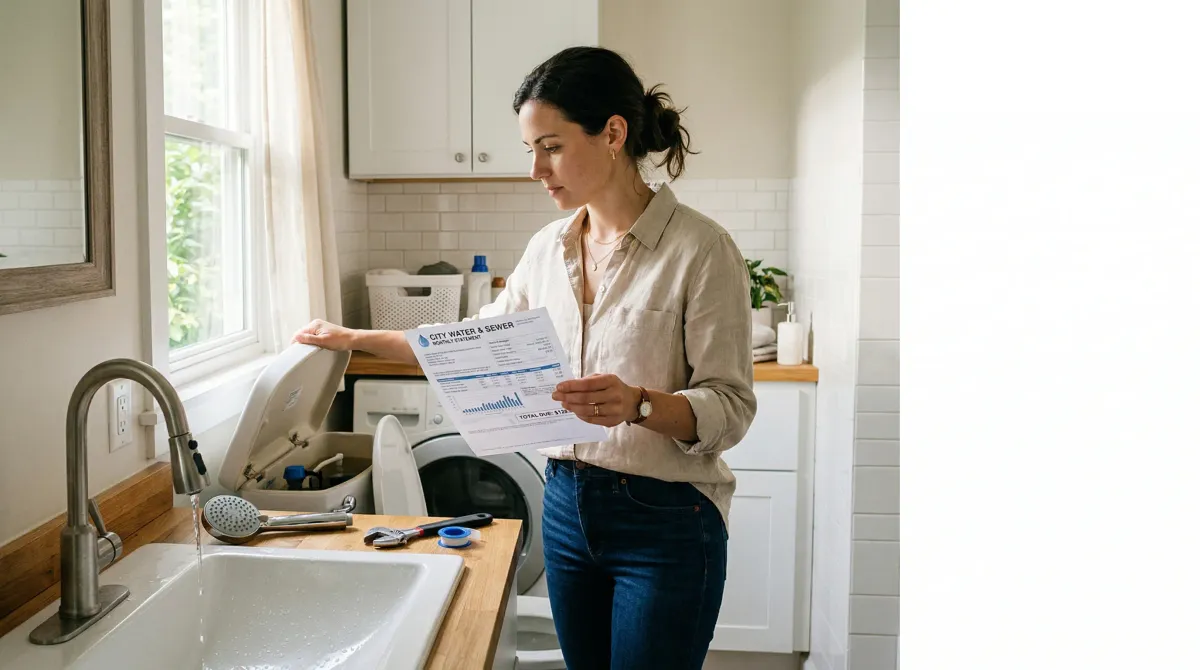
Water bills are annoying for the same reason slow leaks are annoying: they usually do not look dramatic until you add up how long the problem has been sitting there.
One toilet flap that does not seal well. One faucet you keep meaning to fix. One sprinkler head watering the sidewalk like it has a personal grudge. None of that feels urgent in the moment. Then the bill shows up and suddenly the house has opinions.
EPA WaterSense says the average household’s leaks can waste more than 9,300 gallons of water a year, and fixing easily corrected leaks can save homeowners about 10 percent on their water bills. It also notes that the average family can waste about 180 gallons per week from household leaks alone. That is why the cheapest way to lower a water bill is usually not a fancy upgrade. It is catching the waste you already have.
This guide focuses on practical, boring-in-a-good-way fixes that pay back quickly. Some are habit changes. Some are ten-minute repairs. A few are inexpensive fixture upgrades that make sense when the old part is already causing trouble.
How We Picked These Fixes
I kept this list centered on actions that meet three tests:
- They reduce actual household water use, not just general utility costs
- They are backed by EPA WaterSense guidance or WaterSense statistics
- They are realistic for normal homes, renters, and busy people
That means no giant remodel advice and no gadget list built around wishful thinking. Start with leaks, then move to bathrooms, kitchen habits, laundry, and outdoor watering.
11 Ways to Lower Your Water Bill at Home
1. Check for leaks before you start changing habits
If you skip this step, you can spend a month taking shorter showers and still lose the savings to a toilet that keeps running at 2 a.m.
EPA WaterSense recommends looking at water use during a colder month such as January or February. If a family of four exceeds 12,000 gallons in a month, there could be a serious leak. It also recommends the simple water-meter test: check the meter, avoid using water for two hours, then check it again. If the reading changed, water is going somewhere.
This is the first move because it tells you whether you have a behavior problem, a plumbing problem, or both. If your bill has been creeping up and you have also noticed damp cabinets, stains, or musty smells, pair this with our guide to hidden water damage warning signs.
2. Test your toilets for silent leaks
Toilets are the kind of problem people overlook because nothing looks broken. The leak is often quiet, steady, and expensive.
WaterSense says worn toilet flappers are one of the most common household leaks, and it recommends a dye test: add a few drops of food coloring to the tank, wait about 10 minutes without flushing, and see whether color shows up in the bowl. If it does, the toilet is leaking.
This is one of the highest-payoff checks in the house. A new flapper is cheap. Ignoring it is not. If you want a broader list of low-cost fixes in the same category, our article on small home repairs that prevent big bills fits well here.
3. Fix dripping faucets and loose showerhead connections
People get used to drips much faster than they should.
EPA WaterSense says a faucet dripping once per second can waste more than 3,000 gallons per year. A showerhead leaking at 10 drips per minute can waste more than 500 gallons per year. Sometimes the fix is as simple as replacing a worn washer, tightening the connection, or using pipe tape at the showerhead stem.
This is not glamorous work. It is also exactly the kind of repair that keeps paying you back after you forget you ever did it.
4. Replace the old showerhead before you obsess over shower length
Yes, shorter showers help. But an old, inefficient showerhead can waste water every single time you bathe, even when your shower is not especially long.
EPA says WaterSense-labeled products are certified to use at least 20 percent less water while performing as well as or better than standard models. Its statistics page says replacing showerheads with WaterSense-labeled models can save the average family more than 2,700 gallons of water per year.
If your current showerhead is old, sprays unevenly, or leaks anyway, this is one of the cleaner upgrade decisions on the list. You are not buying an experiment. You are replacing a part that was already on borrowed time.
5. Install a faucet aerator and stop letting the tap run for no reason
This one sounds too obvious, which is probably why people keep skipping it.
EPA says turning off the tap while brushing your teeth can save 8 gallons per day. Turning it off while shaving can save 10 gallons per shave. WaterSense also says bathroom faucets and aerators with the label are about 30 percent more efficient than standard faucets, and replacing old faucets or aerators can save the average family meaningful water over time.
The easiest version of this fix is to do both:
- stop the idle water habit
- add a low-cost aerator if your current faucet is older or overly wasteful
It is hard to find a cheaper change with a clearer return.
6. Stop pre-rinsing dishes and run the dishwasher only when it is full
Many people still wash dishes halfway before the dishwasher gets involved, which defeats a good chunk of the point.
EPA WaterSense says dishwashers typically use less water than hand washing, especially when they are full. Its statistics page says running the dishwasher only when full can save the average family nearly 320 gallons of water annually. It also recommends scraping plates instead of rinsing them before loading.
This is one of those habits that feels minor until you multiply it by every dinner, every snack plate, and every weekend when somebody stands at the sink with the water running. Let the machine do the job it was built for.
7. Use the sink like a basin, not a stream
Hand-washing dishes is not automatically wasteful. Hand-washing with the faucet running the whole time absolutely can be.
EPA says letting the faucet run for five minutes while washing dishes can waste 10 gallons of water. Its kitchen guidance recommends plugging the sink or using a wash basin if you wash by hand.
That is a simple mindset change: hold water where you need it instead of paying to send it straight down the drain. The same logic applies when rinsing produce, soaking utensils, or cleaning greasy pans. Running water feels efficient because it is moving. A lot of the time, it is just moving your money out of the house.
8. Wash full loads of laundry and match the water level
Laundry waste is less dramatic than a leak, but it shows up steadily if you run half-loads all week.
EPA WaterSense recommends washing only full loads or using the appropriate water level or load-size setting on the machine. When replacement time comes, it also points to ENERGY STAR certified clothes washers, which use about 30 percent less water than standard models.
This is a good place to be honest about your routine. If you are doing tiny loads because sorting is inconvenient or because you keep running out of basics, the fix may be less about the machine and more about setting a simple laundry rhythm.
9. Treat outdoor watering like a bill problem, because it is one
Outdoor use is where a lot of water bills quietly get stupid.
EPA says outdoor water use accounts for more than 30 percent of total household water use on average, and can be as much as 60 percent in arid regions. It also says as much as 50 percent of outdoor water use can be lost to wind, evaporation, and runoff from inefficient irrigation. That is a brutal sentence if you have ever watered a lawn at noon and called it productive.
Start with the obvious problems first:
- heads spraying pavement instead of plants
- visible leaks at hose connections or irrigation lines
- watering too often
- watering during the hottest part of the day
If your irrigation setup is automatic and older, WaterSense says labeled irrigation controllers can reduce an average home’s irrigation water use by up to 30 percent and save up to 15,000 gallons annually. That is a real upgrade, but only after the obvious waste has been fixed.
10. Use a broom and a bucket more often than a hose
Some outdoor water use happens because a hose is convenient, not because it is necessary.
EPA WaterSense recommends sweeping driveways, sidewalks, and steps rather than hosing them off. It also suggests washing the car with water from a bucket, or using a commercial car wash that recycles water.
This is not about never using a hose again. It is about noticing where the hose became the lazy default for jobs that do not need a steady stream of treated water.
11. Upgrade the fixtures that actually pay back, not every fixture in sight
There is a version of money-saving advice that turns into an excuse to replace half the house. That is not what you want here.
The better move is targeted replacement. EPA says the average family spends more than $1,000 per year in water costs and can save more than $380 annually from retrofitting with WaterSense-labeled fixtures and ENERGY STAR certified appliances. It also says a WaterSense-labeled toilet, showerhead, and faucet aerator in the main bathroom can pay for themselves in as little as one year.
That does not mean you need to rip out a working bathroom on Saturday afternoon. It means when a toilet runs, a showerhead leaks, or a faucet already needs attention, replace it with something efficient instead of buying the cheapest version that recreates the same problem in six months.
What To Do First This Weekend
If you want the fastest reasonable start, do these in order:
- Check the bill and run the two-hour water-meter test.
- Dye-test every toilet in the house.
- Fix any visible faucet or showerhead drips.
- Stop pre-rinsing dishes and stop letting the tap run while brushing.
- Walk the yard and correct the dumbest outdoor watering waste first.
That list is not exciting, which is exactly why it works. A lower water bill usually comes from removing waste that had no business being there in the first place.
Final Thoughts
The most reliable way to lower a water bill is to be a little less casual about waste.
Not paranoid. Not obsessive. Just less casual.
Look for the leak. Test the toilet. Stop letting clean water run while you do something else with your hands. Use full loads. Water the yard like the bill belongs to you, because it does.
If you are also trying to shrink the energy side of your household costs, our guide on how to lower your electric bill this summer is the natural companion to this one. Water waste and energy waste tend to show up the same way: a bunch of small habits and neglected maintenance that get expensive when nobody interrupts them.
Research and References
- Fix a Leak Week, U.S. EPA WaterSense, last updated March 13, 2026
- Statistics and Facts, U.S. EPA WaterSense, last updated March 11, 2026
- Start Saving, U.S. EPA WaterSense, last updated February 27, 2026
- About WaterSense, U.S. EPA WaterSense, last updated June 10, 2025
- WaterSense Products, U.S. EPA WaterSense
Discussion
Comments
Share a helpful tip, question, or takeaway from How to Lower Your Water Bill at Home: 11 Fixes That Actually Cut Waste.
0 Comments
Loading comments…