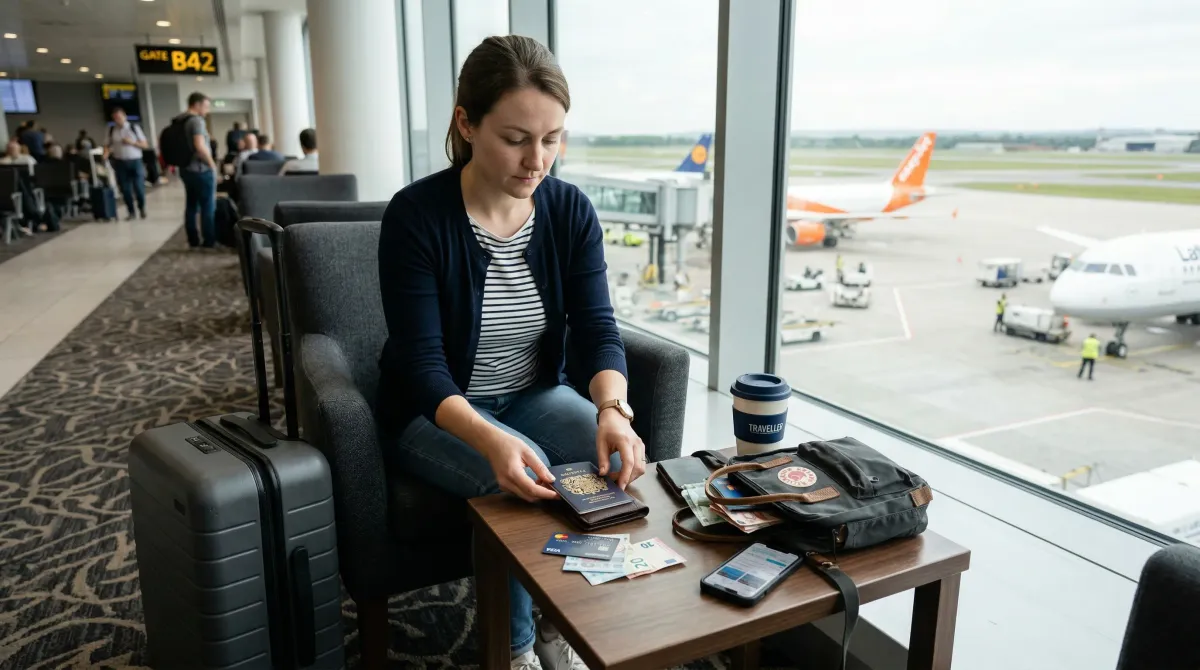
The worst travel wallet setup is the one most people default to.
Passport. Main credit card. Backup card. Most of your cash. Maybe your driver’s license too. All zipped into one neat little pouch that feels organized right up until it disappears.
That is the real problem this article is trying to solve. Good travel wallet safety is not about looking paranoid. It is about making sure one theft, one dropped bag, or one rushed moment at a cafe does not knock out your ID, your money, and your backup plan in the same breath.
I built this checklist from official travel guidance published by the U.S. Department of State, GOV.UK, Smartraveller, and the Government of Canada. The advice overlaps in a useful way: keep valuables secure, carry only what you need, separate critical items, and make sure you still have a way forward if one piece goes missing.
How we built this checklist
The goal is not to create the perfect anti-theft system.
The goal is simpler:
- make yourself a less convenient target
- avoid one-point failure if something is lost or stolen
- keep enough ID and payment access to finish the day and fix the problem
That is why this list focuses more on placement than gear. A clever wallet does not help much if everything important still lives inside it.
Travel Wallet Safety Tips: 10 Smarter Ways to Carry Cash, Cards, and Passport
1. Stop carrying your entire trip in one place
This is the rule that fixes most of the rest.
Do not keep your passport, your primary card, your backup card, and all your cash in the same wallet or sling. If one item is stolen, you want the loss to be annoying, not trip-ending.
GOV.UK’s foreign travel checklist tells travelers to take an extra form of photo ID and make sure they can still access money if their main payment method fails. Smartraveller goes one step further in its Hungary advice and tells travelers to keep a passport separate from other ID.
That is the principle in plain English: separate the things that would hurt most if lost together.
2. Carry only the cash you expect to use soon
The Government of Canada repeatedly warns travelers in destination advisories to avoid carrying large sums of cash or unnecessary valuables. That advice is boring and correct.
You do not need all your cash for the week in your day wallet. You need enough for the next meal, transport, tip, museum ticket, or small emergency.
The rest should be stored separately. That might mean:
- some cash in a different bag
- a small reserve back at your accommodation
- emergency cash split between travel partners if you are not traveling alone
The point is not to create five hiding spots and forget them. It is to make sure a pickpocket does not walk off with your whole money plan.
3. Keep a backup card in a different location from your main card
This sounds obvious until you notice how many people keep two cards in the same wallet and call that a backup system.
It is not.
Your backup card should live somewhere else. A different pocket, a different bag, or a different piece of luggage when you are in transit. If your main wallet vanishes, you still want a way to pay for transportation, food, or a room without immediately calling home in a panic.
GOV.UK’s checklist explicitly tells travelers to prepare for cases where the main payment method fails. That is not only about bank outages or phone problems. It is also about theft, loss, and the very ordinary reality of a card being blocked at exactly the wrong time.
4. Treat your passport as its own category, not part of your spending wallet
A passport is not just another card-shaped thing you carry around.
It is your identity document, your border document, and in many trips the hardest item to replace quickly. The U.S. Department of State says travelers should make copies of key documents and report a lost or stolen passport immediately. Smartraveller also reminds travelers that a passport can be used by others to commit crimes if it falls into the wrong hands.
So unless local law or logistics require otherwise, do not casually store your passport in the same wallet section as the card you use for coffee and transit.
That does not automatically mean “leave it in the hotel room.” It means think about it as a separate risk item and carry it intentionally.
5. Check whether you need the original passport that day
This is the part people oversimplify.
In some places, carrying a copy of your passport may be enough for routine movement. In others, local authorities may expect the original document or another legally accepted ID. Smartraveller’s Hungary advice is blunt: local authorities can ask to see identification at any time, and a photocopy will not be accepted.
So do not copy someone else’s travel habit without checking the rule for your destination.
Before you head out for the day, ask:
- do I actually need the original passport today?
- is another physical ID acceptable?
- will I need the passport for tax-free shopping, train boarding, currency exchange, or hotel check-in?
This one small check prevents a lot of bad decisions made from habit.
6. Keep one backup record of your essentials away from the wallet
Your wallet should not be the only place where your information lives.
GOV.UK tells travelers to keep a backup plan for accessing key information such as passport details, contact numbers, insurance information, accommodation details, and flight details. The State Department says travelers should make multiple copies of required travel documents for replacement if originals are lost or stolen.
So keep a small backup record somewhere else. Not a giant dossier. Just the information that matters:
- passport details
- bank or card emergency numbers
- travel insurance contact
- accommodation address
- embassy or consulate contact details
If you already set up the document kit from our Travel Document Backup Checklist: 10 Things to Save Before You Leave Home, this part is mostly done. If not, this is the moment to fix it.
7. Use your most secure carry setup in transit choke points
Transit is when people get sloppy because they are busy and tired. That is also when thieves do their best work.
GOV.UK warns about theft on public transport and in terminals. Canadian advisories regularly warn about pickpocketing in tourist areas and recommend keeping travel documents secure at all times. In practice, that usually means using the pocket or bag position that keeps your essentials close to your body and harder to access casually.
You do not have to dress like you are smuggling state secrets. Just tighten up when risk is higher:
- airport security lines
- train boarding
- subway platforms
- hotel check-in counters
- crowded markets
Those are the moments when bags are open, attention is split, and people set things down “for one second.”
8. Do not sort cash and cards in the open
One of the easiest ways to advertise what you are carrying is to start flipping through bills and cards in plain view.
GOV.UK’s Argentina guidance tells travelers to carry cash out of sight or close to the body and says a money belt under clothing is the safest option in high-theft settings. Canadian travel advice also repeatedly warns against showing signs of affluence.
You do not need to be theatrical about this. Just avoid the classic mistakes:
- counting a big stack of cash on the sidewalk
- opening the full wallet at a crowded ticket machine
- pulling out every card to find the right one while standing still in a tourist zone
Decide what you need before you step into the queue, then put the wallet away quickly.
9. Watch every ATM and payment terminal interaction
Wallet safety is not only about snatching. It is also about card fraud.
Government of Canada travel advice frequently warns travelers to pay attention when cards are handled by others, cover the keypad when entering a PIN, avoid suspicious card readers, and check statements for unauthorized activity.
That means:
- use ATMs inside banks or well-lit businesses when possible
- cover the keypad
- do not let your card disappear for a long back-room transaction
- check the machine for anything loose, odd, or attached
People often think of travel theft as dramatic. Sometimes it is just a skimmed card followed by a very annoying call to your bank.
10. If you are robbed, protect yourself first and freeze the damage fast
This is not the fun tip, but it matters.
The State Department’s Costa Rica travel advisory tells travelers not to resist robbery attempts. Its lost-passport guidance says a stolen or lost passport should be reported immediately, and once it is reported, it is no longer valid. That is worth remembering because in a stressful moment people often hesitate, hoping the item will turn up.
If something is taken:
- prioritize your physical safety
- freeze or lock affected cards
- report the passport loss or theft if applicable
- contact your embassy or consulate if the passport is involved
- use your separated backup card, cash, or document copies to keep moving
This is the real payoff of the whole article. Good wallet safety is not only about prevention. It is about recovery speed.
A simple setup that works
If you want a clean, low-drama system, this is enough for most trips:
- one main day wallet with limited cash and one primary card
- one backup card stored somewhere else
- passport carried separately or kept securely, depending on local rules and the day’s plan
- a small emergency cash reserve not stored with the day wallet
- a digital and paper backup of key document details
That is a much stronger setup than one overstuffed pouch you check every five minutes.
Final thoughts
Travel wallet safety is really about reducing how much can go wrong at once.
If a card gets blocked, you still have another way to pay. If a wallet disappears, your passport is not automatically gone with it. If your passport is stolen, you still have copies and a contact path. That is the whole game.
If you want to build out the rest of this travel-safety system, this article pairs well with our Travel Document Backup Checklist: 10 Things to Save Before You Leave Home, Hotel Room Safety Checklist: 11 Things to Check in the First 5 Minutes, and Hotel Wi-Fi Safety Tips: 10 Ways to Protect Your Devices While Traveling.
Research and references
- International Travel Checklist, U.S. Department of State
- Lost or Stolen Passport Abroad, U.S. Department of State
- Costa Rica Travel Advisory, U.S. Department of State
- Foreign travel checklist, GOV.UK
- Safety and security - Argentina travel advice, GOV.UK
- Hungary Travel Advice & Safety, Smartraveller
- Travel advice and advisories for Barbados, Government of Canada
Discussion
Comments
Share a helpful tip, question, or takeaway from Travel Wallet Safety Tips: 10 Smarter Ways to Carry Cash, Cards, and Passport.
0 Comments
Loading comments…