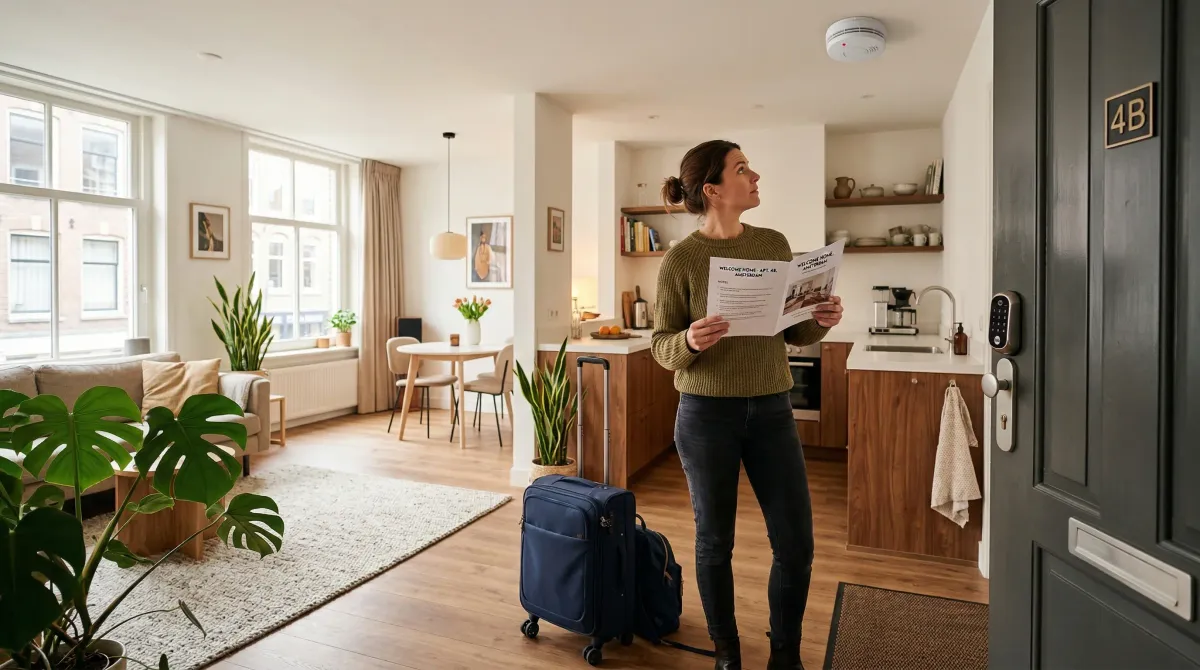
Vacation rentals can make a trip easier. You get more space, a kitchen, maybe laundry, maybe a place that feels less sterile than a hotel room. You also lose some of the built-in safety structure that hotels usually provide.
There may be no staffed front desk. No hallway evacuation map. No one nearby if the door code fails, the smoke alarm is missing, or the listing turns out to be much less real than the photos suggested.
That is why this checklist starts before you pay and ends in the first few minutes after you arrive. A short-term rental can still be a great stay. You just want to confirm the basics before you trust it.
This article draws from guidance published by the U.S. Department of State, the U.S. Fire Administration, the American Red Cross, the Federal Trade Commission, the Government of Canada, and Airbnb’s guest safety guidance. I kept it centered on the checks that matter most in vacation homes, condos, cabins, and short-term rentals.
How We Built This Checklist
I kept the list focused on three common vacation rental problems:
- Booking risks, such as fake listings, false addresses, or payment scams
- Fire and carbon monoxide risks, because short-term rentals are not regulated like hotels
- Arrival-night problems, such as missing alarms, blocked exits, or no clear way to get help fast
The U.S. Fire Administration puts the big difference plainly: homes and apartments used as vacation or short-term rentals are not regulated to the same extent as hotels and motels. That is the main reason this checklist matters.
Vacation Rental Safety Checklist: 12 Things to Check Before You Pay and Before You Unpack
1. Verify the address, photos, and contract details before sending money
Vacation rental safety starts before check-in.
The FTC warns that scammers reuse real listings, swap in fake contact details, or invent properties that are not available for rent at all. The Government of Canada also warns about fake vacation home rental agencies using false addresses and altered property photos.
Before you pay anything, confirm that the address exists, that the rental details stay consistent across the listing and the contract, and that the host or company looks real outside the booking page. If the place is part of a resort or building with on-site staff, verify the location independently.
2. Refuse wire transfers, gift cards, crypto, and rushed payment pressure
This is one of the easiest checks on the list because the red flags are so loud.
The FTC says not to wire money or pay for a vacation rental with prepaid cards or gift cards. It also says to walk away from anyone pressuring you to decide immediately. That combination of urgency and hard-to-reverse payment methods is one of the oldest travel scams around.
If a host says someone else is “about to grab the dates” unless you pay off-platform right now, let them keep the dates.
3. Check what safety devices the listing claims to have
Do not wait until midnight in an unfamiliar house to find out there is no carbon monoxide alarm.
Airbnb’s guest safety guidance says travelers should check whether a space has smoke and carbon monoxide alarms before making a reservation and again on arrival. The U.S. Department of State says to ask whether lodging has carbon monoxide detectors or bring one with you when you travel.
If the rental has a fireplace, gas stove, gas heater, attached garage, or anything fuel-burning, this matters even more. If alarm information is missing from the listing, ask before you book.
4. Keep a backup arrival plan in case the rental goes sideways
Hotels are not the only places where arrival problems happen. Vacation rentals just make them lonelier.
The State Department advises booking accommodations before travel and having backup options ready in case you need to switch locations. That advice fits short-term rentals well because there may be no manager on site, no lobby, and no quick fix if the lock code fails or the property is not what was promised.
Save the host number, check-in instructions, and one nearby backup hotel before you travel. It is a boring step until it saves you an ugly night.
5. As soon as you arrive, save and share the exact address
You want everyone in your group to know where they are staying without guessing.
The U.S. Fire Administration says everyone should know the address of the rental. That sounds simple, but plenty of cabins, condos, and detached houses do a bad job of making the address obvious once you are inside.
Save it in your phone, text it to the people traveling with you, and send it to one trusted contact if you are on a solo trip. If the place is hard to find again after dark, take a screenshot of the map pin too.
6. Test the main entry, bedroom windows, and any sliding or patio doors
In a vacation rental, the doors and windows have to do two jobs. They need to lock, and they also need to open if you have to get out.
The State Department says to ensure doors and windows lock properly. The U.S. Fire Administration and the Red Cross both say you should be able to open all doors and windows that lead outside.
So test both. A stuck window is not only annoying. It can also remove one of your escape routes.
7. Check for working smoke alarms where people sleep
This is one of the clearest differences between “feels fine” and “is fine.”
The U.S. Fire Administration says vacation rentals should have working smoke alarms in every sleeping room, outside each separate sleeping area, and on every level of the rental. The Red Cross repeats the same guidance for condos, homes, and similar stays.
Do not overcomplicate this. Look for the alarms, press the test button if that is appropriate and practical, and contact the host if something is missing or disconnected.
8. Check for carbon monoxide alarms on every level
Carbon monoxide is the kind of danger people forget because you cannot see or smell it.
The U.S. Fire Administration says there should be working carbon monoxide alarms on every level of the rental. Airbnb’s guest safety page says travelers should verify whether a place has them before booking and on arrival, and it notes that travelers may want to bring their own detector if one is not listed.
If a carbon monoxide alarm goes off, Airbnb’s safety guidance says to move quickly to fresh air, never ignore the alarm, and call local emergency services. That is not the moment for group debate.
9. Learn two ways out of every bedroom and out of the rental
Hotels train people to think about exits in hallways. Vacation rentals require a different mental map.
The U.S. Fire Administration and the Red Cross both say everyone should know two ways out of every room and out of the rental in an emergency. That can mean a bedroom door plus a usable window, or the main stair route plus a second exterior door.
Walk it once while everyone is calm and awake. It takes less than a minute and saves you from improvising later.
10. Find the fire extinguisher and first-aid kit now, not later
If you wait until you need one, you waited too long.
The Red Cross says to ask about the presence of fire extinguishers in vacation rentals and know where they are located. The U.S. Fire Administration’s short-term rental flyer says everyone should know where to find a first-aid kit.
Look for both when you first arrive. You are not doing a full inventory. You just want to know whether they exist and whether you could reach them fast.
11. Pick an outdoor meeting spot and know what not to use indoors
This is the part people skip because it feels a little theatrical. It is still worth doing.
The U.S. Fire Administration says to choose an outside meeting place a safe distance from the rental. Airbnb’s fire and carbon monoxide guidance also warns against using generators, grills, camp stoves, or other fuel-burning devices inside a home, garage, basement, crawl space, or partially enclosed area.
If the rental includes outdoor gear, barbecue equipment, or a garage setup, take a second look at how it is being used. A vacation house should not come with homemade combustion experiments.
12. Leave if the basics are missing
This is the least convenient item on the list, and sometimes the most important one.
If the address is unclear, the host is unreachable, the exits are blocked, the alarms are missing, or the property feels unsafe in a way you cannot explain away, move. The State Department’s advice to keep backup options is useful here for a reason.
Short-term rentals can be great. They can also put more of the safety burden on the guest. If the basics fail, trust the failure, not the discount.
The 30-Second Version
If you want the shortest version, do this:
- Verify the address and do not pay off-platform with risky methods.
- Check whether the rental lists smoke and carbon monoxide alarms.
- Save the exact address and host contact before you settle in.
- Test doors and windows for both locking and emergency exit use.
- Find the alarms, extinguisher, first-aid kit, and two exit routes.
- Leave if the rental fails the obvious basics.
That catches most of the big problems early.
Final Thoughts
Vacation rental safety is not about assuming the worst. It is about closing the gap between a polished listing and the real place you are trusting for the night.
That is why this checklist starts before payment and keeps going after arrival. A short-term rental asks you to do more of the verification work yourself. Once you accept that, the smartest checks become pretty simple.
If you are staying in a hotel instead, our Hotel Room Safety Checklist: 11 Things to Check in the First 5 Minutes is the better companion. And if the trip starts at the airport, Airport Security: How to Get Through Faster helps you get there with less friction.
Research and References
- Lodging Safety, U.S. Department of State, last updated August 11, 2025
- Hotel and Vacation Rental Fire Safety, U.S. Fire Administration
- Short-Term Rental Fire Safety, U.S. Fire Administration
- How to Stay Safe on Vacation, American Red Cross
- Getting a vacation rental? Watch out for scams., Federal Trade Commission, published June 23, 2022
- Overseas fraud: an increasing threat to the safety of Canadians, Government of Canada, date modified June 13, 2024
- Fire and carbon monoxide safety, Airbnb Help Center
Discussion
Comments
Share a helpful tip, question, or takeaway from Vacation Rental Safety Checklist: 12 Things to Check Before You Pay and Before You Unpack.
0 Comments
Loading comments…