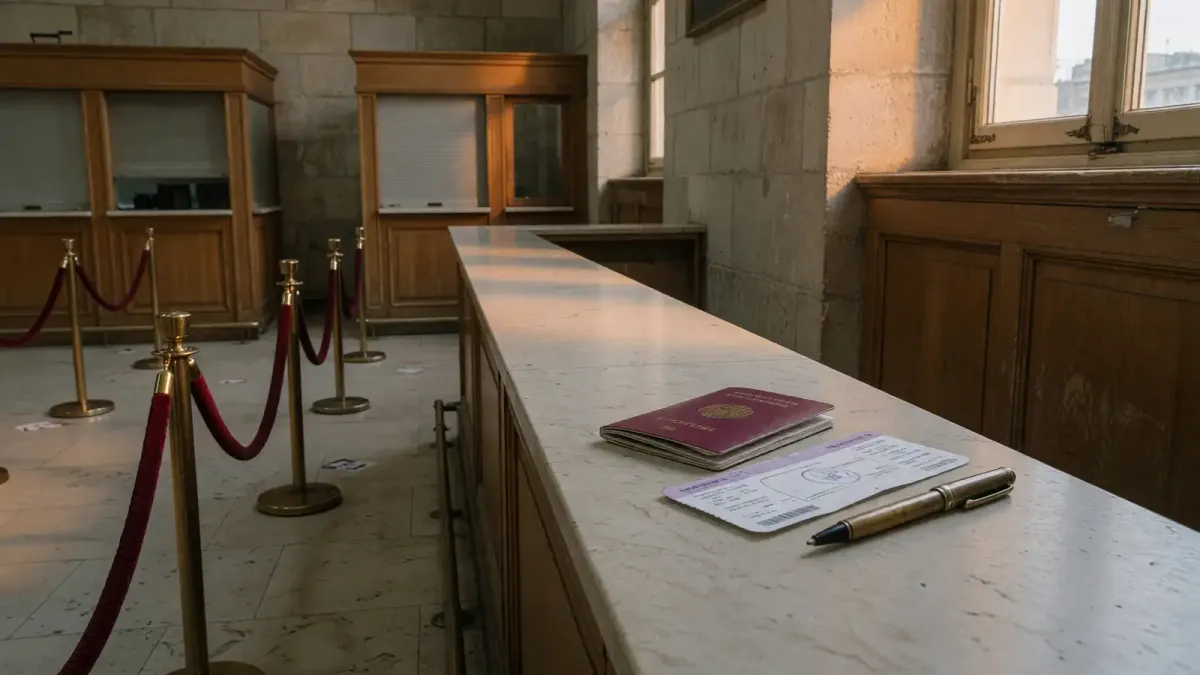
Five hours and under an hour are both in this week’s pages. They are not the same measurement, and they are not a forecast for your gate. Airport Industry-News, in Tiana May’s October 14 piece, says ACI EUROPE and Airlines for Europe told the European Commission that border waits under the Entry/Exit System reach five hours at peak and routinely exceed two hours in some places. The Independent’s October 14 bulletin says an Abta survey found 87 percent of travellers spent under an hour in EES lines. Biometric Update prints an 87 percent too, and attaches it to a smaller group. If you pack for the headline and ignore the denominator, you will either miss a connection or stand in a hall you did not need to fear.
We already had a security line that is not the same as the border desk. What actually moves an airport security queue is a different counter from passport control. We already had a ticket an airline can cancel by mistake. That cancellation is a reservation problem, not a biometric one. We already had a first passport that still has to be done in person. Online renewal is a 2027 date, not this trip. This week’s pair is about the Schengen border clock. I am not going to tell you to skip Europe. The usable part is which hour belongs to which page.
Five-hour EES queues are an industry peak. Under one hour is a survey.
The five-hour figure is not Abta’s. Airport Industry-News attributes it to the joint call from ACI EUROPE and A4E. Peak waiting times reach five hours. In some locations, queues routinely exceeded two hours. The disruption, that page says, has hit passengers, airports, and airlines across the Schengen area, and travellers are at risk of missing flights and connections. Biometric Update uses the same shape: routinely more than two hours, five hours at peak. The Independent adds a summer memory. Ryanair and Airports Council International backed extending contingency rules after summer waits peaked at up to five hours. “Up to five hours” and “reach five hours at peak” are close. They are still not a measurement of the airport you land at on a Tuesday in October.
Abta’s clock is a survey, and the two writeups do not hand you the same 87 percent. The Independent says 87 percent of travellers spent under an hour in EES lines, and 6 percent felt the process made them much less likely to visit the EU. Biometric Update, reporting Abta’s Holiday Habits survey of more than 2,000 travellers, shared at the association’s Travel Convention in Madeira, says only 6 percent said the process had made them significantly less likely to visit EU destinations. It then says 46 percent of travellers heading to Europe had already used EES since the phased introduction began late last year. Among those travellers, half waited less than 30 minutes, and 87 percent waited under one hour.
Read that twice. Independent’s 87 percent is “travellers.” Biometric Update’s 87 percent is the subset who had already been through EES, and that subset is 46 percent of the people heading to Europe in this survey. I am not going to average them. I am not going to say “most people wait under an hour, so the five-hour stories are wrong.” A peak of five hours can sit in the same season as a survey where most recorded waits were under an hour. The people in the long queue are real. They may also be a small share of a 2,000-person poll. The extract does not print that share. If a blog says “87 percent waited under an hour, so allow 45 minutes,” it has invented a planning number neither page printed.
The 6 percent has a wording split too. Independent says “much less likely.” Biometric Update says “significantly less likely.” I am leaving both adjectives on the pages that used them. Six percent is not a collapse in demand, and Abta is not claiming one. It is also not a reason to treat a five-hour peak as a press-release habit. The industry pages are asking for rule changes because missed connections cost airlines and airports, not because a survey average felt slow.
Official use on 12 October 2025 is not six months of full rollout.
Airport Industry-News dates official use to 12 October 2025. The same article says the queues are still there nearly six months after full implementation. Biometric Update quotes Olivier Jankovec, director general of ACI Europe, and Ourania Georgoutsakou, managing director of A4E: six months after full implementation, the system has not delivered the faster crossings that were promised. October 2026 minus six months is April 2026, not October 2025. I am not going to “correct” 12 October 2025 into April. The page printed an official-use date and, in a different sentence, a full-implementation clock. Those can both be true if phased use and full rollout are different events. A caption that says “EES launched in October 2025 and has been fully live for a year” has merged them.
The Independent’s bulletin has a third tense. It says Abta stated that the system should not be fully rolled out until stability and efficiency issues are resolved. If other pages are already counting six months of full rollout, “should not be fully rolled out” is a demand about contingency, not a description of the calendar. I am not going to treat the Independent sentence as proof that EES is still a pilot. Abta’s ask, in that bulletin, is to extend contingency measures into 2027. Biometric Update adds a reason Abta is pushing the date: the launch of ETIAS appears to have been delayed. “Appears” is the word on the page. I do not have an ETIAS start date in these extracts, and I am not going to borrow one from a different week.
ETIAS and EES are different objects even when a headline stacks them. EES, as Airport Industry-News and Travel Market Report describe it, records the entry and exit of non-EU nationals on short stays. It takes a facial image and fingerprints, plus the travel document, and it replaces the passport stamp. Travel Market Report names Canadians as people it applies to. It also applies to other non-EU short-stay travellers. It is not a visa. It is not a pre-trip authorization you buy on a website. If someone at the airport sells you an “EES pass” or an ETIAS voucher, that product is not in these four pages. I am not going to describe a fee I did not extract.
The six-point plan is a rule ask. It is not a shorter queue tomorrow.
Biometric Update dates the six-point plan to October 12. ACI Europe and A4E released it. Travel Market Report prints the same six items, and Airport Industry-News confirms the last one in plainer language. I am using the Biometric Update wording, because it is the most specific, and I am not going to pretend the three pages are a statute.
First, eliminate duplicate verification. Travel Market Report says “double verification procedures.” Biometric Update says “duplicate verification processes.” Same demand, two nouns. I do not know, from these extracts, whether the duplicate is a person checked at a kiosk and again at a booth, or a document checked twice in software. The pages do not draw the diagram. What they do say is that the current process repeats work.
Second, optimize biometric verification. That sentence is a goal, not a setting you can toggle. No page in this set prints a target seconds-per-passenger, a fingerprint-retry limit, or a camera height. If a forum post adds “they want checks under 20 seconds,” that number is not in the October 12 plan as these articles quote it.
Third, prevent duplicate EES traveller profiles. This is the one I would actually remember as a passenger. A second profile is not a longer queue in the abstract. It is your face and your fingerprints attached to two records, and a later officer trying to decide which one is you. The plan asks the system to stop creating those duplicates. It does not say the duplicates are already gone.
Fourth, upgrade the Travel to Europe app and web portal so pre-registration, or pre-enrollment, works better. Airport Industry-News lists shortcomings in that app as one of the unresolved problems, next to staffing, unstable IT, and limited use of kiosks and automated gates. Luke Petherbridge, Abta’s director of public affairs, asked for app enhancements and better pre-arrival triaging, and for the flexible border-check rules to stay. Pre-arrival triaging is his phrase. It is not a feature I can tell you how to turn on. Trying the official app before you fly is still the only pre-step these pages point at. Betting a 50-minute connection on the app having worked is not.
Fifth, expand and standardize automated border control for non-EU travellers. Biometric Update says “third-country nationals.” Travel Market Report says “non-EU travellers.” I am treating those as the same ask in this plan, not as two programs. Limited deployment of kiosks and e-gates is already on the problem list. A plan to standardize access does not mean the gate at your arrival airport is open to your passport this week.
Sixth, restore the ability to pause biometric registration when waits get excessive, and make that pause a permanent part of the operating rules rather than a temporary exception. Airport Industry-News says the associations want authorities to be able to partially suspend EES by pausing biometric registration during severe congestion, as an ongoing arrangement. This is the point that collides with the nine-country list below. A pause is not the same as the system being off. It is a decision, at a border, on a bad hour, to stop enrolling biometrics so the line moves. You may still be checked. You may not get a stamp back. The extracts do not say the stamp returns on a pause day.
Jankovec and Georgoutsakou, in the joint statement Biometric Update and Travel Market Report both quote, said this is no longer a teething problem, and that passengers, airports, and airlines should not keep paying for avoidable disruption. They also said the security gain is real, and that Europe needs a border system that is secure and operationally effective, not one that buys one by spending the other. I am not going to turn that into a verdict on biometrics. The sentence I can use is narrower. The people who run the airports and the airlines are asking for process cuts and for a legal pause button. They are not asking passengers to arrive five hours early as the fix.
Nine countries can already pause registration. Your airport may not be one of them.
Biometric Update says the EU has granted at least nine Schengen countries flexibility to temporarily suspend biometric registration under EES so passenger flow can be kept. The nine it names are France, Germany, Italy, Belgium, the Netherlands, Greece, Malta, Portugal, and Switzerland. “At least nine” means the list might be longer. The extract does not add a tenth. I am not going to add one.
Switzerland is on the list and is not an EU member. Schengen is the relevant club here, not the EU flag on the sign. If your connection is in a Schengen airport that is not on this list, do not assume the pause exists because a neighbouring country has it. If your connection is in one of the nine, do not assume today’s shift is using the pause. The flexibility is a permission. It is not a published daily status in any of these articles.
That is the practical split I would write on a boarding pass sleeve. The five-hour number is a peak the industry is using to ask for a permanent pause rule. The pause that already exists is country-level, temporary, and uneven. A traveller who reads only the five hours will pad every European arrival by an afternoon. A traveller who reads only Abta’s under-an-hour line will book a 45-minute connection into a hub that is having the bad hour. Neither page tells you which hub, on which date. Airport Industry-News does not name the five-hour airport. I am not going to invent one.
The missed-connection risk is the part that survives that gap. The industry statement is explicit that travellers can miss flights and connections. That is a transfer design problem, not a personality problem. If you are entering Schengen and then flying onward, the border desk sits between the two flights. Security, which we have written about as its own line, may be a second stop. I would not stack a short connection on top of a first-time EES enrollment. I also would not treat every repeat entry as free. The extracts do not say a second visit skips biometrics. They say duplicate profiles are a problem the plan wants fixed, which is a hint that repeat visits are not clean, not a hint that they are fast.
What to do with a non-EU passport and a connection
If you are an EU national, these pages are mostly not about your lane. EES, as described here, is for non-EU short stays. Travel Market Report’s Canadian example is the clearest. A US, UK, Canadian, Australian, or other non-EU passport on a short trip is in the same system, even when a specific nationality is not named. I am not going to list visa-exempt countries from memory. Check the official rule for your passport. These articles are about the queue once you are in the system, not about whether you need a visa.
Before you fly, the only pre-step the sources actually name is the Travel to Europe app and web portal. The industry plan says it needs an upgrade. Abta’s public-affairs director asked for app improvements and pre-arrival triaging. So use the official app if you can, and do not pay a third party for a slot in it. Then assume the app may not have cleared you. The shortcomings are on the problem list in October 2026, nearly a year after official use and, on the other clock, six months after full rollout. An app that the airports are still asking to be fixed is not a guarantee you can spend down to the minute.
At the airport, separate three lines in your head. The security line is not the EES line. The EES line is not the airline check-in line, and an airline that cancels a ticket by mistake is a different desk again. If a staff member tells you biometric registration is paused today, that matches the flexibility Biometric Update describes for those nine countries, and it matches the sixth point of the plan as a thing the industry wants made permanent. Ask which country’s rule they are using if you are changing airports. A pause in Paris does not travel with you to a non-listed airport two hours later.
On the survey, keep the nouns. If someone in your group cites 87 percent, ask whether they mean all travellers, as the Independent wrote it, or the 46 percent who had already used EES, as Biometric Update wrote it. If they cite five hours, ask whether they mean a peak ACI EUROPE and A4E are using in an October 12 plan, or their own last trip. If they cite 6 percent, they are talking about people who said they are less likely to visit, not about people who missed a flight. Demand and delay are different charts.
I am not going to close with a packing list. The October pages did not publish one. They published a peak, a survey with two denominators, a six-point ask, a nine-country pause list, and a 2025 official-use date that is not the six-month clock. The work, if you are booking a connection into Schengen this month, is to stop letting one of those numbers stand in for the others.
Discussion
Comments
Share a helpful tip, question, or takeaway from EES Queues Hit Five Hours. Abta Clocked Under One..
0 Comments
Loading comments…