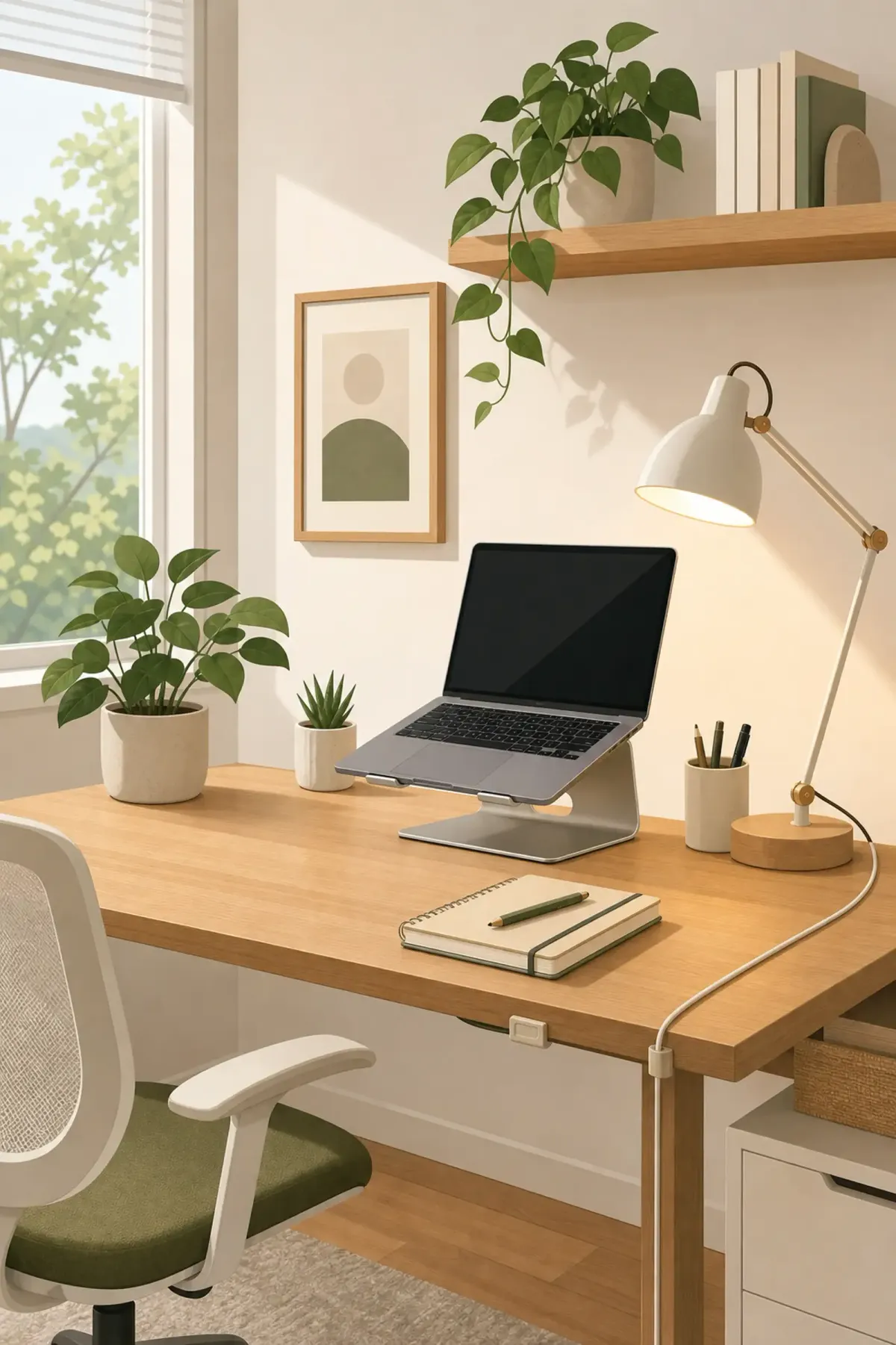
Your home office has to work harder than a corporate cubicle. It’s where you focus, take calls, store supplies, and — since it’s in your home — it’s also subject to the drift of household items that don’t belong there. Here’s how to organize it so it stays a place for work.
Rule 1: The desk is for working, not storing
Your desk surface should hold only what you use during an active work session: computer, monitor, keyboard, mouse, notebook, maybe a drink. Everything else goes into drawers, shelves, or organizers. If your desk holds three coffee mugs, last week’s mail, and a plant that’s slowly dying, it’s not a desk — it’s a horizontal surface that happens to have a computer on it.
Rule 2: Cable management is not optional
Visible cable spaghetti is visual noise that drags down the feel of the whole room. Use a cable tray mounted under the desk, Velcro cable ties, and a cable sleeve for the bundle that drops to the floor. A $20 cable management kit solves 90% of the problem. Label both ends of important cables with small tags so you know what to unplug.
Rule 3: Paper has a 48-hour lifespan
Paper is the enemy of desk organization. Every piece of paper that lands on your desk gets exactly 48 hours to be processed: scanned and filed digitally, acted on and filed physically, or recycled. If a piece of paper sits on your desk for a week, you’re not going to act on it — you’re going to stack more paper on top of it.
Rule 4: The “touch it once” principle for supplies
Office supplies — pens, sticky notes, paper clips — should live in drawers or organizers within arm’s reach, not on the desk surface. When you need a pen, grab it, use it, return it. The “touch it once” principle keeps supplies from multiplying across your workspace.
Rule 5: Separate work from personal
If your home office doubles as a guest room or craft space, create a visual and physical boundary. A room divider, a rug that defines the office zone, or simply facing the desk away from the personal area makes a psychological difference. When work items spill into personal space and vice versa, both feel cluttered.
Rule 6: Lighting matters more than decor
Organization isn’t just about stuff — it’s about creating an environment that supports focus. Natural light is best, positioned to the side of your monitor to avoid glare. A desk lamp with adjustable color temperature lets you shift from cool light (better for focus) in the morning to warm light in the evening. Bad lighting makes even an organized room feel dreary.
Rule 7: The end-of-day reset
Spend two minutes at the end of each workday resetting your desk: put away supplies, clear cups and dishes, close notebooks, straighten the keyboard and mouse. Walking into a reset desk the next morning signals to your brain that it’s time to work. Walking into yesterday’s mess signals that you’re already behind.
Rule 8: One “in progress” project at a time
If your desk is covered in materials for three different projects, your attention is split three ways even when you’re not actively working on them. Keep only the current project’s materials on or near your desk. Store everything else in labeled folders or bins on a shelf. The visual cue of a single project in progress reduces the mental overhead of switching between them.
For more productivity strategies, see our deep work guide and remote worker strategies.

Discussion
Comments
Share a helpful tip, question, or takeaway from Home Office Organization: 8 Rules for a Workspace That Helps You Focus.
0 Comments
Loading comments…