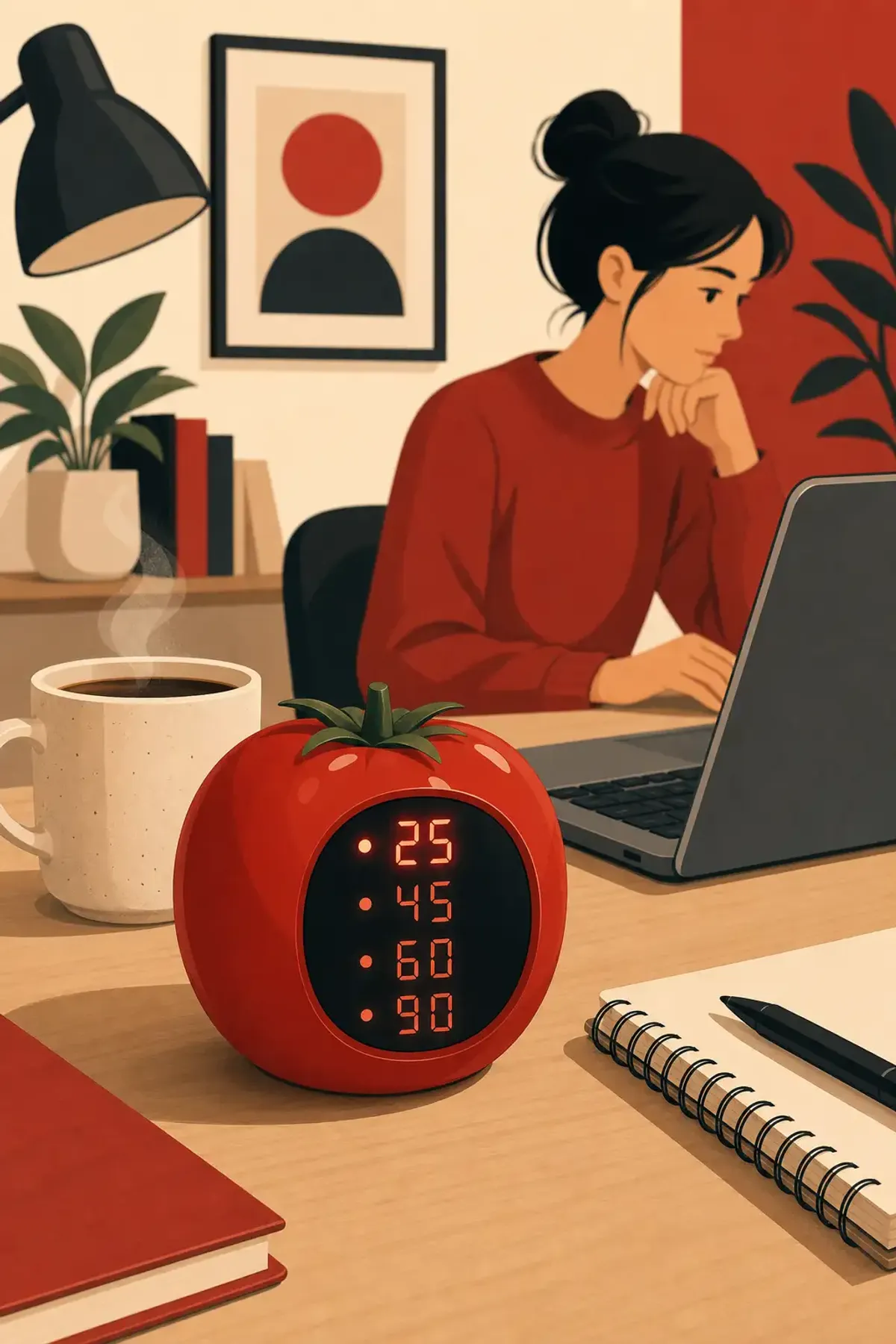
Francesco Cirillo’s Pomodoro Technique — 25 minutes of focused work followed by a 5-minute break — has been around since the late 1980s. It works because it lowers the barrier to starting: anyone can convince themselves to work for 25 minutes. But the rigid 25/5 split isn’t sacred. Adjusting it to match your actual work patterns makes it far more effective.
Why 25 minutes isn’t always right
The 25-minute interval was chosen because Cirillo’s kitchen timer (shaped like a tomato, hence “pomodoro”) happened to measure 25 minutes. It wasn’t based on attention research.
For deep creative or analytical work, 25 minutes is often too short. You spend the first 10-15 minutes loading context into your brain, get 10 minutes of real work done, and then the timer goes off. A 50-minute work block with a 10-minute break is more practical for coding, writing, design, or analysis — activities where you need sustained immersion.
For administrative tasks — emails, expense reports, scheduling — 25 minutes can be too long. You finish the task in 10 minutes and spend 15 minutes finding something else to do. A 15/5 split works better here, or better yet, batch similar small tasks into one 25-minute block.
The 52/17 pattern
A 2014 study by the Draugiem Group tracked the most productive employees using time-tracking software. The top performers didn’t work longer hours — they worked in 52-minute sprints followed by 17-minute breaks. This roughly matches the ultradian rhythm, the natural 90-120 minute energy cycle your body runs on, split into workable chunks. Try 50 minutes of work with a 10-minute break and see if it feels better than the standard Pomodoro.
Handling interruptions
The classic Pomodoro rule is: if you get interrupted, the timer resets. In reality, that’s punishing. A better approach: if the interruption takes under two minutes (quick question, bathroom break, refilling water), handle it and keep the timer running. If it takes longer, note where you stopped, handle it, and start a new Pomodoro. The goal is protecting focus, not gaming a timer.
What to actually do during breaks
The break needs to be genuinely restorative. Scrolling social media is not a break — it’s a different kind of attention drain. Stand up, walk around, look at something far away (your eyes need the break too), drink water, stretch. Physical movement during breaks measurably improves focus in the next work block.
Tracking Pomodoros
The satisfaction of completing Pomodoros and seeing a count at the end of the day is part of the technique’s appeal. But don’t optimize for the count. Ten frantic, low-quality Pomodoros are worse than four focused ones. Track them to learn your patterns — what time of day you’re most productive, how many focus blocks you can sustain — not to hit a target.
Tools
You don’t need a special Pomodoro app. Your phone’s timer works. So does a physical kitchen timer, which has the advantage of not being on the device that also delivers notifications. If you want an app, Focus To-Do and Forest are both good, and Toggl Track integrates Pomodoro-style timing with time tracking if you bill by the hour.
For more on structuring deep work, see our 90-minute rule guide and time blocking guide.


Discussion
Comments
Share a helpful tip, question, or takeaway from The Pomodoro Technique in 2026: Why 25 Minutes Is Just a Starting Point.
0 Comments
Loading comments…