You know that voice. The one that says if you can’t reorganize the entire garage this weekend, there’s no point starting. The one that makes you feel like a failure because the KonMari method left you with a bigger mess than when you started. That voice thrives on all-or-nothing thinking, and it’s the reason most decluttering attempts collapse before the first trash bag is filled.
There’s a different way. It’s called soft decluttering, and it starts with a simple premise: doing something small is infinitely better than doing nothing perfectly.
What Is Soft Decluttering?
Soft decluttering is exactly what it sounds like: a gentler, more forgiving approach to dealing with your stuff. The term gained traction after Jolie Kerr wrote about it in the Washington Post in July 2026, describing it as an “antidote to perfection paralysis.”
The concept isn’t a rigid system with rules and categories. It’s a mindset shift. Instead of asking “How do I perfect this space?”, soft decluttering asks “What small thing can I do right now that will make my life slightly easier?”
The key difference is emotional. Traditional decluttering methods often come with an undercurrent of shame: you should have done this sooner, you should be more organized, you should have less stuff. Soft decluttering strips that away. There’s no “should.” There’s only what helps.
Why Traditional Methods Leave You Stuck
Most popular organizing systems share a fatal flaw: they demand a level of decision-making stamina that the average exhausted person simply doesn’t have on a Tuesday evening after work.
The KonMari method asks you to gather every item in a category, hold each one, and ask if it sparks joy. Marie Kondo herself has acknowledged that tidying with young children in the house is nearly impossible. The method works for some people in some seasons of life — but for many, it creates a pressure cooker of expectation that backfires.
Extreme minimalism pushes you toward owning a fixed number of items, as if life fits neatly into a spreadsheet. The problem is that life doesn’t cooperate. You have kids who bring home art projects. You have hobbies that require equipment. You have seasons that demand different wardrobes. Declaring war on your possessions rarely ends with you feeling peaceful. More often, it ends with you feeling deprived and resentful.
The deeper issue isn’t the methods themselves. It’s that they assume decluttering happens in a vacuum, separate from the chaos of actual life. When you inevitably fail to complete the 30-day challenge or the weekend overhaul, you blame yourself rather than questioning whether the approach was a good fit to begin with.
Seven Principles of Soft Decluttering
These aren’t rules. Think of them as permission slips.
1. Progress, not perfection. A single cleared counter counts as a win. You don’t need to finish the kitchen — you just need to make today’s version of it better than yesterday’s.
2. Work with your energy, not against it. If you have 10 minutes of motivation, use those 10 minutes. Don’t wait for the mythical four-hour block that never arrives. The 10-minute session you actually do beats the four-hour marathon you keep postponing.
3. No guilt, no shame. You are not a worse person because your closet is messy. Clutter is a logistical problem, not a moral failing. The moment you stop treating it as a character flaw, organizing becomes about practicality instead of penance.
4. Your home works for you — not the other way around. A “perfectly” organized home that makes you anxious about maintaining it is worse than a comfortably lived-in one. Design systems that match how you actually live, not how a magazine spread suggests you should.
5. Decluttering is seasonal and cyclical. You will declutter the same drawer multiple times over the years. That’s not failure — that’s life. Kids grow out of toys. Hobbies change. Seasons shift. Accepting this means you stop seeing re-cluttering as evidence that you can’t keep up.
6. Let go of sunk cost guilt. You paid $80 for that sweater three years ago and wore it twice. The money is already gone. Keeping the sweater doesn’t bring the $80 back — it just takes up space and reminds you of the purchase you regret. Donate it so someone else can actually use it.
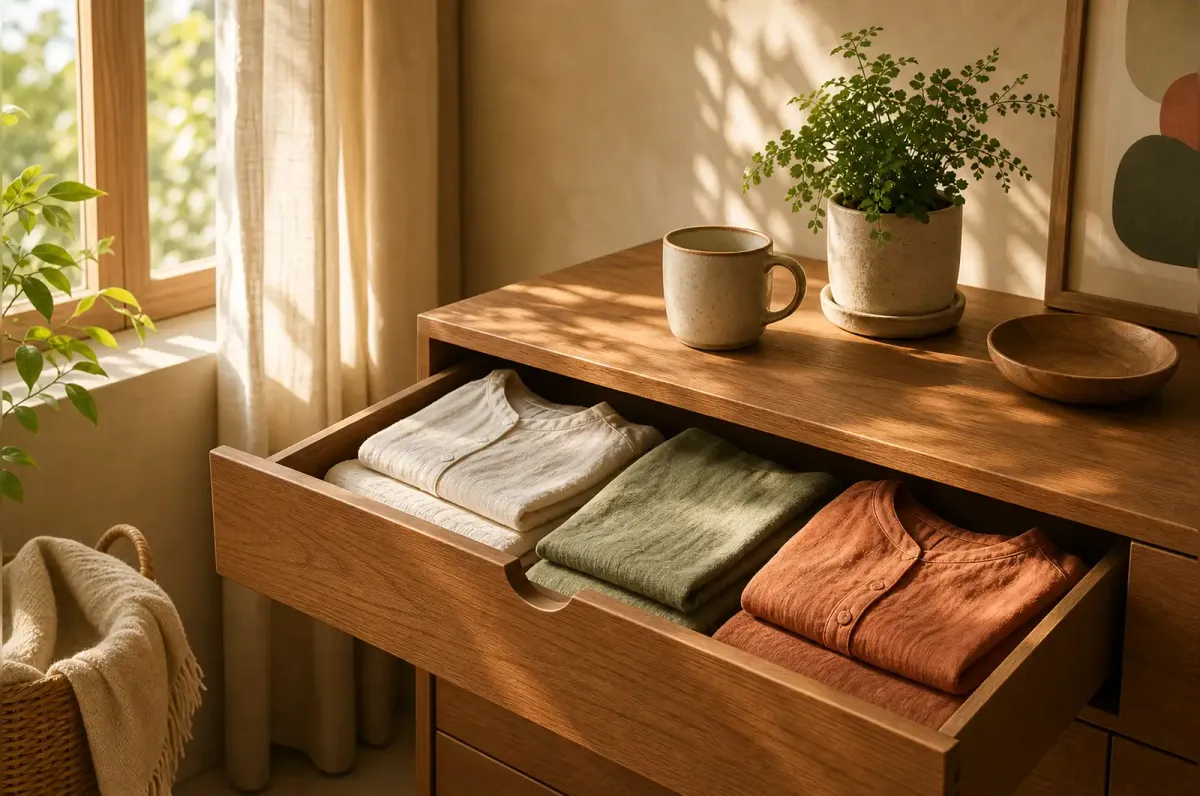
7. One surface, one drawer, one shelf. That’s the unit of progress. Not “the bedroom.” Not “the basement.” A single drawer. If you do one drawer a day, you’ll have reorganized 30 drawers in a month. How many drawers do you actually have?
These principles work because they lower the barrier to entry. Most people don’t struggle with the physical act of putting things away. They struggle with the emotional weight of deciding what stays and what goes, and the exhaustion of facing a mountain of decisions at once. Breaking that mountain into pebbles — and giving yourself permission to stop after one pebble — is what makes soft decluttering sustainable where crash diets of organization fail.
How to Start Soft Decluttering Today
Start with the thing that annoys you most in this exact moment. Not the thing that “should” annoy you most. Not the thing a professional organizer would target first. The thing that you personally trip over, or that makes you sigh every time you open that cabinet.
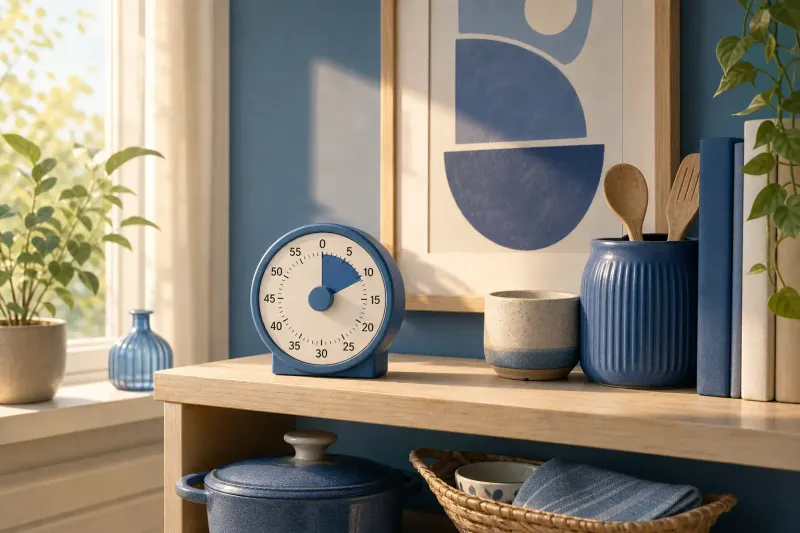
Set a timer for 10 minutes. Seriously — not 15, not 20. Ten. When the timer goes off, you stop. This does two things: it makes starting easy (anyone can survive 10 minutes), and it prevents the burnout that comes from pushing past your natural limit. Most people discover that once they’ve started, they want to keep going. But giving yourself the option to stop removes the psychological barrier that prevents starting in the first place.
During those 10 minutes, make exactly three types of decisions:
- Trash: Broken, expired, or genuinely unusable items. Throw them out.
- Donate: Things in good condition that you don’t use. Bag them immediately and put the bag by the door or in your car.
- Keep: Things you actually use and have space for. Put them back neatly.
Do not create a “maybe” pile. The maybe pile is where decluttering goes to die. If you can’t decide in 30 seconds, it’s a keep — for now. You can revisit it next time. The goal is momentum, not perfect sorting.
Do this once a day for a week and pay attention to how you feel afterward. Most people notice two things: the physical space feels lighter, and (more surprisingly) so does their mental space. There’s a reason for this. Visual clutter creates low-grade cognitive load. Every item in your field of view is something your brain has to process and file, even if you’re not consciously aware of it. Reducing that load, even slightly, frees up mental bandwidth you didn’t know you were spending.
How Soft Decluttering Differs From Other Methods
If you’ve read about micro-decluttering on this site, you might notice similarities. Both approaches value small, consistent actions over dramatic overhauls. The difference is in the emotional framing. Micro-decluttering is a strategy — a practical system you implement. Soft decluttering is the psychological permission slip that makes any strategy sustainable. You can do micro-decluttering with a harsh inner critic, and it’ll still work mechanically. But it won’t feel good. Soft decluttering asks you to also address the voice in your head that says you’re doing it wrong.
Compared to KonMari, soft decluttering doesn’t require you to handle every item in a category at once. It doesn’t ask you to define what “sparks joy.” It meets you where you are — tired, busy, overwhelmed — and says: just do one thing.
The two-foot rule is another effective tool for daily maintenance. Once a room drifts two feet from order, you reset it. Soft decluttering works well alongside that habit because neither demands perfection. Both accept that order is something you maintain, not something you achieve once and keep forever.
The Psychology Behind the Gentle Approach
There’s a reason self-compassion works better than self-criticism for almost any behavior change, and decluttering is no exception. Research on habit formation consistently shows that people who forgive themselves for slip-ups are more likely to stick with new routines than people who berate themselves.
When you approach organizing as a punishment — something you have to do because you’ve been “bad” about letting things pile up — you’re activating avoidance circuits in your brain. Your brain treats the task like a threat. That’s why you scroll Instagram instead of cleaning out the junk drawer. It’s not laziness. It’s your nervous system protecting you from something it perceives as hostile.
Soft decluttering reframes the activity as an act of care. You’re not punishing yourself for the mess. You’re giving yourself the gift of a more functional space. That shift from punishment to gift changes which neural pathways are involved. Suddenly, organizing doesn’t feel like a chore to avoid. It feels like something you’re doing for yourself, because you deserve a home that supports you rather than drains you.
This isn’t just feel-good rhetoric. The practical outcome is that you actually do the thing. A method you sustain for six months at 80% effort produces far more results than a method you attempt at 100% effort and abandon after two weeks. Soft decluttering bets on sustainability over intensity, and the math consistently favors that bet.
What Comes Next
Soft decluttering won’t transform your home overnight. That’s the point. Overnight transformations are dramatic and photogenic, but they rarely stick. They’re the crash diets of home organization. What sticks is the quiet accumulation of small decisions, made gently, over time.
A month from now, you could have dealt with 30 individual problem spots: one drawer, one shelf, one surface at a time. You won’t have a magazine-worthy home. But you’ll have a home that feels a little kinder to live in, a little easier to move through, and a little more like the space you actually want to come home to. And that’s a better outcome than any perfectly color-coded closet could deliver.
Discussion
Comments
Share a helpful tip, question, or takeaway from Soft Decluttering: A Gentle Approach to Organizing Your Home Without the Guilt.
0 Comments
Loading comments…