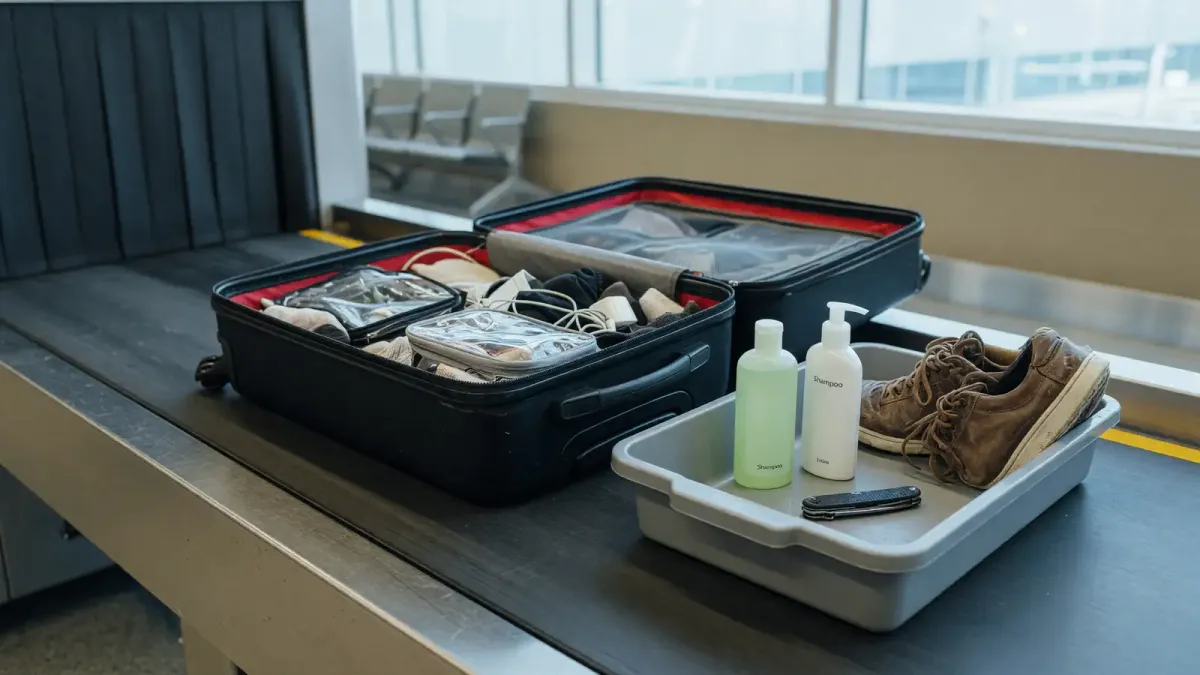
You can pack well and still lose 12 minutes at the belt because one object in the bag is a conversation with a stranger in a uniform.
This week Travel + Leisure ran three lists in a row from people who stand next to that belt for a living: impractical luggage to stop bringing, eight things a flight attendant would leave out of a Europe bag, and what a former airport worker keeps seeing TSA take. The articles are stuffed with Amazon links. Under the merch, the same three categories keep showing up: liquids that fail the 3-1-1 rule, blades that belong in checked bags, and bulk that never earns a seat on the plane.
This is not another packing-cube sermon. We already have a carry-on packing piece. This one is a leave-it-home list, written against those three roundups, plus the TSA rules they keep bumping into.
Full-size bottles still lose
The former gate agent piece ends where every security line actually ends: shampoo, conditioner, and anything else you bought in a 12-ounce bottle because it was on sale. Carry-on liquids still have to fit the 3-1-1 pattern. Officers do not care that the bottle is half empty. They care what the label says and whether it fits in a quart bag.
If you fly once or twice a year, the full-size set feels like being prepared. It is the opposite. You spend the first 40 minutes of the trip in a plastic bag argument, or you check a bag you did not need so the bottles can ride below. Hotels still have soap. Pharmacies still exist at the destination. Decant what you actually use into 100 ml containers, or buy a travel kit once and refill it at home.
Count the bottles before you zip. If the quart bag does not close flat, you already lost. Squeeze travel tubes beat “almost empty” salon bottles. Powder detergent sheets, solid shampoo, and a small deodorant stick survive more lines than a family of liquids. Prescriptions stay in original labeled bottles; that is documentation, not clutter.
The Europe flight-attendant list is the same idea with a passport in it. International trips punish weight. A 500 ml bottle of something you already own is a kilo you will carry through a train station after the flight. If you need a specific sunscreen or a prescription lotion, pack that. Leave the rest of the bathroom shelf where it is.
If you only remember one liquids rule: put the bag of bottles in the bin yourself. Do not make the officer dig. That is the airport security version of being polite.
Knives belong downstairs, or not at all
The confiscation piece is blunt. Pocket knives and Swiss Army knives still walk into carry-ons every day. Multi-tools with blades are on the TSA prohibited list for cabin bags. The former worker’s advice is boring and correct: if you truly need the tool, check it, and cover the blade so it does not open in someone else’s hands.
They mention a flat Victorinox SwissCard as a cabin-legal stand-in for clippers, a file, tweezers, and a screwdriver. Then they undercut it: they have watched officers take nail clippers with metal files anyway. “Too small to matter” is not a TSA category. Discretion sits with the person in front of you.
So the practical rule is narrower than the affiliate list. Do not pack a knife in the personal item because you might need to open a package. Buy scissors at the drugstore. If you camp or work with gear, put the real multi-tool in checked luggage and accept that you will not have it until baggage claim. If you do not check a bag, you do not bring a blade.
That sounds obvious until you watch a grown adult argue about a 5 cm knife at 6 a.m. The argument never works. The knife goes in a bin. The flight does not wait.
If you hike the day you land, check the bag with the tool, or ship gear ahead. Do not try to “just this once” a blade through a domestic connection. Connections are where confiscation lists get longer, not shorter.
The five-piece luggage set is a house, not a trip
The impractical-luggage roundup keeps circling hard-shell sets: multiple cases, spinner wheels, TSA locks, the whole Cosbarn-style five-piece stack. Those sets photograph well in a hallway. They are a nightmare in a regional jet, a cobblestone street, or a 14-seat van.
You do not need a matching 20-inch, 24-inch, and 28-inch plus a vanity case for a week. You need one bag you can lift into a bin without asking a stranger, and maybe a personal item that fits under the seat. Spinner wheels die on gravel. Extra shells eat closet space at home and overweight fees in the air.
TSA locks are fine on checked bags. They are not a reason to buy four more suitcases. If your current bag zips and the zipper is not exploding, keep it. Replace wheels or the handle before you replace the entire family of luggage.
Measure the bag against the airline you actually fly, not the store tag. A “carry-on” that is 56 cm at home can be 2 cm too tall at a low-cost gate. Soft sides forgive that. A rigid five-piece set does not. If you fly mixed carriers, pack to the smallest bin on the itinerary.
For Europe, the flight-attendant list leans the other way: a crossbody you can wear, a cardholder you can feel, shoes you can walk in. That is not aesthetic. That is pickpocket math and cobblestone math. A rolling set that needs an elevator is the wrong tool.
If you already own a giant set, use the smallest piece as the trip bag and leave the rest in the garage. You will not miss them until you are not dragging them.
Clothes and shoes that never leave the bag
Every packing list still includes a rain coat, a third pair of shoes, wide-leg travel pants in three colors, and a wrinkle spray. Some of those earn their keep. Most of them ride in the lid for the entire trip and come home with the tags of “I might need this.”
The test is ugly and accurate: if you did not wear it on the last two trips of the same type, it does not go. A city trip in September is not a hike. A beach week is not a wedding. One pair of walking shoes beats a sneaker plus a sandal plus a “nice” shoe you wear for 40 minutes.
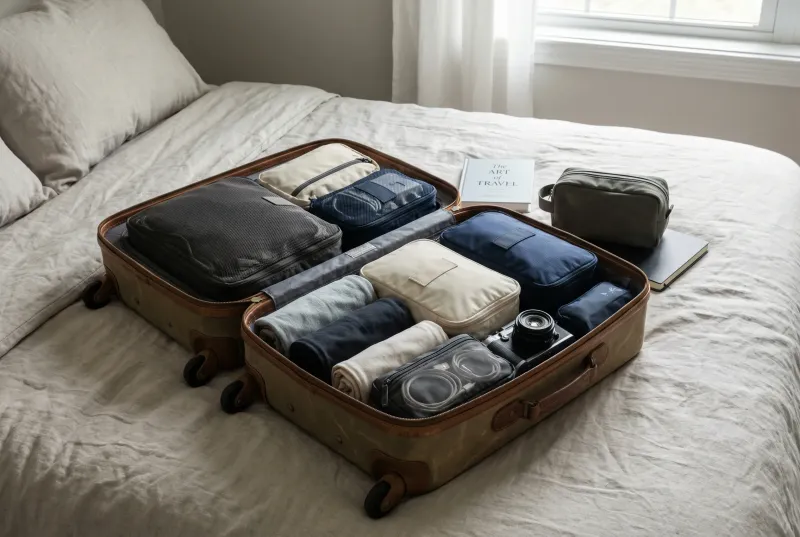
Wrinkle spray is optional. A T-shirt you hang in the bathroom while you shower is free. Packing cubes help if they stop you from dumping the bag every morning. They do not help if you use them to hide a fourth outfit.
The 3-3-3 packing method showed up in another T+L piece this week (three tops, three bottoms, three shoes). Treat it as a ceiling, not a personality. If you can do two shoes, do two.
Wash one shirt in the sink if you must. Hotel sinks exist. A wet shirt on a hanger is lighter than a dry third outfit that never leaves the cube. If the trip is work plus dinner, one dark shirt that can do both beats a “nice” shirt you are afraid to sit in.
Gadgets that copy what you already packed
Power banks, cable pouches, extra headphones, pill organizers, luggage scales, trackers, and a second tote all appear in the collages. Some are useful. The failure mode is packing the backup of the backup.
One charged power bank that you have tested is better than three that died in a junk drawer. One cable per device, in a pouch, is enough. A luggage scale matters if you fly a carrier that bills at 23.0 kg and you pack heavy. It does not matter if you fly carry-on only.
Charge the bank at home the night before and confirm the cable actually fits your phone. A brick with the wrong port is a paperweight. Skip the extra pair of over-ear headphones if you already packed earbuds. Skip the second tote unless you know you will shop. A folded shopper from the destination supermarket is free.
AirTags and similar trackers are reasonable on a checked bag. They are theater on a backpack that never leaves your feet. A passport holder is optional if your passport already lives in a zip pocket you can reach without unpacking.
eSIMs now cover most of the “I need a gadget to get online” panic. If you still roam on a physical SIM, read the eSIM guide before you add another hotspot brick to the bag.
What to do the night before
Lay the bag on the floor. Take out anything that exists “just in case” and is not medicine, documents, or a charger. Put liquids in one clear bag and park that bag on top. Put anything with a blade in the checked bag or on the kitchen counter.
Weigh the bag if you are checking it. If you are not checking it, lift it. If you cannot lift it to chest height, it is too heavy for a bin.
Print or screenshot boarding passes. Screenshot the hotel address. Those two photos replace a paper folder people still pack “just in case.” If a document is required in original form, it is already in the zip pocket, not in a 40-page binder.
Then stop shopping for a new set. The roundups this week are useful as a mirror, not as a cart. The items that keep getting named are not exotic. They are the bathroom shelf, the junk drawer knife, and the luggage that looked good in a product shot.
If you want a single pass: bottles, blades, extra shells. Everything else is taste. Leave those three at home. The line moves. You still have soap at the hotel.
Discussion
Comments
Share a helpful tip, question, or takeaway from Stop Packing These Airport Items in 2026.
0 Comments
Loading comments…