Open your email. Respond to two messages. Switch to Slack and answer a thread. Back to email. A notification from Jira interrupts. Now you’re reading a ticket. You have no idea what you were doing 20 minutes ago.
This is not a character flaw. It’s how most people work. It’s also why most people feel busy all day and finish nothing important.
The neuroscience is clear: humans can’t multitask. We task-switch, and every switch carries a cost. Researcher Gloria Mark at UC Irvine found that after an interruption, it takes an average of 23 minutes and 15 seconds to return to the original task with the same level of focus. Most of us get interrupted every 3 to 11 minutes. Do the math.
What Batch Working Actually Means
Batch working is the opposite of task switching. Instead of bouncing between email, meetings, deep work, and admin tasks all day, you group similar work into dedicated blocks. All your emails at once. All your calls back to back. All your writing in one stretch.
The reason this works is that your brain runs in different modes. Writing requires a different mental engine than responding to quick messages or crunching numbers in a spreadsheet. Switching modes is expensive. Staying in one mode is cheap.
How to Set It Up
First, identify your work categories. Most knowledge workers have about four: deep work (writing, coding, analysis), shallow communication (email, Slack, messages), meetings and calls, and administrative stuff (expenses, scheduling, filing). Your list might be different. The categories don’t need to be perfect — they just need to group tasks that use similar mental muscles.
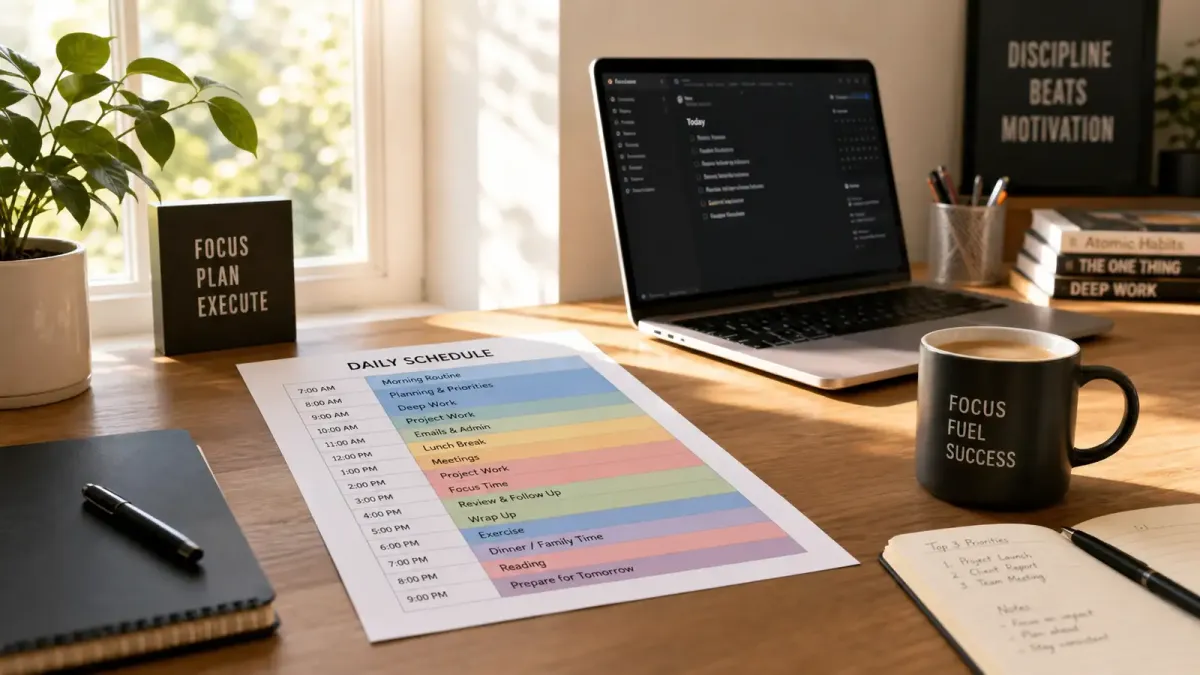
Second, assign each category to a time block. The classic split looks like this: 8:00 to 10:00 a.m. for deep work, 10:00 to 11:00 for communication, 11:00 to noon for meetings, and the afternoon for admin or a second deep work block. This is a template, not a prescription. Adjust it to your energy levels and your job’s demands.
Third, defend the deep work blocks. This is the hard part. Close email. Close Slack. Put your phone face down. Tell your team when you’re unavailable. A status update — “heads-down until 11” — sets expectations without being anti-social. If you have an office door, close it. If you don’t, noise-canceling headphones are the modern equivalent.
Why This Is Better Than Just “Trying to Focus”
Willpower is a limited resource. Every time you resist the urge to check your phone or click an email notification, you burn a little of it. By the afternoon, your willpower tank is empty, and you’re scrolling Twitter while pretending to review a document.
Batch working removes the need for constant willpower. You’re not resisting distractions all day — you’re just following a schedule. At 10 a.m., you check email. Before 10 a.m., email doesn’t exist. The decision is pre-made. That’s the difference between a system and a hope.
The Email Problem
Email is the worst batch offender because it feels productive but isn’t. Most people check email 15 to 20 times a day — and each check triggers a cascade of small tasks and mental context switches. Treating email as a batch task, checked three times a day, reclaims hours of focus with zero loss of responsiveness. People who email you at 9:15 a.m. can wait until 10:30 for a reply. They’ll survive.
Start Small
Don’t overhaul your entire workday tomorrow. Pick one batch: email from 10:00 to 10:30 and 3:00 to 3:30 only. Do that for a week. When you see how much better your mornings feel, you’ll want to add more batches. But start with one, prove it works, and build from there.


Discussion
Comments
Share a helpful tip, question, or takeaway from Your Brain Wasn't Built for Multitasking: A Practical Guide to Batch Working.
0 Comments
Loading comments…