The useful sentence in this week’s coffee-maker story is not a scare. Deirdre Bardolf’s Oct. 4 piece for Fox News Digital quotes Heather Perry, CEO of Klatch Coffee and a two-time U.S. Barista Champion, saying equipment cleanliness matters more for flavor than as a safety problem. Perry’s line, as the piece prints it, is that coffee is “totally fine to be type B about.” I am using that sentence as the job description. A viral mold post is not a maintenance schedule, and this article does not invent one.
We already wrote the room where mold is a real building problem in how to stop bathroom mold before it starts. We wrote the appliance that fails in a more expensive way in eight dishwasher tasks that fix most “it isn’t cleaning” complaints. We wrote the general version in appliance maintenance that extends the life of the machine. A drip machine is a smaller object than those three. The Fox piece is specific about which part of it changes the cup, and which popular fixes Perry does not want.
Coffee maker mold is low on her list, and the bean claim is marketing
Perry told Fox News Digital there is little reason for most home brewers to panic. The piece sets that against recent reports and viral posts about mold and bacteria inside home machines, and against beans sold as “tested for mold.” Her answer on the home machine is blunt: “You do not at all need to be worried at home about mold and bacteria.” She called it “incredibly low on the list of things to worry about” for coffee equipment. On the bean label, she said “that is 100% a marketing thing.”
I am not turning that into a medical clearance. The article does not test a carafe, and Perry is talking about flavor priority, not about a lab result you can wave at a sick relative. What I can use is the ranking she is willing to put her name on. If the chore you were about to do this weekend was thrown at you by a video of a black ring in a reservoir, she is telling you that ring is the wrong emergency. The bathroom piece we already published is about a room that stays wet and feeds the wall. A coffee maker is a different wet object. She is not saying ignore a machine that smells rotten. She is saying the viral framing is louder than the problem she sees in home equipment.
The marketing line is the one I would remember at the grocery store. A bag that advertises a mold test is selling the fear the video planted. Perry’s assessment does not prove every test is fake. It says the label, as a reason to pay more, is a sales move. I would not pay a premium for that phrase on the strength of this interview. I would spend the same attention on the pot, which is the part she actually ranks first.
She also does not give a cleaning calendar. No “every Sunday.” No vinegar ratio. No descaling tablet brand. I am not going to fill those blanks from a different article, because this week’s source does not contain them. A tip list without a frequency is still a tip list. It is not a contract.
The carafe is the part that gets into the next cup
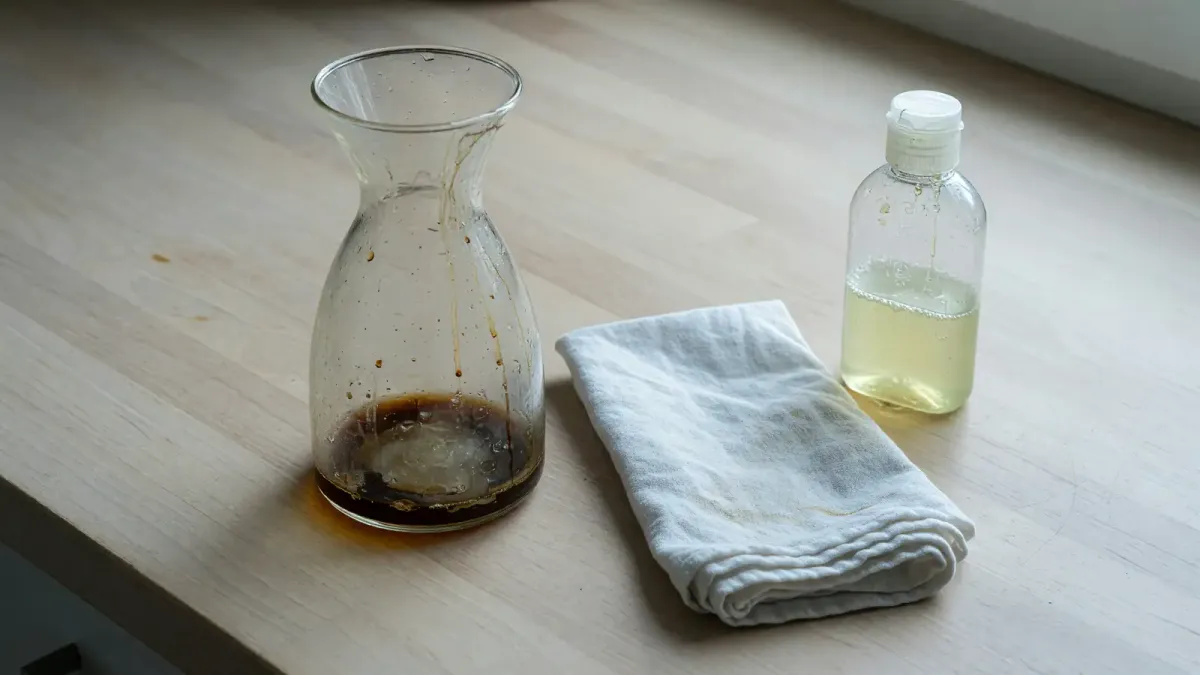
Perry said the part you should be most worried about cleaning is the pot. Her reason is taste, not a scare: “Once that’s in your pot, you’re gonna taste that in your cups.” The piece adds that coffee stains and oils build up inside carafes and grinders over time, and that stains especially build up in insulated carafes you cannot see into. “Those thermos pots are where I think we find a lot of coffee stains are staying, and that will absolutely begin to affect the flavor of that coffee.”
That is the maintenance distinction I wanted from a champion, and it is ordinary. The reservoir is the part the viral posts photograph, because it is the part that looks like a science experiment when you forget it. The pot is the part the coffee sits in after it is brewed. If the stain is in the pot, the next cup is a mixture of new coffee and old oil. An insulated carafe makes the problem worse in a boring way. You cannot see the line. A glass carafe at least argues with you. A thermos pot does not.
I would start there on a Monday, before I bought anything. Empty the pot, look at the bottom, and if it is a thermos, assume the stain is there even when the opening looks clean. The piece does not say soap versus a brush versus a tablet. It says the pot is the part that changes the cup, and the hidden pot is where stains stay. Our dishwasher guide is about a machine that has a filter you are supposed to pull. This is closer to wiping the thing the drink actually touches. If you only do one of Perry’s five points, this is the one with a mechanism.
The reservoir still exists. She did not say never rinse it. She said it is not the part she worries about most. I am keeping that ranking, because the internet has the ranking backwards and the backwards ranking is what sells mold videos. A brown ring in a tank is ugly. A brown film in the pot is what you drink.
Hard water shows up on the showerhead before it shows up as a bad cup
For homes with hard water, the piece says mineral buildup can gradually affect the machine’s performance and, in the end, the taste. Perry’s visual cue is not inside the brewer. “Whatever you see in your sink faucets, your showerheads, that’s what’s happening with your coffee brewer.” If the showerhead needs a soak, the brewer is on the same water.
The easiest limit, in her telling, is to start with good water. She recommended water filtered at home or, where the tap is particularly hard, bottled water. She cautioned against distilled water and reverse-osmosis water, because those lack the minerals that help flavor. The sentence I would put on a note is hers: coffee is 98% water, “you want good water, and you want it to have enough minerals because that’s what the coffee flavor sticks to.”
This is the opposite of the advice I have heard in kitchen conversations, where “purer” is treated as automatically better. Distilled water is pure in a way that makes a bad cup, according to this interview, because the flavor needs something to stick to. I am not going to invent a mineral target in parts per million. She did not give one. She gave a household test you already own: look at the showerhead. If it is crusted, your brewer is drinking the same crust, more slowly.
Bottled water is the fallback she offers for particularly hard tap water, not a personality. I would not make a weekly run for gallon jugs if a pitcher filter is already next to the sink. I would stop using the jug of distilled water that was bought for an iron or a humidifier. That jug is the wrong ingredient for this machine, on her account, even though it looks like the careful choice.
Performance and taste are two effects, and the piece names both. Mineral buildup can change how the machine runs, and it can change the cup. I cannot tell you from this interview which one shows up first in a specific model. I can tell you the cue is outside the machine, on metal you already look at. That is more useful than a chart of grain sizes I do not have.
Grinder oils come off with a dry paper towel, not a soak
If you grind your own beans, Perry does not want a constant deep clean. She wants you to check the hopper and the grounds area for an oily film, and to wipe it with a dry paper towel. “Get the coffee oils off of it.” The smell is the other cue. “It’s not that fresh coffee smell, it’s that old coffee smell.” And the time warning: “If you start to see coffee oils forming, the longer they stay, the harder they are to get off.”
A dry towel is a specific instruction, and I am not going to upgrade it to a damp one. Water in a grinder is how people ruin burrs and how they create the damp spot a mold video is about. She asked for dry. The oil is the problem she is naming, not a need to sanitize. Old smell means the oil has been sitting. Fresh smell means you are still in the window where a wipe is easy.
This is also a reason not to buy a second gadget this week. The Fox piece is not a product roundup. The job she describes fits in a drawer you already have. If the hopper looks shiny in a way beans are not shiny, wipe it. If it smells like yesterday’s pot rather than the bag, wipe it. If you have been meaning to deep-clean the grinder because a video said so, she is not on that schedule. She is on a film-and-smell check, and she is explicit that waiting makes the film harder.
I grind beans most mornings and I still skip this. The piece is useful because it names the skip. The oils are not a moral failing. They are a residue that moves from “wipe” to “scrape” if you leave them. I would rather catch the wipe. I would not take the grinder apart on a weeknight because a caption told me to, and this interview does not ask for that either.
The fridge is the wrong shelf, and the open bag has a month
Perry’s fifth point is storage, and it is the one most likely to start a fight in a shared kitchen. Grounds in the fridge can absorb moisture and the smells around them. “Your freezer is actually a better preservative,” she said. Even the freezer may be unnecessary. “Leave the one bag out that you’re using right now. As long as you’re consuming it within a month, it’s going to be fine.”
A month is the only duration in the interview. I am not going to stretch it into a roast-date rule or a “beans die in two weeks” rule. Those are other people’s articles. This one says the bag you are drinking can live on the counter if it will be gone inside a month, and that the fridge is a bad neighbor because coffee picks up what is next to it. Onion, leftover fish, a cut lemon. The freezer is the better preservative if you are holding coffee you are not opening every morning.
The practical split is one bag out, the rest colder if you bought ahead. I would not move the open bag into the fridge to be careful. That is the careful move that makes the coffee taste like the fridge. I would also not freeze a bag I am opening every day, because the interview does not ask for that, and a month on the counter is the window she gave for the bag in use.
She closes on ingredients, not on a scrub. “Start with really good ingredients. Coffee and water are absolutely going to be your two biggest starting points.” The cleaning tips sit under that. A clean pot cannot rescue a bad bag or distilled water. A good bag poured through a stained thermos pot will taste like the stain. Both sentences can be true. The viral post only had room for the scary one.
If I were writing the Monday list from this interview alone, it would be short. Wash the pot, and assume a thermos is dirtier than it looks. Look at the showerhead before you blame the beans. Do not brew with distilled or reverse-osmosis water. Wipe grinder oil with a dry towel when the smell goes stale. Keep the open bag out of the fridge, and finish it inside a month. Skip the mold-tested upcharge. She did not give you a tablet, a vinegar ratio, or a Sunday alarm. I am not going to add them so the list looks complete.
Discussion
Comments
Share a helpful tip, question, or takeaway from The Coffee Maker Job Is the Carafe, Not the Mold.
0 Comments
Loading comments…