The slime and the white dust are not the same job. Cory Fernandez’s October 8 guide at NBC Select is a cleaning sequence for a tank that has been holding water. Sarah Connor’s October 14 gear piece at Popular Mechanics is a shopping list for machines whose removable parts, or some of them, can go in a dishwasher. One page tells you how long to soak. The other tells you which dollar amount comes with a stainless tank. Neither page is a substitute for the other, and neither page cleans the part the manufacturer still wants done by hand.
We already had the white-dust version of this machine. A 1940 house ate two HVAC filters in ten days, and the thread pointed at the ultrasonic. We already had a coffee maker whose real job was the carafe, not the mold story people reach for first. That carafe piece is the closer cousin. We already had a fall outdoor job that was a nozzle choice, not a new tool. Leave the red nozzle alone on the gutters. This week is indoors, and it is the tank. I am not going to turn either article into a health guide. Fernandez cites the Environmental Protection Agency for what a humidifier can do for dry air. That citation is not a treatment plan, and I am not extending it. The usable part is the cleaning interval and the parts list.
Weekly is Murphy’s line for a machine you actually run
Robin Murphy, president of the cleaning company Maid Brigade, is the named cleaner in the NBC piece. The sentence worth pinning up is the interval, not the brand of cloth. A humidifier should be cleaned at least once a week if it is used regularly, Murphy says. That helps prevent the buildup of bacteria, mold, and minerals that can affect both the performance of the humidifier and the air quality in the home. If you only run one every once in a while, such as when you are sick, Murphy says once a month is fine. The same quote still wants the tank emptied after each use, and the parts dried before the next fill.
Those are two clocks, and a shopping headline will merge them. “Clean it weekly” is the regular-use line. “Once a month” is the occasional-use line. A machine that runs every night from October through March is the first clock. A machine that comes out for three days in January is the second. Popular Mechanics does not print either interval. Connor’s piece is about models she would buy so the chore feels smaller. It does not replace Murphy’s week. If your note on the tank says “dishwasher, so I skipped the calendar,” you imported a gear review into a slot the gear review did not fill.
The empty-after-each-use line is stricter than the weekly soak, and it is easy to drop because it is not a product. Fernandez writes that you should really only have water in the humidifier if you are actively using it, and otherwise keep it empty when it is not on. Stagnant water in a container with little ventilation is the condition Murphy’s earlier point, as Fernandez frames it, ties to mold and bacteria growth. I am not going to add a species list or a symptom list. The instruction that is actually on the page is mechanical: pour it out, let it dry, do not store it wet.
A weekly soak on a tank you left full all week is still a weekly soak. It is not the empty-and-dry step. Both sentences are in the NBC piece. A card that records only one of them is half the system.
The humidifier soak is equal parts, and the clock is 30 minutes
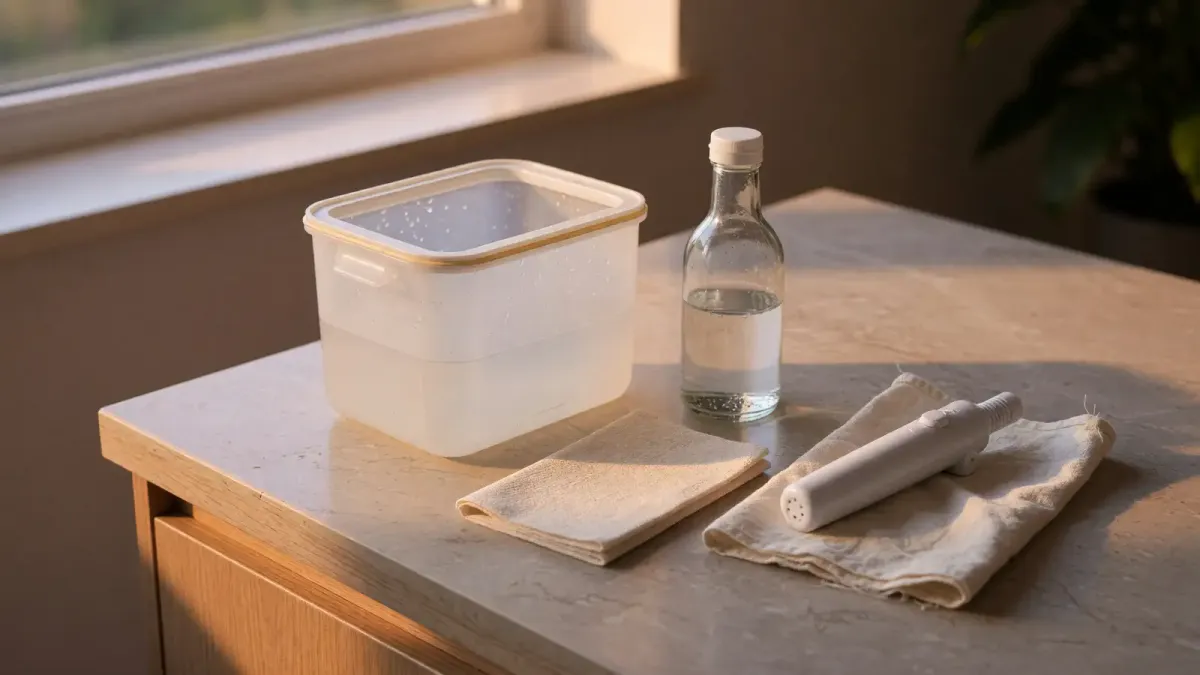
Fernandez’s sequence is short enough to copy onto a card, and the numbers are the part a “just use vinegar” habit will smear. Unplug the humidifier. If it is warm to the touch, let it sit a few minutes. Pour out any water in the tank. Wipe visible slime or residue with a paper towel. Remove detachable parts. On an evaporative unit, that includes the filter inside. Wipe the inside of the tank with a paper towel soaked in warm soapy water and wrung out, or lightly coat the inside with a sprayable dish soap. NBC names Dawn Platinum Powerwash Dish Spray as an example of that soap, not as the only soap that works. Then add equal parts white vinegar and water, let it sit for 30 minutes, and pour the mixture out. The 30 minutes, in that step, is for odors and remaining residue.
Equal parts is a ratio. “A splash of vinegar” is not the ratio on the page. A full-strength pour that you do not time is not the 30 minutes on the page either. I am not going to invent a second ratio for a tank the article did not measure. If your tank is a gallon and you cannot see the water line, mark the line before you pour. The article does not give you a tablespoon count. It gives you a half-and-half mix and a half hour.
The evaporative filter is a separate object in the same piece. If the filter is reusable and relatively new, Fernandez says soak it in vinegar and water for 30 minutes, scrub residue with a nylon bristle brush, and let it dry before you put it back. If the machine has a wick filter, the same section says it is best to replace it. NBC names the Durabasics Premium Humidifier Filter as an example of a replacement, and mentions multi-packs. I am not reviewing that filter. I am noting that “soak the wick” and “replace the wick” are different sentences, and the wick sentence is the stricter one. A dishwasher cycle, later in this piece, does not appear in the NBC wick paragraph at all.
Fernandez also writes that you can use dish soap, white vinegar, and hydrogen peroxide to clean a humidifier. The numbered steps I am using are the soap wipe and the vinegar sit. The extract I am writing from does not print a peroxide dilution, a sit time, or a rinse count for peroxide. I am not going to supply one. If you want that third chemical, you need a page that actually measures it. This one, in the chunks that carried the method, measured vinegar.
Bleach is a caution in the same interview, not the default
Murphy does not recommend bleach or bleach-based products for a humidifier unless it is done with caution. The reason in the NBC piece is the residual smell. It can irritate the eyes and the respiratory system, especially because the machine is releasing moisture into the air. If you do use bleach, the instruction is a small splash diluted with water, the same method as the white vinegar, and a thorough rinse after.
That is not “never.” It is also not “bleach is the mold step.” The default sequence on the page is soap, then equal-parts vinegar, then pour it out. Bleach is the branch Murphy does not want as the habit. A social clip that leads with bleach has picked the branch and dropped the caution. I am not going to expand the irritation sentence into a medical rule, and I am not going to tell you the splash is safe because a cleaner mentioned it. The sentence is a limit. Small splash, diluted, same sit as vinegar, rinse thoroughly. Anything past that is not in the October 8 piece.
Rinsing is the word people skip because vinegar smells like the job is finished. The bleach branch says rinse thoroughly. The vinegar step, as printed, says pour out the mixture. I am not going to pretend those are the same verb. If you used bleach, the page wants the rinse. If you used only vinegar, the page I have wants the pour-out, and it does not print a second rinse count. Do not invent a bleach rinse and paste it onto the vinegar step as if Murphy wrote it twice.
Dishwasher-safe is a parts list, and the lists do not match
Connor’s reason for the October 14 piece is personal and specific. She writes that she has gone through dozens of humidifiers because it is pretty much impossible, in her experience, to make them last longer than a season. Even with thorough cleaning, she finds it very difficult to be sure every nook is mold-free. That is why she switched to a humidifier with dishwasher-safe pieces. Being able to put removable parts in the dishwasher cuts the tedium. Then she writes the sentence the product cards will bury: not every humidifier is designed the same way, and dishwasher-safe components vary by model, so check exactly which parts can go in the machine before you buy.
The Popular Mechanics page is a gear review. The editors say they may earn a commission if you buy from a link. Prices below are the prices printed on that page on October 14, against Amazon or the brand site as labeled. They are not a quote I can refresh for you tomorrow.
The Carepod One 31S is listed at $279. Connor says it uses ultrasonic technology, a fine cool mist, rooms up to 500 square feet, a 4-liter stainless steel tank, up to 30 hours of runtime, three mist settings, and a built-in timer. It has three removable parts. Carepod, as she reports it, says the stainless steel tank and the inner lid cover are dishwasher-safe. Clean the white wand by hand. That last sentence is the whole argument. Dishwasher-safe, on this model, is not the machine. It is two of the three removable parts. The wand stays at the sink.
The Levoit Superior Studio Smart Evaporative is listed at $140. Connor says a built-in sensor adjusts humidity, an app checks the room and sets schedules, cleaning reminders and an automatic drying mode are meant to keep the reusable wick fresher between uses, and the 4.5-liter tank lasts up to 40 hours. She says dishwasher-safe parts make cleanup easier. The extract does not name which parts. I am not going to copy the Carepod split onto this Levoit. “Dishwasher-safe parts” without a list is a claim you still have to open the manual for. The 40 hours is a runtime, not a cleaning interval. Murphy’s week still sits next to it.
The Levoit NeoClassic 350 is the budget line, $45. A 3.2-liter tank, gentle cool mist, up to 26 hours per fill, a night-light Connor describes as soft and blue-light-free, and it doubles as an aroma diffuser. The removable tank and cover are dishwasher-safe. The cover is named. A base, a sensor, a wick, if this model has one, is not named in the sentence I have. An aroma diffuser is a second reservoir. The NBC piece does not discuss oil in a tank that also gets a vinegar soak. I am not going to mix those instructions. If you put scent in the water, you are outside both of the steps I am willing to copy.
The Livatro 6L stainless warm-mist model is listed at $190. Connor says it boils water before it releases warm steam, does not need replacement filters, runs up to 24 hours on a 6-liter tank, has a sleep mode, and the stainless tank is dishwasher-safe. A built-in cleaning mode is described as help for stubborn mineral buildup. Boiling is a different mechanism from the ultrasonic Carepod and from the evaporative Levoit. Mineral buildup is the white-dust family we already wrote about, not the slime wipe that starts Fernandez’s sequence. A cleaning mode for minerals is not a 30-minute vinegar sit, and a vinegar sit is not a boil cycle. If your note says “the machine cleans itself,” ask which of those three you mean.
A fifth pick, the Canopy all-in-one humidifier and purifier, is listed at $320 on the same page. The extract I used stopped before the specs. I am not going to borrow another site’s Canopy sheet and pretend Connor printed the tank size. If the part you care about is whether the filter goes in the dishwasher, this article does not have that sentence. Go to the page.
White dust and slime do not share a cloth
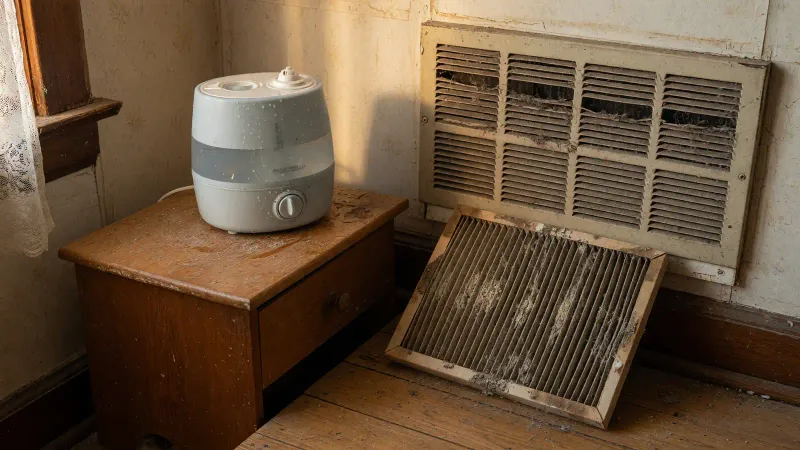
The September piece on this site was a filter that turned white in ten days. The suspected mechanism was an ultrasonic throwing minerals from tap water into the room, and then into the return. That is a dust problem. Fernandez’s first wipe is slime or residue in the tank. Murphy’s weekly line names bacteria, mold, and minerals in one breath. Minerals are the overlap. Slime is not the white powder on a pleated filter. A dishwasher cycle aimed at a stainless tank does not answer the HVAC filter. An HVAC filter change does not answer the wand Carepod still wants washed by hand.
Connor’s ultrasonic example is the Carepod, 500 square feet, 4 liters, 30 hours. Our older piece did not test that model, and I am not going to assign the 1940-house dust to it. What I will say is that “ultrasonic” on a new shopping card is the same technology word as the machine that made white dust in the earlier story. Dishwasher-safe does not repeal that. If you buy the Carepod because the tank can go in the machine, you have solved Connor’s nook problem for the parts Carepod named. You have not solved the mineral path if you still fill the tank from the tap. The NBC piece, in what I used, does not print a distilled-water rule. I am not going to import one from the September article and attribute it to Fernandez. The two pages are about two residues. Keep the water advice on the page that actually gave it.
The wick is the other object that falls between the articles. NBC says replace a wick rather than trust a soak. The $140 Levoit, in Connor’s telling, has a reusable wick, cleaning reminders, and an automatic drying mode. Those features are the manufacturer’s attempt to make a reusable wick less disgusting. They are not a sentence that says the wick is dishwasher-safe. Drying mode is not replacement. If your model is the one NBC would rather you re-wick, the Popular Mechanics drying mode does not apply until you have confirmed it is the same class of filter. I do not have that confirmation in either extract. Leave the gap on the card.
What to write on the tank, if you only write five lines
I would write the source next to the line, because next October you will not remember which page said 30 minutes.
One: empty it when it is off. That is Fernandez, reporting the condition Murphy’s mold point depends on. Two: if it runs most nights, clean it at least weekly. If it runs rarely, monthly, and still empty it after each use. That is Murphy, in the NBC piece. Three: soap wipe, then equal parts white vinegar and water, 30 minutes, pour it out. Wick filters, replace. Reusable non-wick filters, 30-minute soak and a nylon brush, then dry. Four: bleach only as the caution branch, small splash, diluted, rinse thoroughly. Five: if the manual says dishwasher, list the parts, not the brand. On the Carepod as Connor reports it, tank and inner lid yes, white wand no. On the $45 Levoit, tank and cover. On the $140 Levoit, “parts,” which is not a list. On the Livatro, the stainless tank, plus a mineral cleaning mode that is not the slime wipe.
Prices move. The $45 and the $279 are October 14 numbers on a commission page. The 30 minutes is a method, and it does not depend on which of those machines you own. A dishwasher does not start the Murphy clock. It only shortens the chore for the parts a given maker agreed to put in the rack. The wand, the unnamed part, and the wick are still yours.
Discussion
Comments
Share a helpful tip, question, or takeaway from The Humidifier Soak Is 30 Minutes. Not the Wand..
0 Comments
Loading comments…