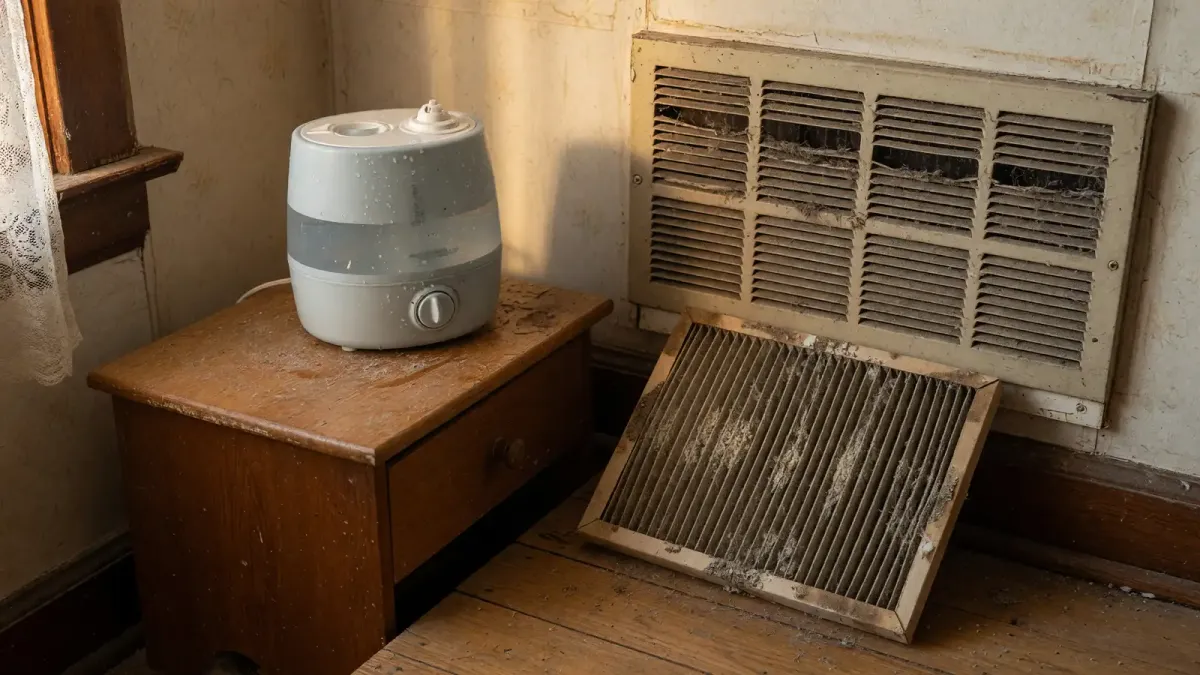
A furnace filter is supposed to go gray. Gray is lint and skin and the dog. White, in ten days, twice, is a different mess.
The Cool Down picked up a r/HVACAdvice post this week. The homeowner swapped the filter, photographed it next to a new one, and said a technician had already been through the system. The house is from 1940. No renovation. No mystery construction dust. The thread did not invent a cracked heat exchanger. It pointed at a small humidifier.
That is a cleaning job. It is not a new furnace.
Fall maintenance still starts with gutters and a furnace that has been asked to run. This is the indoor half people skip because the box on the nightstand looks harmless.
White powder is minerals, not “dusting”
Baumann & DeGroot’s shop write-up is blunt. Portable ultrasonic humidifiers throw fine mineral particles into the room. You see it on dark furniture. You see it on the return. You see it packed into the pleats of a filter that should have lasted a month.
Ultrasonic units do not boil. They vibrate water into a mist. Whatever was dissolved in the tap rides along. Impeller “cool mist” boxes do a similar trick. Steam humidifiers leave more of the minerals in the tank, which is why the tank looks filthy and the air looks cleaner. Whole-home units that hang on the furnace are a different machine. They are not the $40 cylinder you refill from the kitchen sink.
In the Cool Down piece, a commenter said a friend ran tap water in an ultrasonic and packed a filter in a month. Ten days is faster. Hard water and a return that sits in the same room will do that. The technician who “found nothing” was looking at the air handler. The mineral factory was on a dresser.
EPA’s humidifier page has said this for years. Ultrasonic and impeller units can put microorganisms and minerals into indoor air. “White dust” means the minerals are not being removed. Bottled water labeled spring, artesian, or mineral is still mineral water. Distilled is the boring answer.
Do this before you buy a thicker filter
A MERV bump feels like action. It is also a way to choke a 1940 blower if the filter cakes in a week. Clean the source first.
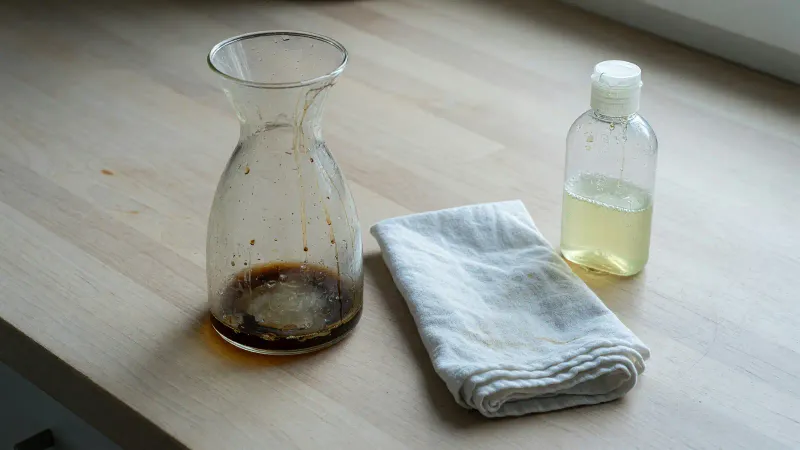
Unplug the humidifier. Dump the tank in the sink, not into a houseplant. Fill with a 3% hydrogen peroxide solution if the manual does not name a cleaner, which is EPA’s fallback. Wipe every surface that touched water. Rinse with several changes of tap water so you are not aerosolizing the cleaner the next time you run it. Let it dry open.
If the tank smells like a gym bag, you waited too long. Standing water grows whatever likes standing water. EPA is not being poetic about lung inflammation from dirty mist. Empty unused water every day. Do not top off yesterday’s tank.
Refill with distilled water only. In a hard-water city, distilled is cheaper than a stack of filters and cheaper than the cartridges that claim to catch minerals and then quietly stop. Watch for white dust after you switch. If it continues, the unit is still throwing something, or you have a second humidifier you forgot in a kid’s room.
Move the box away from the return. If the mist can see the grille, the filter will eat it. A closed bedroom door with a humidifier on high and a central return in the hall is how you paint one filter white and leave the rest of the house dry.
The filter you already ruined
Pull it. If the intake side is pale and crusty, do not rinse it and shove it back. Pleated media is not a kitchen sponge. Buy the size printed on the old frame. Write the date on the cardboard with a marker. Ten-day failure is a clue, not a subscription.
Vacuum the return grille. The powder sits on the slats and then re-enters. Wipe the floor in a two-foot radius. If you have been running the ultrasonic for weeks, the white film on the TV stand is the same material.
Do not pay for a duct cleaning because a humidifier stained a filter. Duct cleaning is for actual debris and for the sales pitch that follows. Mineral dust from a bedroom unit is local. If an inspector finds a collapsed liner or a nest, that is a different invoice. White powder in ten days is not a nest.
While you are in the closet, check that the filter is seated. A bypass gap next to a packed filter is how you get dirty coils and a clean-looking lie. Seat it. Close the door. Run the fan for an hour and feel whether the house still smells like wet rocks.
How wet is too wet
Humidifiers exist because winter air is dry and people wake up with cracked lips. They also exist because a sales page said 50% humidity is wellness. You want enough moisture that wood does not split. You do not want condensation on windows at 7 a.m.
A $15 hygrometer is more useful than a “auto” knob. Aim for the low forties in a heated house, not a spa. If the windows fog, turn it down or off. Fog is water on cold glass. That water is also in the sash, and later it is mold paint.
Steam units still need cleaning. They just fail differently: scale in the boiling chamber, a cutoff that you ignore, a tank you never empty. The ultrasonic is louder about its sins because the sins land on black furniture.
If you have a furnace-mounted humidifier, that is a fall inspection item with the rest of the heat. Bypass dampers left open in cooling season, cracked water panels, a saddle valve that weeps. Different checklist. Today’s problem is the portable.
A Saturday order of operations
One room. Unplug. Empty. Peroxide or the named cleaner. Rinse until it does not smell like a pool. Dry. Distilled only from now on.
Pull the HVAC filter. Photograph the dirty side. Replace it. Date the frame.
Wipe the return and the nearest hard surfaces. If the robot vacuum has been spreading grit in a loop, empty that too. The vacuum still needs cleaning after it “does the floor”. White dust will cake in the filter there as well.
If you have two ultrasonics, you have two tanks. People hide one in a nursery and forget it for a week. That is a biology experiment with a night light.
Do not run the humidifier “just in case” in September if the house is already 50% from last night’s rain. The machine does not know the weather. You do.
What the bill looks like if you ignore it
Filters are cheap until they are weekly. A packed filter makes the blower work. The blower is not cheap. Coils that fur up are a service call. None of that requires a conspiracy. It requires tap water in a mist machine pointed at a return.
EPA’s page is older than the Reddit thread. The Cool Down piece is new only because someone photographed the before and after. The shop blog in Michigan has been answering “why is there white powder in my filter” long enough to put it in the FAQ.
I would rather you spend six dollars on distilled water than forty on another “allergy” filter that dies in ten days. If the white returns after distilled water and a clean tank, then call the HVAC shop and talk about the air handler. Until then, the humidifier is the suspect that was sitting on the nightstand the whole time.
Leave the unit unplugged when you travel. Standing water in a plastic tank is how you come home to a smell you will not forget. Empty it. Dry it. The house will survive a dry week better than a dirty mist.
Distilled, demineralizer, or a different machine
EPA is specific about water. Distillation removes most minerals. Deionization and reverse osmosis remove a lot and still leave more than distilled, on average. “Purified” on a label can mean any of those, or something weaker. Spring water is groundwater in a bottle. If you can taste the minerals, the filter will taste them too.
Demineralization cartridges exist because people hate buying distilled by the gallon. EPA says performance varies, and you should watch for white dust as the failure sign. When the dust comes back, the cartridge is done, even if the plastic still looks new. In a hard-water city I would run the math once: a case of distilled versus a stack of cartridges versus a stack of HVAC filters. The HVAC filters lose.
Steam humidifiers still scale up. You clean the boiling chamber or the unit dies. They put less mineral into the air, which is the point of this article. They also use more power and they burn you if you open them stupidly. Impeller units are the noisy cousins of ultrasonics. Treat them like ultrasonics: distilled, empty, peroxide, rinse.
A furnace-mounted humidifier is not off the hook. It has a water panel that grows scale and a drain that clogs. That is a fall inspection with the rest of the heat, not a nightstand problem. If you have both a portable and a whole-home unit running, you are humidifying twice and cleaning neither.
A filter calendar that survives real life
Monthly is the brochure. Weekly is what a dirty portable buys you. After you switch to distilled and pull the machine off the return, go back to monthly and actually look. Gray is normal. White crust is the humidifier. Black spots are a different conversation about moisture in the handler.
Write the size on the inside of the closet door so you do not stand in the hardware aisle guessing. 16x25x1 and 20x25x1 are not interchangeable because they look similar in the car. A wrong size with a gap is an open hole.
If the blower screams after you install a high-MERV “allergy” pad, you bought restriction. A 1940 house with original returns does not owe you hospital air. Clean the humidifier, use the filter the handler was designed for, and run the bathroom fan when you shower. Mold in a sash is a humidity problem you can see. White powder in a filter is a humidity gadget you can unplug.
I keep a gallon of distilled next to the unit so I do not cheat with the tap at 11 p.m. Cheating is how the ten-day photo happens. The Cool Down homeowner had a technician in the house. The technician cannot confiscate the nightstand. You can.
Discussion
Comments
Share a helpful tip, question, or takeaway from Your HVAC Filter Turned White in 10 Days. Check the Humidifier First.
0 Comments
Loading comments…