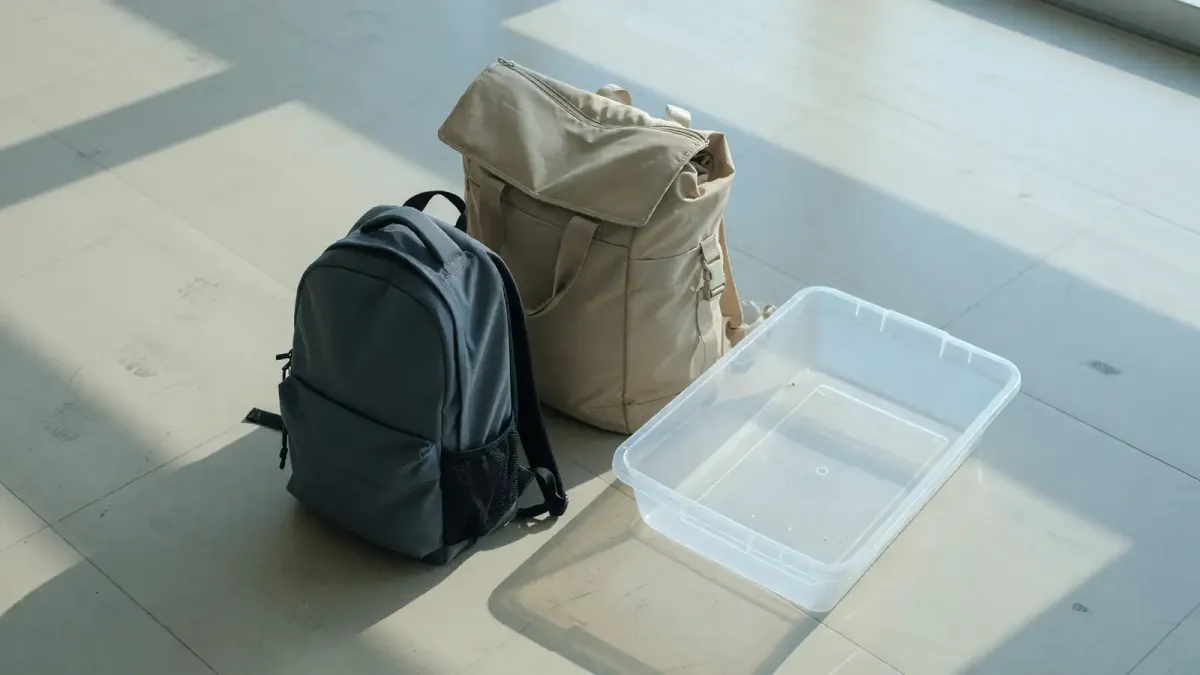
The free cabin bag is not a rule you can use at the gate this month. Deborah O’Donoghue at Travel Tomorrow, writing on Oct. 5, says the new EU air-passenger agreement was signed on Oct. 2, 2026, and is expected to come into force by Oct. 23, 2027. Selin Chatzi Ali Oglou at IamExpat, a day later, names the text: Regulation (EU) 2026/2202, in force on that same October date, and points at the Official Journal. If you are buying a ticket for a trip this fall, the gate agent can still charge you for the bag over the seat. The rule is real. The calendar is not this week.
We already wrote the U.S. side of a ruined departure in book the morning flight when cancellations are running hot. We wrote the voucher fight in the DOT category that decides your hotel on Oct. 19. We wrote what a policy actually pays in the travel-insurance guide. This piece is the European luggage rule those three do not cover. I am not a lawyer, and I did not sit with the Official Journal line by line. What follows is what the two Oct. 5 and Oct. 6 writeups actually print, and what I would do with a booking screen between now and next October.
What the free cabin bag actually includes
Travel Tomorrow calls this the first revision of the relevant Parliament rules in more than two decades. The signed text, as that piece quotes it, enshrines “the right to carry on board, without additional fee, one personal item, such as a small bag or backpack.” Carriers will also have to “permit passengers to carry a piece of hand baggage into the cabin.” That second sentence has a hole in it. The permission is “subject to the capacity of the aircraft cabin,” which means a bag you were allowed to bring can still end up in the hold if the bins are full.
IamExpat is more specific about the small item. A standard fare legally includes one under-seat bag, a handbag or backpack, measuring up to 40 by 30 by 15 centimeters, at no extra charge. Travel Tomorrow adds the piece that sits next to it: the free personal item should fit under the seat in front, and it can come into the cabin alongside another carry-on weighing up to 7 kilograms, with maximum combined dimensions of 100 centimeters. Those are two descriptions of a two-bag cabin, not a license to bring a full-size roller and call it personal.
The practical reading I would use at a booking page is this. One small bag under the seat is the guaranteed free item. A second cabin bag, 7 kilograms and 100 centimeters combined, is the one the Council text is trying to stop airlines from selling as a surprise. Neither writeup says the airline has to find bin space that does not exist. IamExpat’s useful clause is the fee, not the bin: if an approved cabin bag has to go into the hold because of space or an aircraft swap, the airline cannot charge an extra fee for that. You may still walk to the gate and hand the bag over. You should not get a new charge for the privilege.
Airlines fought this for the obvious reason. Travel Tomorrow says carriers have argued that a mandated free bag interferes with the right to price tickets differently and to compete on extras. The European Council’s answer, in the same piece, is that the current mess is a transparency problem. The full price, including luggage fees, has to be clear up front on airline websites and on intermediary platforms. The Council line O’Donoghue quotes is blunt: airfares that include an allowance for a piece of hand baggage “shall be displayed by default before the start of any booking process to facilitate fare comparisons.” IamExpat says the same thing in plainer English. Airlines and flight-search sites must show a price that already includes hand luggage before you start booking.
There is a concession, and it is the one budget carriers will use. Negotiators agreed that airlines may offer a cheaper ticket to a passenger who voluntarily travels without hand luggage. IamExpat repeats it: a lower base fare is still allowed if you choose to fly light. So the rule does not kill the bare fare. It kills the version where the bare fare is the only number on the first screen, and the bag appears after you have already compared three airlines on a lie.
The date is October 2027, and a UK departure is a different ticket
Do not pack for this rule on a flight you take this month. Both pieces put the start on Oct. 23, 2027. Travel Tomorrow says “expected to come into force by” that date. IamExpat says “coming into force on” that date. I would treat Oct. 23, 2027 as the day the obligation begins, and I would not assume a grace period or an early opt-in. If an airline advertises the free bag sooner, that is the airline’s commercial choice. It is not the regulation arriving early.
The United Kingdom is the exception that will confuse a lot of booking screens. Travel Tomorrow is explicit. Since Brexit, the UK is a third country. A traveler can still be required to pay for hand luggage on a flight that departs the UK. easyJet and British Airways, the piece says, will only need to honor the new rules on return flights that depart an EU airport and come back to the UK. A London-to-Amsterdam ticket and an Amsterdam-to-London ticket on the same airline can sit in the same confirmation email and follow two luggage regimes. If you buy the pair as one booking, read the bag line twice. The outbound from London is the one that can still carry a fee.
I would not stretch that sentence to every non-EU passport. The piece is about where the flight departs, and about UK carriers on the return from the EU. It does not walk through a U.S. airline flying New York to Paris, and I am not going to invent that coverage. If your itinerary leaves the EU, the return-leg point is the one these articles actually make. If it never touches an EU airport, this regulation is not your rule.
Travel Tomorrow also embeds an Oct. 2 post from EU Publications that lists, among the strengthened rights, an end to “no-show” penalties on return flights. I did not open that social post myself. I am using it only as something the Oct. 5 article displays. The practical version: if you miss the outbound, the return on the same ticket should not be voided as a punishment. Confirm that on your own ticket conditions before you skip a leg. A tweet quoted in a travel piece is not the contract on your reservation.
Refunds, meals, and the three-hour clock
The luggage rule is the headline. The rest of Regulation (EU) 2026/2202, as IamExpat lays it out, is a disruption schedule with numbers attached. Standardized compensation stays at 250 to 600 euros, depending on flight distance. The extract does not print the distance bands, so I am not going to guess which kilometer mark flips 250 into 400 or 600. If you need the band, open the Official Journal link IamExpat cites. What I can use is the range, and the new clocks around it.
If a flight is cancelled, or delayed by at least five hours, the airline must issue a full cash refund within seven calendar days. Missed connection on a single contract: the airline has to reroute you, and if it cannot offer alternative travel within five hours, you get a full refund. Vouchers are no longer the default shove. They can be issued only with explicit consent, they last at most 12 months, and any balance you do not spend has to come back as cash.
The clause I would actually memorize is the self-reroute. If the airline does not offer alternative transport within three hours of the disruption, you can buy your own ticket and claim reimbursement of up to 400 percent of the original ticket price, and you have 14 days to make that claim. Four hundred percent is a large number. It is also a cap, not a promise that every replacement fare will be paid in full if you book the last business seat in a panic. Keep the receipt. Keep the timestamp of when the airline failed to offer you a seat. The seven-day cash refund and the 14-day self-reroute claim are different clocks. Mixing them up is how people lose the one they actually qualify for.
Airlines also have to tell you about your compensation rights electronically within 96 hours of the disruption. That is a notice duty, not a payment. A email that says you may have rights is not the 250 euros. It is the channel the regulation wants you to have, so the claim does not depend on you already knowing the rule.
Duty of care gets a timetable too. Free refreshments every two hours. A meal after three hours, up to three meals a day. Free internet, and two phone calls. Overnight waits get a hotel and the transfer, capped at three nights when the cause is an extraordinary circumstance. IamExpat says that three-night cap does not apply to vulnerable passenger groups. It does not define the group in the paragraphs I am using, so I will not invent a list of who counts. If you are traveling with someone who cannot sleep in a terminal, ask for the exception in writing and keep the reply.
Tarmac delays are separate from the hotel rule. After 30 minutes on the ground, the aircraft has to provide adequate heating or cooling and free drinking water. After two hours, disembarkation is mandatory. That two-hour mark is the one I would want a cabin crew to hear from more than one row. It is also the one that does not help you if you are already at a hotel three cities away. Different failure, different clock.
Families, name typos, and the airport itself
A few of the everyday fees are in the same regulation, and they are the ones people pay without calling them compensation.
Airlines must seat a child next to an accompanying adult, free of charge, when they are on the same booking. Families can keep a pram or pushchair until the aircraft door, at no extra cost, and they get priority boarding. I have watched people pay a “family seating” extra at the seat map because the free option was buried under a paid one. After Oct. 23, 2027, that extra is the thing the rule is aimed at, at least for a child and the adult on the same reservation. It does not say two adults who want to sit together get the same free adjacent seats. Do not book on that hope.
Spelling mistakes on a ticket have to be corrected free of charge at least once, if you ask at least 48 hours before departure. That is a narrow window and a narrow fix. A wrong letter is not a name change. Ask early, and ask once in a way you can screenshot.
A downgrade has its own refund: 30 to 75 percent of the flight price, automatic, within 14 days, if you are placed in a lower travel class. Again, the extract does not split 30 from 75 by distance or cabin. I am not filling that in. The useful part is “automatic” and “14 days.” If the money is not back in two weeks, you have a date to point at, not a vibe.
Commercial EU airports, not just airlines, pick up two duties. Free drinking-water refill stations, and device charging points. That will not save a missed connection. It will matter on the three-hour wait the self-reroute clock is counting.
What I would do with a ticket bought this month
None of this is in force for a flight you take before Oct. 23, 2027. A blog post that tells you to refuse a bag fee at the gate next Tuesday is telling you to have a bad afternoon. Pay the fee or repack. Argue the 2027 rule with a 2026 gate agent and you will miss the flight you were trying to protect.
What you can do now is read the first screen as if the rule were already live, because that is the comparison the Council wants and the airlines do not always give you.
Look for the bag inside the headline fare, not in a later extras step. If the first price is a bare seat and the cabin bag appears only after you pick a fare family, you are looking at the structure the new display rule is written to kill. You can still buy it. Just compare it to a competitor whose first number already includes a cabin bag, or you will “save” 18 euros and spend 35 at the end.
If you are willing to travel with only an under-seat bag, the voluntary waiver is the fare to hunt. The regulation keeps that cheaper ticket on purpose. A 7-kilogram roller you do not need is not a right you have to exercise. It is a right you can sell back to the airline in exchange for a lower fare, once the rule exists, and some airlines already sell that trade today.
On a UK departure, assume the fee survives. On the return from an EU airport, ask whether the carrier is one of the ones Travel Tomorrow names, or read the bag line on that leg alone. easyJet and British Airways are the examples in the piece, not a complete list of who must comply. A different carrier flying Amsterdam to London is not automatically described by that sentence.
If the trip is a connection on one ticket, write down the three-hour and five-hour marks before you fly, even though the new clocks are a year out. The habit is the same one we used for the U.S. cancellation year: know which failure gets you a hotel, which one gets you a new ticket you buy yourself, and which one is just a late departure you eat. The European numbers will be 250 to 600 euros, a seven-day cash refund, and a self-reroute capped at 400 percent. The U.S. numbers in our earlier pieces are a different statute. Do not quote one at the other’s counter.
And keep the receipt. IamExpat’s closing line is the only advice that works before the regulation does: check the small print, and do not throw away the ticket record. The free cabin bag is a 2027 right. The paper that proves what you paid is useful on either side of that date.

Discussion
Comments
Share a helpful tip, question, or takeaway from The Free Cabin Bag Is Law. It Starts in 2027..
0 Comments
Loading comments…