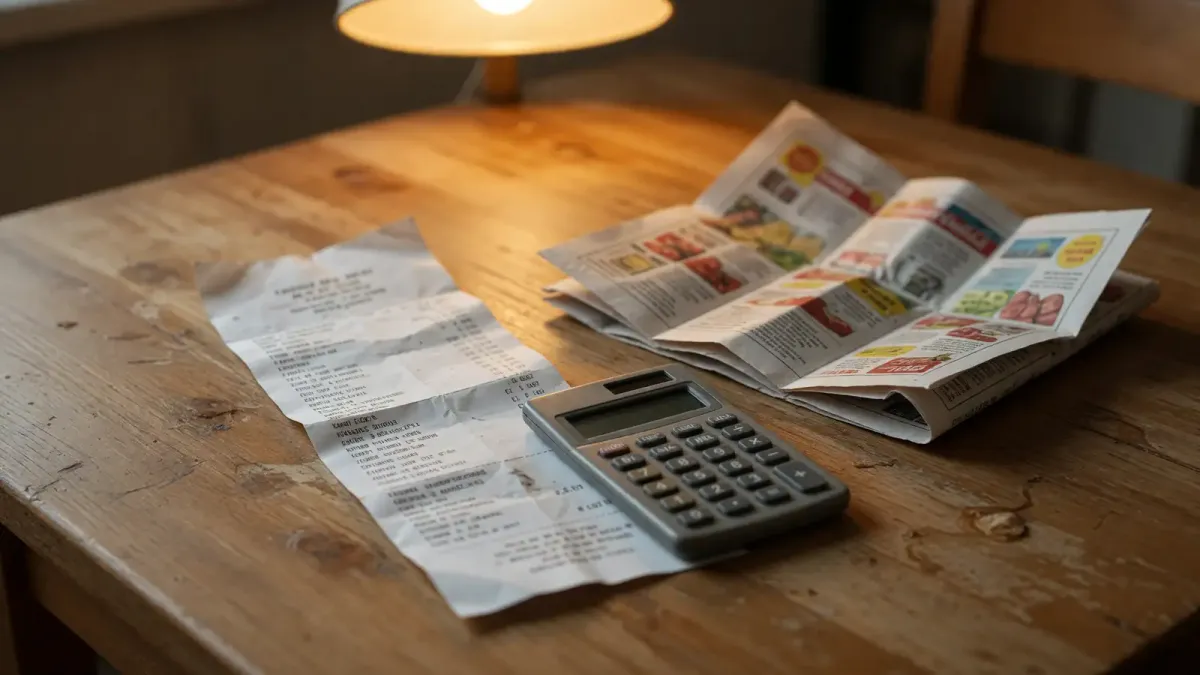
Three reports landed in the same few days, and they are not saying the same thing. Kevin Brasler in the Minnesota Star Tribune on Sept. 26 is selling specific cuts from Twin Cities Consumers’ Checkbook: switch the insurer, switch the supermarket, cook more, stop paying a delivery app to walk the bag to the door. Betty Lin-Fisher at USA Today on Sept. 25 interviewed people who study the cart, not the mortgage. Tamika Cody at WTOP on Sept. 26 is the uncomfortable one. AARP’s numbers say a lot of adults over 50 already cut the grocery bill last month, which is not a strategy. It is a symptom.
If you already read the piece on changing the store instead of the card APR, this is the dollar version of that argument, with a second pile of money sitting in the insurance file. I am not going to turn Brasler’s preventive-care paragraph into health advice. The moves that do not require a doctor are the store, the insurer, and the delivery app.
Where the grocery bill actually moves
Brasler, writing up Checkbook, uses a plain example. A family that spends $300 a week at the supermarket and finds a store that is 15% cheaper saves $2,340 a year. That is not a coupon stack. It is a price-level difference between two buildings that both sell milk.
I would not treat 15% as a promise. Checkbook’s line, as Brasler reports it, is that most shoppers can save by using a lower-cost supermarket. The $2,340 figure is what 15% looks like on a $300 week, not a receipt he audited at your store. If your week is $180, the same gap is about $1,400. If you already shop the cheap store, the gap is someone else’s. The useful part is the unit: a percentage on the weekly total, multiplied by 52, is a vacation or a car repair. A “10 cents off yogurt” clip is not.
Lin-Fisher’s USA Today piece has the inflation backdrop, and the paper had to correct it. The food-at-home index rose 2.2% in August compared with a year earlier, according to the Bureau of Labor Statistics consumer price index. An earlier version of the story named the wrong index. Two percent does not feel like a crisis until you put it next to a bill that was already tight. It also does not explain a 15% store gap. Inflation is the tide. The store you pick is the boat.
Brian Vines, marketplace reporter at Consumer Reports, told USA Today that cooking at home is the biggest swing versus delivery apps or eating out, and then undercut his own cheer. Cooking does not save money if the shopping is sloppy. By some of his estimates, “shopping smart” can free as much as $5,000 a year, money that can move to another part of the budget. I have not seen the worksheet behind the $5,000. Treat it as his ceiling, not your forecast. The $2,340 store gap and the $5,000 shopping-smart ceiling are different claims. One is arithmetic on a stated week. The other is an expert’s upper bound. Do not add them.
Vines also described how he actually shops. He does not run to the store mid-prep because one ingredient is missing or because he wants a specific thing that night. He starts from the weekly circular, decides the meals, and treats the doors of the store as too late to begin thinking. That is less romantic than a pantry system. It is also the part most grocery advice skips, because it happens on Wednesday, not in the aisle.
The labels and the shelf are doing a job
Ellen Van Loo, an associate professor of agricultural economics at Purdue, studies how labels, policy, and marketing shape what people put in the cart. She told USA Today she watches large companies run marketing that leads shoppers to pay more for a trait they think they are buying. Her egg example is the clean one. Cartons are often labeled hormone-free. U.S. law already bars hormones in egg production. The label is not a lie in the sense of a hidden hormone. It is a fee for a distinction the law already made.
I would not build a whole shopping religion out of one carton. I would use it as a test. If a package is shouting a trait that the category is not allowed to lack, you are paying for the shout. Van Loo’s other two checks are physical. Compare weight and serving size, because some boxes are mostly air. And do not stop at eye level. Stores sell that band. Manufacturers pay to sit there, and to take more of it. Eye level is not a quality seal and it is not the cheap seat. It is an ad you can touch.
Online order-ahead for pickup is her third practical point, and it is the one I trust most for people who already know they impulse-buy. You are not walking the endcap. You are looking at a list you typed at the kitchen table, which is a worse place to fall in love with a seasonal display and a better place to notice that the “family size” is 11 ounces. Pickup still has fees at some chains. If the fee is $5 and it stops a $28 unplanned basket, the fee won. If the fee is $8 and you were going to the store anyway, you paid for a service you did not need.
Brasler puts a second grocery number next to the store switch. Making your own meals a few more times a week can save a typical household $150 to $200 a month compared with restaurant prices. He also says that when you do get takeout, pick it up. Delivery apps, in his words as reported, are brutally expensive. I am not going to pretend $150 to $200 is a measured study I can cite beyond his Checkbook summary. It is a household range from a consumer reporter who shops this beat. It lines up with Vines on the direction: the restaurant and the app are where the week leaks, and the leak is larger than the yogurt coupon.
We have written the meal-planning version of this before. The new information is the pairing. The store gap ($2,340 a year in the Checkbook example) and the cooking gap ($150 to $200 a month) can both be true, and they fail in different ways. The store gap fails if the cheap store is a 25-minute drive and you buy more because the trip feels like an event. The cooking gap fails if “cook more” means a $40 specialty ingredient for a recipe you make once. Vines’s circular rule is the patch for both.
Insurance is the other pile, and it is not a grocery problem
Brasler’s Checkbook research, again via the Star Tribune, says most people who hold a car or home policy can save more than $500 a year by moving to a lower-priced auto insurer, home insurer, or both. Some save $1,000 or more. That is a different phone call from the supermarket. It is also the number I would chase before I spent a Saturday clipping.
We already walked through how to lower car insurance and what to do when home insurance jumps. I am not repeating those scripts. The new point is priority. A $500 to $1,000 insurance gap is in the same neighborhood as the $2,340 store gap, and it does not require you to change what you eat. It requires you to get two quotes and read the deductibles so you are not “saving” money by buying a policy that pays nothing until the damage is absurd. If the cheap quote raises the deductible by $1,500 and you do not have $1,500, you did not save $500. You sold a claim.
Cody’s WTOP piece is where this stops being a tip list. AARP found that 41% of adults 50 and older said they had cut back on groceries in the previous month. The survey behind that finding, as WTOP describes it, asked 1,017 adults ages 50 to 64, from July 16 through July 20. The research was published Sept. 11. WTOP’s writeup is Sept. 26, which is why it is in this week’s pile. Dining out was the most common cut, at 58%. Entertainment was 52%, clothing 47%, hobbies 42%. Groceries at 41% is not the top of that list. It is the line that should not be on a discretionary list at all.
WTOP also writes that older adults reported cutting groceries at a higher rate than people 65 and older, 45% compared with 38%. I am not going to pretend that sentence is clean. “Older adults” and “people 65 and older” overlap in ordinary English, and the survey description in the same article is ages 50 to 64. Use the 41% figure. Leave the 45-versus-38 comparison until you can see AARP’s table. I have not seen the PDF. Cody’s article is the source I have.
Christopher Mayer, CEO of Longbridge Financial, is quoted as a housing and retirement economist, not as a grocer. His point is that food is competing with insurance, property taxes, and the cost of keeping a house. He says more people are not paying for homeowners insurance, and he notes the timing: hurricane season. That is not a budgeting aesthetic. An unpaid home policy is a bet that the bad week will not arrive. I am not going to tell you to drop coverage to make the grocery math work. I am going to tell you the Checkbook $500 switch is the version of this problem that does not require going bare.
If your grocery cut is already happening because the insurance bill ate the month, the store switch still helps, and it will not fix the policy. Do those in that order only if the policy is the one that can wipe out the house. Mayer’s line is the reason I would not celebrate a lower grocery receipt that was funded by an unpaid premium.
What I would actually do this week
Start with the two quotes, not the aisle. Car and home, same coverage limits you have now, written down before you call so the agent cannot “save” you by shrinking the policy. If the gap is under $200 a year, the switching cost in your time may not be worth it. If it is over $500, Brasler’s Checkbook range says you are in the common case, not a unicorn. Our older insurance pieces have the scripts. This week’s number is the reason to open the file again.
Then price one week at a second store, on paper, using the circular Vines wants you to read before you drive. You do not need a year of loyalty cards to test the 15%. You need one overlapping list: milk, eggs, bread, the proteins you actually cook, the cleaning stuff you actually buy. If the second store is not close to 15% off that list, do not move your life for a slogan. If it is, the $2,340 example stops being someone else’s family.
Skip the hormone-free egg premium unless you have a reason that is not the label. Van Loo’s point is narrow and useful. The law already did that work. Spend the difference on the item whose unit price you checked by weight, not by the height of the box.
If you are over 50 and the AARP cut is already your month, the tip tone of this article is the wrong tone. A 41% grocery pullback is not a hack. It is the bill set winning. The insurance quote and the second-store test are still the two moves that do not require you to eat less. Delivery, in Brasler’s telling, is the one to kill first, because it is a fee on top of food you were going to buy anyway.
I do not have Checkbook’s credit-card section in enough detail to repeat it, and I will not invent a balance-transfer trick from a headline. The Star Tribune deck mentions credit. The figures I can stand behind this week are the store, the kitchen, and the policy. Those three are enough to move a year. The rest can wait until the quote comes back.
Discussion
Comments
Share a helpful tip, question, or takeaway from Your Grocery Bill Has a $2,340 Gap. Insurance Has Another..
0 Comments
Loading comments…