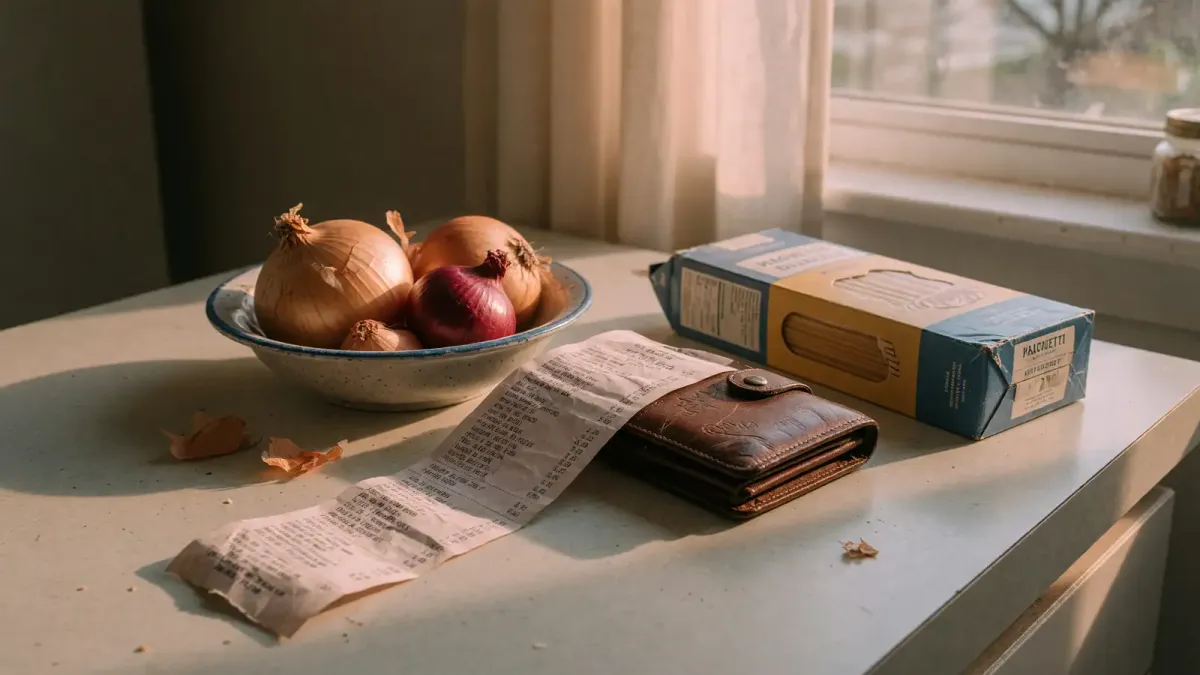
Gas already took a bite this month. AAA had regular over $4 for Labor Day, and diesel set a record. Food is the other line that does not wait.
WRAL ran the Consumer Reports package on 7 September. FOX5 Las Vegas put the same tape up on the 10th. The number that should make you sit down: a new Urban Institute analysis found more than one in four working-age adults had trouble paying off groceries they put on a credit card last year. Nearly one in ten also used Buy Now, Pay Later at the supermarket, and a lot of those people are behind on the installments.
That is not a budgeting personality test. It is a price and a product. Groceries are a weekly bill. Revolving credit is a tax on being late. If the card is how the cart gets through the lane, the interest is part of the meal.
The inflation story and the receipt are not the same file
Numerator’s August index, dated 10 September in Chain Store Age, says everyday household goods fell 0.1% in August after a 0.4% drop in July. Year over year, those prices were up 2.2%, down from 2.6% in July. Paul Stanley, their senior economist, said prices cooled even as gasoline climbed back above $4 a gallon. Low-income households saw the sharpest slowdown in the everyday-goods slice.
That sounds like relief. Read the next sentence. The same index says the basket is still 33.2% above January 2018. Quick-service restaurant prices are up 53.1% over that stretch. Numerator builds this from about 7 million item-level transactions a month, 200,000 households. They claim a 0.93 correlation with the PCE food and beverage index since 2019. I am not going to litigate their model. I will say a 2% year-over-year print does not put 2018 prices back on the shelf.
The Northeast had the smallest cumulative increase of the four regions. If you do not live there, do not take the national average as your Kroger.
Cooling inflation also does not refinance last year’s grocery balance. Urban Institute is talking about people who already used the card. Those statements keep going after the CPI chart turns green.
Stop financing the cart
Consumer Reports’ Brian Vines starts in the kitchen, not the aisle. Check what you already have before you write the list. That is not a lifestyle tip. It is how you stop buying a third jar of the same sauce because the old one is hiding behind the baking soda.
Then set a number. A grocery budget that exists only in your head is a wish. Write the weekly cap on the list. If you use a card for points, it has to be a card you pay in full on the due date. If you cannot say that out loud, use debit or cash for food this month. The 3% cash back is not a win against 20% interest.
BNPL at the supermarket is a special kind of trap. Groceries are gone in a week. The installment is not. Nearly one in ten shoppers used it anyway, according to the same Urban Institute cut CR is citing. If the store offers four payments on a $180 cart, that is not a discount. That is a calendar you now have to remember while you also buy milk again.
We already wrote a meal-planning piece that is about not hating the plan. Use it if you need a structure. Do not add a new app. The list and the pantry check are the whole system.
Where CR actually found cheaper food
In Consumer Reports’ price comparison, Costco, BJ’s, Aldi, and Lidl were among the least expensive places to buy groceries, and all four beat Walmart. That sentence is doing a lot of work in a country that treats Walmart as the default cheap store.
You do not need a warehouse membership to use the finding. Aldi and Lidl are ordinary grocery stores with a smaller SKU count. The savings come from fewer national brands on the shelf, not from a secret coupon stack. If the nearest Aldi is 40 minutes away, the gas math from earlier this month can eat the difference. If it is on the way home, go there for the boring staples: milk, eggs, oats, frozen vegetables, canned tomatoes, store pasta.
Warehouse clubs only win if you will finish what you buy. A 36-pack of yogurt is not a deal in a one-person apartment. Split a membership with someone who already shops there before you add another annual fee to the pile.
Store brands, coupons, and the combination that still works
CR says many supermarket versions cost half as much as the name brand, or less, and that some taste as good or better. I have no tasting panel. I do have a rule: try the store version once on a product where the ingredients list is short. Salt, flour, beans, peanut butter, frozen fruit. If it is bad, you are out two dollars. If you default to the national brand because the box is familiar, you are paying for the commercial.
Coupons still exist. They moved into the store app. Digital coupons and loyalty prices are the same job paper used to do. Some stores let you stack a manufacturer coupon on top. Do that when the math is obvious. Do not build a hobby around it. The Urban Institute number is about people who already cannot clear the card. A 40-minute coupon session that saves $6 is a poor hourly rate.
If you only change one habit this week, make it this: national-brand snacks and soda become store brand or they leave the list. Those are the lines where the markup is lazy.
A week of moves that do not require a personality transplant
Monday: dump the fridge and the pantry onto a piece of paper. Circle what expires first. That is dinner for two nights.
Tuesday: write a list that fits a dollar cap. Put the store you can actually reach at the top, not the store you wish you had.
Wednesday: if last month’s grocery charges are still on a card, pay the grocery line first. Food interest is the dumbest interest you will pay.
Thursday: skip the drive-through. Numerator’s restaurant prices have outrun the grocery basket since 2018. Cooking the leftover rice is the cheaper inflation hedge.
Friday: if you use BNPL anywhere, turn it off in the store app. You can turn it back on after the grocery balance is gone. You will not.
Weekend: one warehouse or discounter run for the boring bulk, one neighborhood store for produce you will eat before it dies. Two trips is allowed. Three apps is not.
The receipt test
Take last week’s grocery statement, if you still have it. Split the lines into three piles: food you cooked, food you threw out, and food that is really a snack with better branding. The middle pile is the one people lie about. If two bags of salad went slime-green, that is not a vitamin strategy. That is a $9 interest-bearing mistake if it rode on the card.
The snack pile is where store brands and “just don’t buy it” both work. CR’s tasting note is useful here because nobody’s identity is in a box of crackers. Swap those first. Leave the one national brand your household will mutiny over. One. Not seven.
If the card statement mixes gas, groceries, and a home-goods run, stop using that card at the supermarket. A dedicated debit card or cash envelope for food sounds ancient. It also makes the Urban Institute problem visible in the week it happens, not in a 22% APR letter.
Unit prices on the shelf still beat loyalty theater. If the store app wants 14 taps to reveal that the 24-oz jar is cheaper than two 12-oz jars, write the unit price on the list at home with a calculator. You already own a phone. You do not need a new one.
Delivery fees belong in the same math as BNPL. A $7.99 delivery on a $42 cart is a 19% markup before tip. If you are carrying grocery debt, you cannot afford that convenience tax. If mobility is the issue, that is different, and a neighbor or a weekly warehouse trip is still cheaper than financing DoorDash.
What this is not
It is not a lecture about never using credit. A card you pay in full is a receipt with extra steps. It is also not a claim that Aldi will fix wages. Urban Institute is describing a working-age problem. People with jobs are still putting dinner on revolving credit.
Numerator can say the month-over-month print went negative. Your statement does not read indexes. It reads last Tuesday’s cart plus the APR.
Heating season is next. Do not arrive there with a grocery balance and a $4 gallon. The move this week is smaller and ruder: stop borrowing for food you will eat before the statement closes, and buy the cheaper box when CR already told you it is the cheaper box.

Discussion
Comments
Share a helpful tip, question, or takeaway from One in Four Adults Can't Pay Off the Grocery Card. Change the Store, Not the APR.
0 Comments
Loading comments…