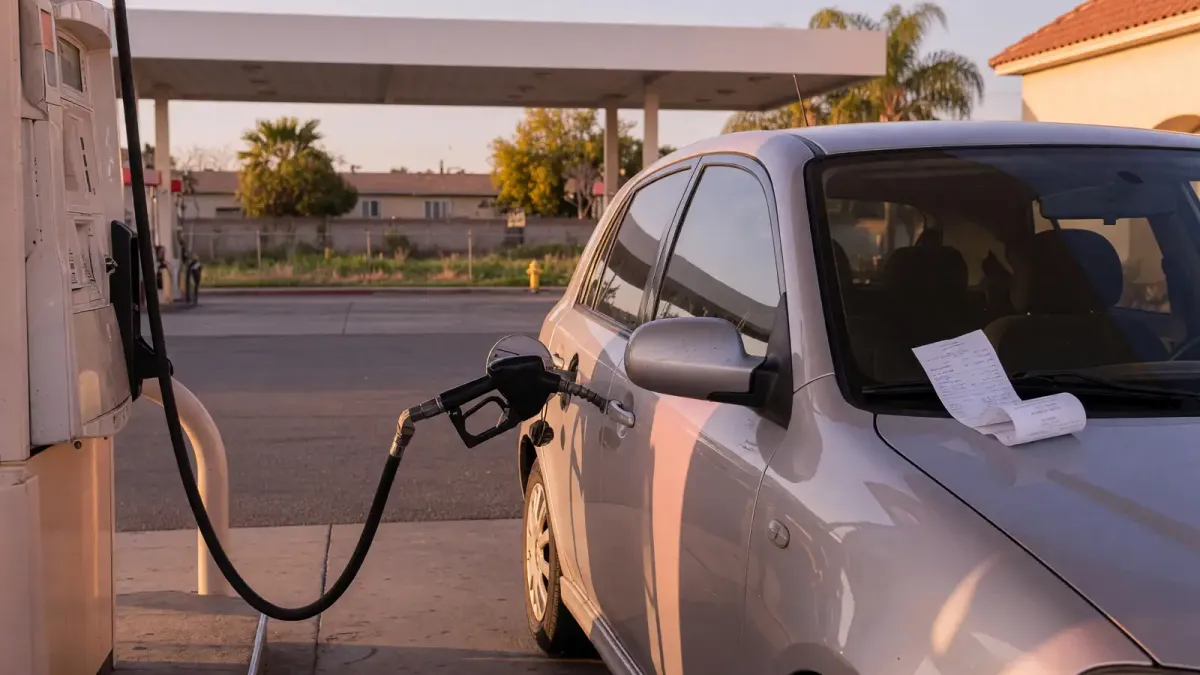
The summer driving season is supposed to end with cheaper gas. It did not.
AAA said on September 3 that the U.S. average for regular sat at $4.14 a gallon, four cents higher than the week before, and that Labor Day had never cleared $4. The old Labor Day mark was $3.82, set on September 3, 2012. CBS News, working from the same AAA tape, had diesel at $5.78 that Thursday, a few cents under the June 2022 high. The next day’s GasBuddy print, reported by Transport Topics, put the official national diesel average at $5.848, above the $5.819 record from June 17, 2022.
By September 6, AAA’s live board had barely moved on gasoline ($4.1473) and had diesel at $5.8970. A year ago those numbers were $3.20 and $3.71. That is the gap this article is about: not a lecture on geopolitics, and not a promise that prices fall next week. Just what the bill looks like from the driveway, and what still reduces it.
What the new numbers actually cost
Household fuel math is ugly because it hides in $50 fill-ups. Use round numbers.
A car that burns 12 gallons a week at last year’s $3.20 is about $40. At $4.15 it is about $50. That is $10 a week, $40 a month, a little over $500 a year if the price sticks. Plenty of commuters burn more than 12 gallons. A 15-gallon weekly habit is closer to $750 extra versus 2025.
Diesel hits a different budget. Pickup and van owners who used to see $3.71 are looking at $5.90. Fifteen gallons a week goes from $56 to $88. The extra $32 is a grocery run that no longer happens. Transport Topics notes diesel crack spreads sitting near records and seasonal inventories at their lowest for this point in the year. Goldman Sachs had already lifted fourth-quarter diesel margin forecasts. If you heat with heating oil or run a contractor truck, this is not a Labor Day blip.
CBS cited a Brown University tracker putting extra gasoline and diesel costs above $741 per U.S. household since the Iran war started. Treat that as an order of magnitude, not a line on your bank statement. Ipsos, in the same Transport Topics piece, found 38 percent of Americans saying prices felt higher shortly after the war began, and 79 percent saying so in late August. The feeling caught up with the receipt.
Hawaii on the AAA map was $5.40 for regular on September 6. If you live there, national averages are a courtesy. Everyone else should still look at their own state page before planning a long weekend as if $3 gas is coming back.
Why this Labor Day broke the script
AAA’s own note is the useful one: gasoline demand usually drops after August, and prices usually follow. This year crude in the $90 range overrode the seasonal fade. CBS and AAA both point at the Strait of Hormuz. Transport Topics adds a second squeeze that does not show up in gasoline headlines: Russian refining capacity after months of drone strikes, which tightens diesel even when gasoline looks merely expensive.
None of that is something you can vote down at the pump. It does change the household question. Last year you could wait a week and often catch a 10-cent dip. This month the weekly AAA print went the other way, and diesel jumped from $5.60 a week earlier to $5.90. Waiting for a “normal September” is how you donate another tank.
If money stress is already leaking into the workday, that is not a separate problem. We wrote last week about how cost-of-living worry shows up at the desk. Fuel is one of the few line items you can still cut without a new job or a new lease.
Habits that still move the needle
AAA’s fuel-saving page is unfashionable and still correct. Personal driving habits are the largest factor in what a given car burns. The list is short enough to keep on a note in the visor.
Keep the tires at the door-jamb number, not “looks fine.” Soft tires waste fuel and they fail in heat, which September still has. If the check-engine light is on, AAA’s point is blunt: that light is an emissions and economy problem, not a decoration. Fix it before you start hunting 3-cent apps.
On the highway, aerodynamic drag climbs fast above 50 mph. You do not need to crawl. You do need to stop treating 80 as the default. Smooth throttle lets an automatic upshift sooner. Cruise control on dry, uncongested roads holds a speed your right foot will not. On a manual, upshift early without lugging, and skip a gear when it is practical.
Those habits sound small next to a $1.70 year-over-year diesel jump. They are not supposed to erase the jump. They are supposed to claw back 10 to 20 percent of what the car actually uses. On a $50 weekly gasoline habit, 15 percent is $7.50. Over a school year that is a car-insurance deductible you no longer have to finance. Pair it with the premium and coverage cleanup we already walked through if the same vehicle is also over-insured.
Do not buy premium because the handle is yellow. AAA has spent years repeating that most cars listed for regular gain nothing from mid-grade. At $4.65 mid-grade and $5.03 premium on the September 6 board, that mistake is a $8 to $12 tax every fill.
Trip design beats a new car
The other cheap lever is how often the car moves at all.
Stack errands on the commute instead of making a second cold start after dinner. Cold engines are thirsty; three 4-mile loops cost more than one 12-mile loop. If two adults in the house drive overlapping school and grocery routes, pick one car for that loop for a month and write down the gallons. You do not need an app. A notepad in the kitchen beats a “fuel challenge” that dies in week two.
Remote days are a fuel tool when your boss already allows them. One day a week off a 30-mile round trip, at 28 mpg and $4.15 gas, is roughly $4.50. Fifty weeks is $225. That is not a raise. It is the gap between “we cannot do youth sports this fall” and “we can.”
A more efficient car is the AAA first item for a reason, and it is also the one most households cannot use this month. If you were already shopping, look at the best mpg in the class you actually need, not a larger engine “in case.” If you were not shopping, do not finance a new hybrid to escape a $4.15 gallon. The payment will eat the savings.
Diesel households have fewer cute tricks. Contractors can idle less on site, combine dumps, and stop using the truck as a 12-mpg errand car. If the family sedan can take the school run, let it. The $5.90 gallon is trying to teach that lesson the expensive way.
What not to do this week
Do not hoard gasoline in random cans. It goes stale, it is a fire hazard, and the savings versus next Tuesday are smaller than people think.
Do not drive across town for a 6-cent discount if the detour burns a gallon. GasBuddy and AAA’s locator are useful when you are already on that road. They are not a quest.
Do not time the market. Crude at $90 with a shipping chokepoint does not care that Labor Day is over. The seasonal pattern AAA described failed in public. Budget as if $4.10 to $4.20 regular and high-$5 diesel are the working numbers through fall, then smile if you are wrong.
Watch the heating side in parallel. We already covered September deadlines and cheap weatherization for the heating bill. Diesel tightness and heating oil are cousins. If you are in a heating-oil house, treat this diesel print as an early warning, not a curiosity from the trucking news.
If you already drive an EV, the receipt still exists
AAA’s September 6 board listed E85 at $3.13, which only helps if the car is built for it. Public charging is its own line item. On the same AAA site, the most expensive public charging states were in the 47 to 52 cents per kilowatt-hour band, with West Virginia, Hawaii, Alaska, Louisiana, and California in that group. A 60 kWh fill at 50 cents is $30. That can beat $4.15 gasoline. It can also lose if you only charge on highway DC fast and sit in a garage that still bills like a hotel.
Do the same receipt trick as gasoline: two weeks of charging costs on a card. Home Level 2 on an off-peak rate is the actual EV savings. Public fast charge as your default is just a different pump.
Grocery prices will follow diesel with a lag. Transport Topics’ refining-capacity point is why. The truck that restocks milk runs diesel. You will not see a $2 diesel jump print on the gallon of milk the same week. You will see it as fewer sales and more “temporary” shrinkflation. If you already cut heating paperwork in September, keep a tighter food list now rather than waiting for a headline that says “food inflation” in October.
Apps, warehouse clubs, and other side quests
Price apps help when you are already on that road. They do not justify a 12-minute detour. If Costco or Sam’s is on the weekly loop, warehouse gas is often cheaper than the branded station on the same block. If it is a 20-minute extra round trip, run the gallons. At 25 mpg and $4.15, 8 extra miles costs about $1.30. A 20-cent discount on 12 gallons is $2.40. That one still wins. A 20-cent discount on 8 gallons after 15 extra miles does not.
Skip the viral “fill at 6 a.m. because tanks are cooler” thread. The measurable stuff is tire pressure, speed, cold starts, and which vehicle leaves the driveway. AAA’s own habit list beats folklore.
If you are carrying a roof box from July, take it off. Drag is not theoretical at highway speed. Same for the 80 pounds of “might need it” in the trunk. AAA’s ownership section starts with buying the efficient car in class. For people not buying, the version is: stop making the car you have less efficient on purpose.
A one-hour checklist
Tonight, 60 minutes:
- Read the door-jamb tire pressure and fill to it. Both cars if you have two.
- Write last week’s miles and gallons on a card. If you do not know gallons, keep every receipt for 14 days.
- Pick one recurring trip that can ride with another trip. Put it on the calendar so it actually happens.
- If the check-engine light is on, book the shop. Guessing is how you buy coils twice.
- If you have a diesel truck and a gasoline car, move household errands off the truck for two weeks and compare.
None of this is clever. The $4.14 Labor Day number is the clever part, and it is not on your side. The only leverage left is how often the engine runs, and how sloppy it is when it does.



Discussion
Comments
Share a helpful tip, question, or takeaway from Labor Day Gas Hit $4.14. Diesel Just Set a Record..
0 Comments
Loading comments…