
Clogged gutters cause more damage than most homeowners realize. Water that overflows from blocked gutters pools against your foundation, seeps behind siding, and creates the perfect conditions for ice dams in winter. The National Foundation Repair Association estimates that poor drainage is responsible for roughly 60% of foundation problems in residential properties.
Most people wait until they see water streaming over the edge of a gutter before doing anything about it. By then, the damage has already started. A proactive approach costs a fraction of the repair bills.
Why Clogged Gutters Are a Bigger Problem Than You Think
When gutters fill with leaves, twigs, and shingle grit, they stop directing water away from your house. Instead, water overflows and runs down the fascia board, behind the siding, or straight down to the foundation. Over time, this causes wood rot, basement flooding, and soil erosion around the perimeter of your home.
Ice dams make the problem worse in cold climates. A gutter packed with wet leaves holds standing water. When temperatures drop below freezing, that water expands outward against the trough and fasteners. Repeated freeze-thaw cycles through winter can pull gutters loose from the fascia entirely, according to Glide Window Cleaning. You end up with sagging sections, separated joints, and water pouring behind the gutter instead of through it.
Clogged gutters also attract pests. Mosquitoes breed in standing water trapped in debris. Birds and rodents build nests in the accumulated material. Carpenter ants and termites are drawn to the moisture-damaged wood around overflowing gutters.
The financial toll adds up quickly. A single season of neglected gutters can lead to fascia board replacement costing $1,000 to $3,000, foundation repairs running $5,000 to $15,000, and interior water damage that varies widely but rarely comes cheap. Compare that to the cost of a few hours of cleaning twice a year.
The fix is straightforward: clean them regularly and maintain the system before problems start.
When to Clean Your Gutters
Timing matters more than people think. Clean too early in fall and a second wave of leaves refills the gutter before winter arrives. Wait too long and water sitting in the trough can freeze before you get to it, creating exactly the ice dam situation you are trying to avoid.
The ideal window is after most leaves have fallen from nearby trees but before the first hard freeze. In most of the northern United States, that window falls between mid-October and mid-November. Warmer climates like the South and Southwest can push this into December or even January.
Watch your local trees, not the calendar. Deciduous trees in your yard and your neighbors’ yards are a better signal than any fixed date. Once the canopy is mostly bare, the gutter’s debris load for the season is close to its peak.
You should also do a quick check after major storms year-round. A heavy summer thunderstorm can dump enough debris to clog a section in a single afternoon. Spring cleaning matters too, since winter ice and accumulated grit from roofing materials settle in the troughs over the cold months.
Tools You Actually Need
You do not need a truck full of specialized equipment. A basic gutter cleaning kit includes:
- A sturdy extension ladder with a stabilizer bar
- Work gloves (leather or heavy rubber)
- A plastic scoop or small trowel
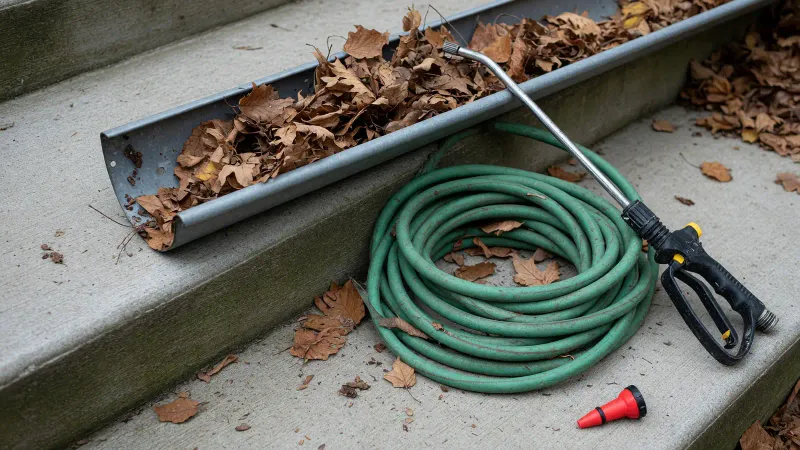
- A garden hose with a spray nozzle
- A bucket or tarp to collect debris
- Safety goggles
The ladder stabilizer is worth calling out separately. It hooks over the gutter edge and distributes weight across a wider area, preventing the ladder from crushing or bending the gutter. Most home improvement stores sell them for under $30, and they make the difference between a safe cleaning session and a damaged gutter.
A gutter scoop designed for the job costs around $10 and has a curved shape that fits the trough profile. A plastic garden trowel works in a pinch, but the dedicated tool is faster and puts less stress on the gutter seams.
Skip the pressure washer for routine cleaning. High-pressure water can separate gutter joints and force water behind the fascia. A regular garden hose with moderate pressure is enough to flush remaining debris after you have scooped out the bulk.
The Step-by-Step Cleaning Process
Start at the downspout end and work backward toward the far end of each gutter section. This way, any water you use for flushing flows toward the outlet instead of pooling in front of you.
-
Set up the ladder on firm, level ground. Have someone spot you if possible. Position it so you can reach the gutter section without leaning sideways.
-
Remove large debris by hand. Put on your gloves and scoop out leaves, twigs, and shingle grit. Drop everything into a bucket hanging from the ladder or onto a tarp spread below.
-
Work from the far end toward the downspout. Move the ladder every four to six feet. Do not overreach. Climbing down and repositioning takes thirty seconds. Falling off a ladder takes a lot longer to recover from.
-
Flush with the garden hose. Once the visible debris is cleared, run water through the gutter to check flow. If water backs up, you have a blockage in the downspout.
-
Clear the downspout. Run the hose at full pressure down the downspout from the top. If water does not flow freely, try a plumber’s snake from the bottom up. For stubborn clogs, remove the downspout entirely and flush it on the ground.
-
Inspect for damage. While you have access, check for rust spots, cracks, loose fasteners, and sections that are pulling away from the fascia. Tighten what you can and note anything that needs repair.
-
Test the system. Pour a steady stream of water at the highest point of the gutter and watch it flow to the downspout. The water should move freely with no pooling or overflow.
Safety Tips That Matter
Ladder falls send over 150,000 people to the emergency room every year in the United States, according to the Consumer Product Safety Commission. Gutter cleaning is one of the activities most associated with these injuries.
Never clean gutters alone if you can avoid it. A spotter can hold the ladder, hand you tools, and call for help if something goes wrong. At minimum, keep your phone within reach.
Avoid leaning to either side of the ladder. The rule of thumb is that your belt buckle should stay between the side rails at all times. If you cannot reach a section, climb down and move the ladder.
Wear non-slip shoes with good tread. Wet leaves on a ladder rung are surprisingly slick. Work gloves protect your hands from sharp metal edges and rusty fasteners.
Check the weather before you start. Wind gusts above 15-20 mph make ladder work dangerous. Rain makes every surface slippery. Save the job for a calm, dry day.
If your home is two stories or higher, or if you are not comfortable working at height, hire a professional. Most gutter cleaning services charge between $100 and $250 for a standard residential job, which is cheap insurance against a fall or foundation damage.
Prevention: Stop the Clogs Before They Start
Cleaning gutters twice a year is the baseline. Reducing how often you need to do it is the real win.
Gutter guards cover the top of the gutter and let water in while blocking leaves and large debris. Mesh screens are the cheapest option and work well for moderate tree cover. Reverse-curve guards channel water over a curved surface while leaves fall off the edge. Foam inserts sit inside the gutter and absorb water while blocking debris. No guard eliminates maintenance entirely, but quality guards can stretch your cleaning interval from twice a year to once. Budget between $1 and $3 per linear foot for materials on a typical 150-foot gutter run.
Trim back tree branches that overhang your roof. Branches within three feet of the gutter line are the primary source of debris. Pruning them back in late summer reduces the fall leaf load significantly. If you have large trees close to the house, consider hiring an arborist for the upper branches rather than attempting it yourself.
Install downspout extensions that carry water at least four to six feet away from the foundation. Splash blocks work, but buried drain lines that slope away from the house are more effective and invisible. The goal is to keep water from pooling near the foundation walls, where it can seep through cracks and into your basement or crawl space.
Check your roof condition. Damaged or aging shingles shed granules that accumulate in gutters. If you notice a lot of shingle grit in the trough, your roof may be approaching the end of its life. Addressing roof issues early prevents the secondary problem of gutter overflow from accumulated debris.
Seal joints and seams. Gutter sections are joined with seams that can separate over time. A bead of gutter sealant along each joint during your fall cleaning prevents small leaks from becoming big ones. Inspect corners and end caps while you are at it.
Seasonal Maintenance Calendar
Gutter care fits naturally into a seasonal routine. Building it into your existing home maintenance schedule means you are less likely to skip it.
- Spring: Flush gutters to clear winter grit and check for damage from ice. Repair any sections that pulled loose during freeze-thaw cycles. This is also a good time to test downspout flow and clear any blockages that formed over winter.
- Summer: After major storms, do a quick visual check from the ground. Look for water stains on fascia boards, which indicate overflow. Trim branches that are approaching the roofline before they drop leaves in fall.
- Fall: Full cleaning after leaf drop. This is the most important session of the year. Inspect and tighten all fasteners before winter. Apply gutter sealant to any joints that look suspect.
- Winter: Watch for ice dams. If icicles form along the gutter edge, water is trapped. Safe removal of snow buildup from the roof edge can prevent ice dam formation. A roof rake designed for this purpose lets you clear snow from the ground without climbing a ladder in icy conditions.
Keeping gutters clear is not glamorous work, but it prevents some of the most expensive home repairs. A few hours of maintenance in fall can save you from foundation cracks, basement flooding, and emergency roof repairs in the middle of winter. The math is simple: prevention costs less than repair every single time.

Discussion
Comments
Share a helpful tip, question, or takeaway from Gutter Cleaning in 2026: When to Do It and How to Not Fall Off a Ladder.
0 Comments
Loading comments…