Every organizing system eventually fails. The labeled bins get mismatched. The color-coded closet falls apart after one shopping trip. The elaborate storage solution you spent a weekend installing becomes a graveyard for junk you never sorted in the first place.
If you have tried—and failed—at keeping your home organized more than once, the problem is not your willpower. It is the complexity of the system itself. The more complicated an organizing method, the harder it is to maintain. And anything hard to maintain will eventually be abandoned.
There is one rule that avoids this trap entirely. It costs nothing. It requires no bins, no labels, no weekend project. It is the one-in-one-out rule: every time you bring a new item into your home, you remove one existing item.
Why This Rule Works When Others Do Not
Most organizing methods ask you to do a big purge, then maintain the result. The purge is painful but finite. The maintenance is where things fall apart, because it requires you to make judgment calls every single day: Is this worth keeping? Do I have space? Will I use this again?
The one-in-one-out rule eliminates those decisions. You do not need to evaluate whether you have space. You do not need to ask whether you will use the old item. The math is simple: new thing in, old thing out. The count stays the same.
This works because clutter has a simple cause: accumulation without a corresponding exit. People bring things home faster than they remove them. Over time, even a large house fills up.
The average American home contains roughly 300,000 items, according to estimates from the National Association of Professional Organizers. That number does not grow because people buy 300,000 things in a single shopping spree. It grows because people buy three things a week and remove none. Over ten years, that adds up.
Research from the UCLA Center on Everyday Lives of Families found that cluttered homes correlate with elevated cortisol levels—up to 25 percent higher than in tidy environments. The stress is not just about aesthetics. It is about the cognitive load of living surrounded by more things than you can process. The one-in-one-out rule keeps that load in check.
Where to Start
The rule works best when you apply it to specific categories rather than trying to overhaul your entire home at once. Pick one area that bothers you most and commit to the rule there first.
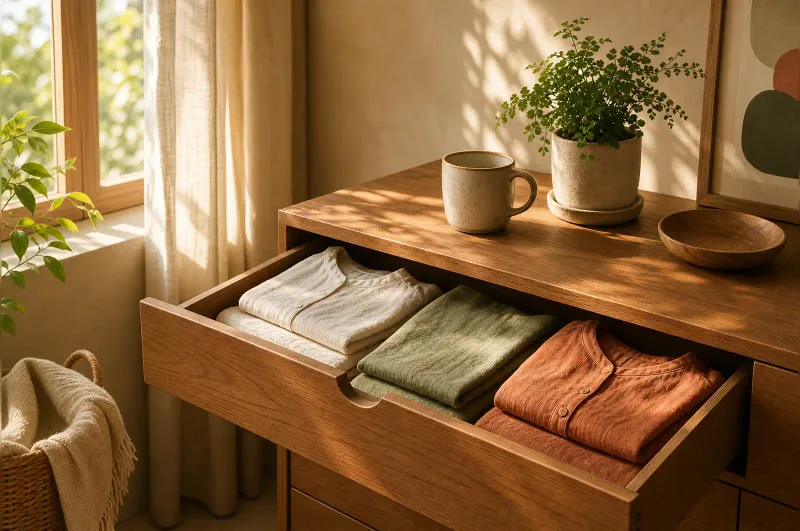
Clothing is the easiest starting point. Most people wear 20 percent of their clothes 80 percent of the time. When you buy a new shirt, choose one from your closet to donate. Not the shirt you are wearing. Not the one you just washed. An actual item from your collection that you are no longer reaching for.
Kitchen gadgets are another strong candidate. The average kitchen contains a startling number of single-purpose tools: avocado slicers, garlic presses, egg separators, melon ballers. Each one takes up drawer space and contributes to the feeling that your kitchen is too full. When a new gadget arrives, an old one goes.
Books are tricky because people attach emotional meaning to them. But the one-in-one-out rule does not ask you to get rid of books you love. It asks you to be honest about which ones you will read again. Most people do not reread books. If you have not opened a book in two years, you probably will not. Let it go to someone who will.
Electronics and cables are another category where the rule pays off. The average household has a drawer full of old phone chargers, random adapters, and mystery cables. When a new device comes in, find the corresponding old cable and recycle it. Most electronics recycling centers accept cables free of charge.
Bathroom products are an overlooked category. Sample-size shampoo bottles from hotels, expired medications, and half-used lotions accumulate slowly. When you buy a new lotion, finish or discard an old one. The bathroom counter clears itself.
The Variations
The basic rule is one in, one out. But depending on your situation, you might want to adjust the ratio.
One-in-two-out works when you are actively trying to reduce, not just maintain. If your closet is already overstuffed, bringing in one new item and removing two makes a dent. Over a few months, the difference is noticeable. This version requires more discipline, so start with it only after you have built the habit of one-in-one-out.
Category-specific rules can also help. Instead of applying the rule across your entire home, apply it to one type of item at a time. Every new pair of shoes means an old pair gets donated. Every new pan means an old one gets tossed. This is less overwhelming and gives you a clear, binary decision each time.
Some people apply the rule to household expenses instead of physical items. Every new subscription means cancelling an existing one. Every new streaming service means dropping another. The principle is identical: prevent accumulation by creating a fixed capacity.
A seasonal variation works well for families with children. Before birthdays or holidays, do a one-in-two-out sweep of toys and clothes. Kids grow out of things fast, and the months before gift-giving season are the natural time to make room. Frame it positively: you are making space for the new things they will love, not taking away the old things they have outgrown.
Why People Resist It
The one-in-one-out rule sounds almost too simple. People dismiss it because it does not feel like a real system. There are no bins to organize, no color codes to follow, no five-step process to memorize. It feels inadequate compared to the elaborate methods promoted by organizing shows and social media accounts.
But simplicity is the point. A system you actually follow beats a perfect system you abandon. The one-in-one-out rule works because it is easy to remember, requires no preparation, and produces immediate results. You do not need to wait for a weekend purge to see progress. Every time you follow the rule, you have maintained balance.
There is also the psychological resistance to letting go. People keep things because of sunk cost fallacy (I paid for this), because of potential utility (I might need it someday), or because of emotional attachment (this was a gift). The one-in-one-out rule does not ask you to evaluate those feelings. It asks you to make a trade. You are not losing an item. You are swapping it for something you actually want.
Another barrier is the assumption that organizing requires a big commitment. People wait for the right moment—a long weekend, a move, a burst of motivation—before they start. The one-in-one-out rule removes that barrier. You can start the next time you buy anything. No preparation needed.
Making It Stick
The biggest challenge with the one-in-one-out rule is consistency. It is easy to follow when you are excited about a new organizing method and hard to follow three months later when the novelty wears off.
A few practices help. Keep a donation bag or box in a closet. When you bring something new home, walk to the bag before you put the new item away. Make the removal part of the same action as the acquisition, not a separate task you will get to later.
Set boundaries for yourself. Decide in advance which categories the rule applies to. If you apply it to everything, you will exhaust yourself. If you apply it to clothing and kitchen items, you cover the two areas where most clutter accumulates.
Tell someone. Accountability works even for small rules. When you tell a partner or friend that you are doing one-in-one-out, you create social pressure to follow through. It is easier to maintain a habit when someone else knows about it.
Track your progress. A simple tally on your phone or a note on the fridge counts how many items you have removed this month. The number itself does not matter. What matters is that you can see the habit forming.
The Long-Term Effect
After a few months of consistent one-in-one-out, something shifts. You start thinking differently about purchases. Instead of buying impulsively and figuring out storage later, you weigh whether the new item is worth losing an existing one. This is not deprivation. It is being deliberate about what you own.
Homes that follow this rule tend to stay at a consistent level of stuff. They do not go through cycles of accumulation and purging. The clutter never builds up enough to require a big cleanup, because it never builds up in the first place.
The financial benefit is real too. When you factor in the cost of storage bins, closet organizers, and the occasional professional organizer, the one-in-one-out rule saves money on both ends: you buy less, and you need less infrastructure to manage what you have.
There is also a secondary effect that surprises people: they enjoy their possessions more. When you own fewer things, each item gets more attention and use. The jacket you wear every week gets appreciated. The kitchen tool you reach for daily becomes part of your routine instead of buried under five things you never touch.
When It Is Not Enough
The one-in-one-out rule is not a cure-all. If you are dealing with hoarding behavior, compulsive shopping, or a home that is already severely overwhelmed, this rule alone will not solve the problem. Those situations require professional help, not a simple heuristic.
The rule also has limits when it comes to shared households. If three people live in a home and only one follows the rule, the net accumulation remains positive. Getting everyone on board— or at least everyone in their own spaces—matters.
For most people, though, the rule is enough. It is not glamorous. It will not make for a dramatic before-and-after photo. But it is the one method that works quietly, consistently, and without fanfare. And that is exactly why it lasts.
Related reads: Why Your Decluttering Never Sticks (And the 10-Minute Daily Fix That Does) | Soft Decluttering: A Gentle Approach to Organizing Your Home Without the Guilt | The Two-Foot Rule: A Decluttering Method That Actually Sticks
Discussion
Comments
Share a helpful tip, question, or takeaway from The One-In-One-Out Rule: Why Simplicity Beats Complexity in Home Organization.
0 Comments
Loading comments…