If your company dragged everyone back to the office this year, you are probably not getting as much done as you used to. The open floor plan, the spontaneous desk drive-bys, the commute that eats two hours you used to spend on actual work. You are not imagining the drop in output, and you are definitely not alone.
A Federal News Network survey of 7,463 federal employees conducted in May 2026 found that 76% described themselves as less productive after returning to the office full-time. Only 3% said they were more productive. The rest reported no change. For context, that is not a marginal dip. Three out of four people in one of the largest workforces in the country are saying the office makes them worse at their jobs. Those numbers are hard to dismiss as a few people missing their sweatpants.
That same survey, cited by Government Executive alongside Gallup data, found the share of federal employees classified as “thriving” dropped from 58% in 2024 to 48% in 2025. Meanwhile, workers categorized as “struggling” climbed from 37% to 47%, and those “suffering” rose from 3% to 5%.
You cannot control whether your employer calls everyone back. You can control how you respond to it. That starts with accepting that the office is not a neutral environment for focus work and building your day around that reality. Here is what the research says about staying productive when the office is working against you.
Why the Open Office Keeps Breaking Your Focus
The obvious culprit is noise. But the real problem runs deeper than volume.
Remote work gave people something they rarely had in an office: control over their sensory environment. No unplanned conversations. No fluorescent lights humming. No colleague eating something crunchy two feet away. Nargiza Noimann-Zander, a clinical psychologist and neuroscience researcher, told Business Insider that returning to the office “can feel more intense than it did before, because people have now experienced an alternative.” Your brain got used to choosing its conditions. Now it has to fight through whatever the office throws at it. That is not weakness. It is a predictable response to losing a level of environmental control most people did not know they needed until they had it.
The architectural reality is not helping. Most open-plan offices were designed for a pre-pandemic world where managers equated visibility with productivity. Stephanie Miller, a spokesperson for design firm HOK, told Business Insider that office design “fundamentally impacts productivity,” and that finding “the environment that supports your sensory levels” is the difference between focused work and constant distraction. Cisco redesigned its London office with a soundproof wellness room that has no technology at all, specifically so employees can “reset their minds” after a commute. Most of us do not work in a Cisco office.
There is also a mismatch between the stated reasons for RTO and what actually happens in the building. Office of Personnel Management Director Scott Kupor wrote in January 2026 that in-office presence “boosts productivity and collaboration” and that “supervising a massive, largely remote federal workforce is not something the federal government is well equipped to do.” But survey respondents described the opposite outcome: long commutes combined with distributed teams still on Zoom meant they got “the worst of both scenarios.” They were in the office but still collaborating virtually, just with worse coffee and a longer drive.
Kastle data shows weekly office occupancy now averages about 52.5%, near its post-pandemic high. The offices are filling back up. The floor plans have not changed.
Match Your Work to Your Energy, Not the Clock
For decades, business culture has treated early risers as the default. The 5 a.m. CEO. The executive who “gets more done before 8 a.m. than most people do all day.” Productivity advice tells you to “eat the frog” first thing in the morning: tackle the hardest task while your willpower is fresh.
For a lot of people, that advice backfires.
A study of more than 8,000 office workers in Japan found that productivity dropped when work schedules conflicted with a person’s natural sleep patterns, or chronotype. The researchers concluded that aligning working hours more closely with an individual’s internal clock improved both sleep quality and workplace performance. A Forbes analysis of the findings put it bluntly: for someone whose concentration naturally develops later in the day, forcing hard tasks into early morning slots leads to “slower thinking, unnecessary mistakes, and avoidable frustration.”
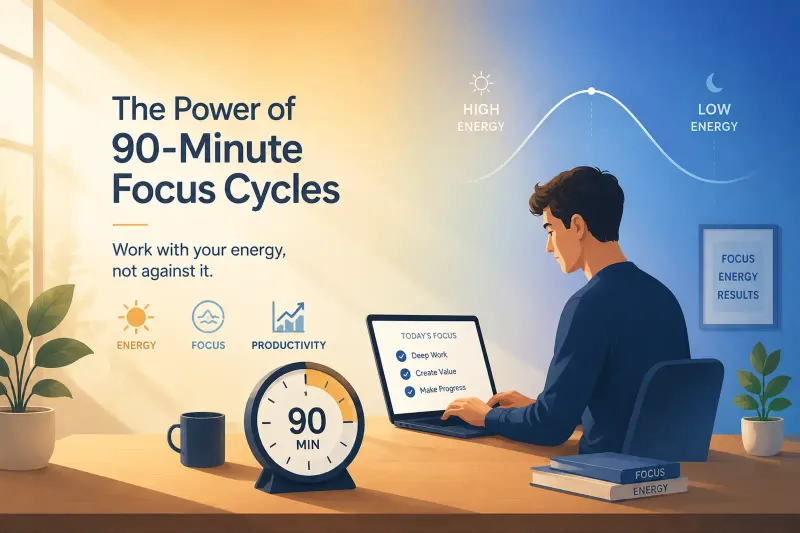
The fix is not asking your boss for a later start time, though that might help if you can get it. The practical version is restructuring how you use the hours you already have. Move demanding work (writing, analysis, strategic decisions, anything that requires sustained attention) into your peak alertness window, whenever that falls. Reserve your low-energy stretches for email, scheduling, expense reports, and the kind of administrative work that does not punish you for being at 70%.
If your peak is 10 a.m. to 1 p.m., guard those three hours like they are the only productive window you get, because they might be.
Build a Focus Bubble in the Middle of the Noise
You cannot redesign your company’s floor plan. You can still carve out a workable environment within it.
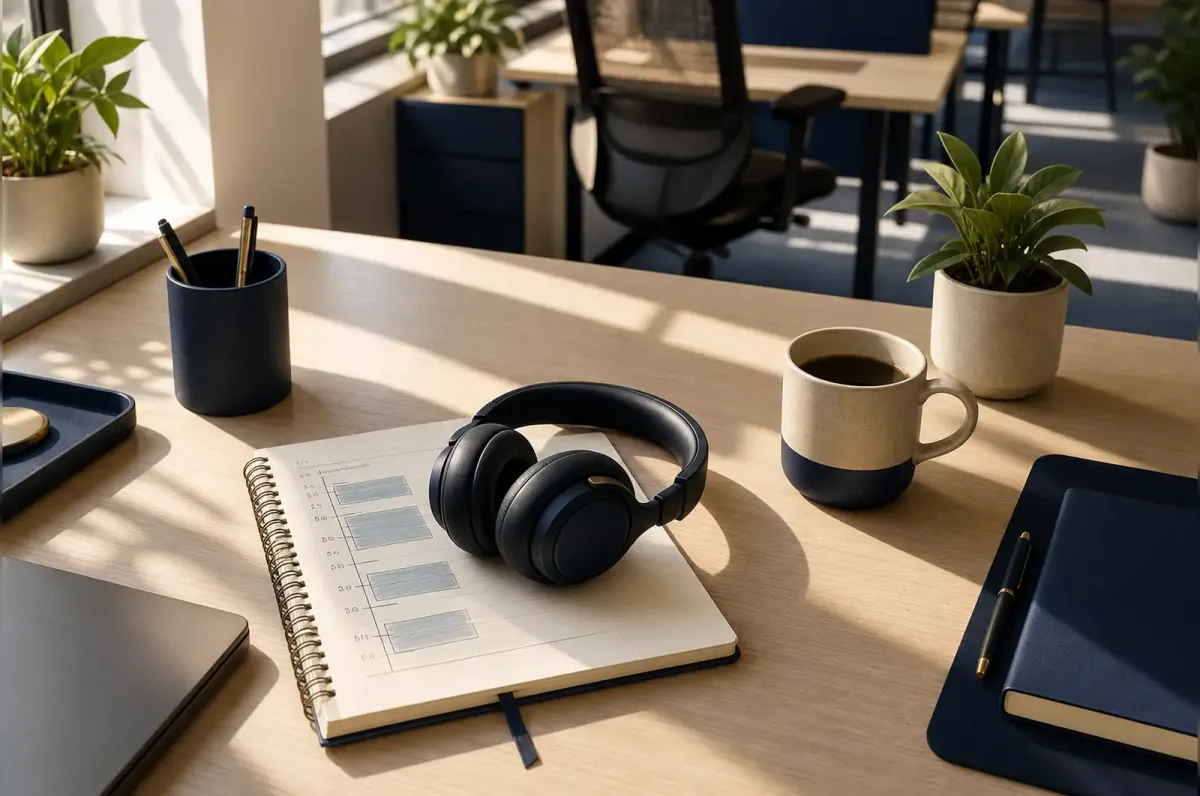
The simplest tool is a pair of noise-canceling headphones. Charles Broomfield, a 26-year-old engineering analyst at Google who goes to the office five days a week, told Business Insider he keeps his headphones on throughout the day and prefers to eat meals alone unless someone asks to join. “I like the quiet time and that space and that recharge,” he said. That is not antisocial. It is just recognizing that focus is fragile and the open office does not protect it for you.
Beyond headphones, look for the spaces your office already has that people forget about. Empty conference rooms during lunch hours. A corner of the cafeteria before the rush. A phone booth if your office has them. Even relocating to a different floor where your team does not sit can buy you an hour of uninterrupted work, because the interruptions that kill focus are mostly from people who can see you. The goal is not to hide from your team. It is to give yourself stretches of uninterrupted time for the work that actually moves projects forward, then be fully present for the collaborative parts.
If your office has no quiet spaces at all, bring the strategy home in a different way: batch your meetings into a single block of the day and protect the remaining hours as deep work time. The constant ping-pong between a 30-minute meeting and trying to refocus is what burns through your energy, not the meetings themselves.
Have the Conversation Before You Burn Out
A lot of people quietly adapt to RTO conditions without ever explaining the impact to their manager. The manager, meanwhile, assumes everything is fine because nobody said otherwise.
That silence creates misunderstandings that get worse over time. Someone who contributes less during an 8 a.m. standup might appear disengaged even if they produce their strongest work every afternoon. As the Forbes piece noted, the solution is not asking for special treatment. It is having a straightforward conversation about how you work most effectively.
You do not need to frame it as a complaint. Frame it as a productivity discussion. Explain that you are fully available during standard hours, but that you consistently produce your strongest analytical work in specific windows of the day and would benefit from protecting those windows for focused projects. Offer a concrete example: “I notice my best writing happens between 10 and 2. If I can block those hours for deep work and shift my meetings to afternoons, I think my output will noticeably improve.” Most competent managers would rather know this than silently lose your best hours to open-office noise.
Measuring commitment by who logs on first each morning has always been a bad metric. As hybrid work becomes the norm in many industries, it is also becoming an increasingly outdated one. The managers who adapt to this reality keep their best people. The ones who do not keep losing them.
Recovery Is Not Optional
Catherine Fadashe, who works in marketing and communications in London, returned to the office in 2023 and described it as a “huge adjustment.” Her solution: after every in-office day, she spends a full hour in complete silence, avoiding all social media, just to decompress. On the three days a week she goes in, she mentally prepares as if she is about to go onstage.
That might sound extreme. But the data backs up the idea that office days carry a real cognitive cost. The Federal News Network survey respondents specifically cited long commutes, distributed teams that made collaboration no better than remote, and inadequate workspace as the combination that created “the worst of both scenarios.” You are commuting for an hour to sit on Zoom calls with people in other buildings.
The takeaway is not that offices are hopeless. It is that they demand a recovery strategy most people never build. A 20-minute walk after you get home before you look at another screen. A hard rule against checking work messages in the evening. Something that tells your brain the workday is actually over, even if your body already left the building.
The commute itself is part of the cost. Federal telework hours dropped 75% between January and October 2025, according to OPM data. For a lot of people, that meant suddenly adding back hours of driving or transit time each week that had been repurposed for exercise, family, or actual rest during the remote period. You cannot get those hours back, but you can decide not to let them eat into the recovery time you still have. Even a 15-minute buffer between arriving home and checking your phone makes a difference.
The RTO wave is not reversing soon. Office occupancy is still climbing. The companies that mandated returns are mostly holding firm. If you want to stay effective, you have to stop treating the office as something to endure and start working around it on purpose. The research is there. The tactics are simple. The hard part is actually doing them.
Discussion
Comments
Share a helpful tip, question, or takeaway from How to Stay Productive When You're Forced Back to the Office.
0 Comments
Loading comments…