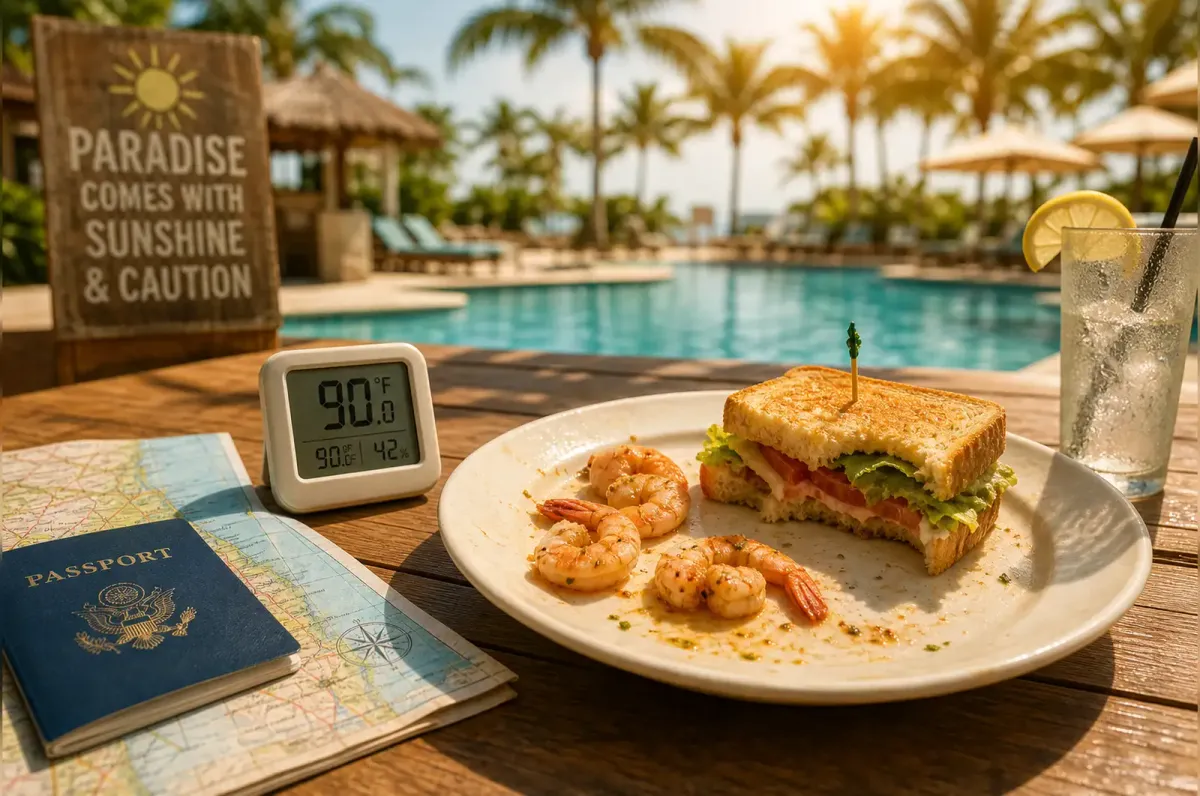
It starts with a plate of shrimp at the resort buffet. It looks fine — pink, chilled, sitting on a bed of ice. You eat it. You feel fine.
Six hours later, you’re on your knees in the bathroom of your hotel room, and your vacation is over.
Late summer is the worst time of year for this. The heat is breaking records, the travel system is melting down, and the one thing nobody is talking about is what’s happening to your food while you wait for a delayed flight or graze a buffet for the third hour. The breakdown of temperature controls is quietly turning ordinary vacation meals into medical emergencies, and most travelers have no idea it’s happening.
You cannot smell or taste the danger. “You won’t smell or taste it, but the risk is right there,” says Mario Hupfeld, a microbiologist and CTO of NEMIS Technologies. The bacteria that wreck your gut do not announce themselves. They just multiply.
The danger zone is smaller than you think
Trisha Pasricha, a gastroenterologist and assistant professor at Harvard Medical School, defines the “danger zone” for bacterial growth as anything between 40 and 140 degrees Fahrenheit. She puts it in terms that are hard to forget: “Boiling water is 212 degrees, but a comfortable bath temperature is around 100. If you could take a bath in it, bacteria can rapidly multiply.”
That bathroom-temperature shrimp at the buffet? The one sitting in a shallow ice bath that looks cold but isn’t? The clock is running.
Robert Glatter, an emergency physician in New York City, points out something even more alarming: when refrigerated food hits room temperature for even short periods, the time it takes pathogens like Listeria and Yersinia to reach infectious levels gets cut by up to 50 percent compared to continuous refrigeration. You are not working with the same safety margins you have at home, and you are 3,000 miles from your doctor.
Summer travel creates endless opportunities for this to happen. Hot outdoor markets. Food trucks with barely-there refrigeration. Airport lounges where the heat lamp has been on since 10 a.m. Pasricha warns that even high-quality restaurants and resorts sometimes lack proper refrigeration and food safety training. You cannot assume the place that charges $40 an entree has its cold chain under control.
The buffet is a minefield, and you’re the one walking through it
Dean Harper, a private chef in London, has watched this play out hundreds of times. The specific behavior that turns a mediocre buffet meal into a medical event is grazing.
“People graze for hours at a buffet, effectively turning a short exposure into a long one as food sits in the danger zone,” Harper says.
Guests judge food by how it looks, not how cold or hot it actually is. They trust shallow ice baths and barely-warm chafing dishes. They trust heat lamps that do not hold food at the required 135 degrees Fahrenheit. And the kitchen has a habit that makes all of this worse.
It is called topping up. Saifur Rahman, head chef at Tower Tandoori in London, explains that in an effort to keep the buffet looking full and fresh, staff often layer new food directly onto older batches instead of swapping out the whole pan. The fresh product gets seeded with whatever bacterial load was already building in the old batch underneath. That scoop of “fresh” potato salad you just took? It might be sitting on three-hour-old potato salad teeming with Staphylococcus aureus.
Then there is the rice. Rahman warns that cooked rice, curries, stews, and gravies sitting in the danger zone let Bacillus cereus and Clostridium perfringens multiply fast. Sharon Nachman, chief of pediatric infectious diseases at Stony Brook Children’s Hospital, calls out rice and mayonnaise-based dishes as the two highest-risk items on any buffet. The toxins these bacteria produce can hit you with vomiting and diarrhea just a few hours after you eat.
So the fried rice at the airport lounge that has been under a heat lamp since mid-morning? That is not a safe choice. Neither is the pasta salad at the hotel happy hour that has been sitting out since 4 p.m.
Your flight delay is also a food safety problem
When the airline system breaks down, the food safety system breaks down with it. Allan Hou, a sales director who oversees temperature-sensitive goods through Asia and Australia, has the data to prove it. “A single hour at an airport or hub can put perishable foods into the danger zone,” he says.
Hou saw it happen with a shipment of chilled seafood delayed by extreme heat at a coastal airport. The shipping container stayed sealed, but the internal data loggers recorded temperatures above 50 degrees Fahrenheit within two hours. “As soon as temperatures are above this level, bacterial growth increases exponentially,” he says.
Now apply that logic to the turkey wrap on your delayed flight. It has been sitting on the tarmac for three hours while the mechanics fix the air conditioning. The cold chain snapped somewhere around hour one. Nobody is going to tell you that. The catering sticker still says it is safe. The sticker is lying.
Airline catering caught in prolonged tarmac delays loses its safe temperature window without any obvious warning signs. Rahman notes that the degradation is invisible — you bite into the wrap and it tastes normal. Six hours later, you are not normal.
Your hotel mini-fridge is not your kitchen fridge
Your hotel mini-fridge is the thing you are probably using to store leftovers right now — and it is not as safe as you think.
Meridan Zerner, a dietitian at the Cooper Clinic in Dallas, warns that many hotel mini-fridges simply do not get cold enough to safely store perishable food. Hupfeld agrees. “The mini-fridges back at the hotels are just as much of a problem because they’re not going to sufficiently cool your food like the ones you have in your kitchen,” he says. “Especially if the fridge is packed full.”
Zerner advises never storing perishables on the doors or top shelves of these units — those are the warmest spots. If you are counting on a lukewarm hotel fridge to save your leftover sushi from dinner, you are gambling with your digestive system.
And there is a version of this problem that plays out before you even check in. Hupfeld calls it the backpacker fallacy. “You’ll see a lot of backpackers walking to and fro from convenience stores, thinking that the food was only out for 20 minutes and that it’s safe,” he says. “But even those 15 minutes out in the summer heat is more than enough for bacteria to get a head start.”
The backpacker buys a sandwich at 7-Eleven, walks 10 minutes back to the hostel in 95-degree heat, puts it in the mini-fridge, and thinks everything is fine. It is not fine. The head start already happened.
Practical rules that actually work
None of this means you should spend your vacation eating only prepackaged crackers. It means you need a few low-effort rules that catch most of the risk.
Audit the buffet like you mean it. Harper’s advice: take small portions only from a pan that just got swapped in. Avoid anything sitting low in the well — the stuff at the bottom has been there longest. Skip any item without visible steam or solid ice underneath. And never eat from the last, tired tray right before the buffet closes. That tray has been in the danger zone longer than anything else in the room.
Watch the clock, not the cooler. Do not trust your hand to tell you if something is cold enough. Trust time instead. Hou’s rule: “Avoid consuming any food item that has been left outside for more than 2 hours in warm temperatures.” If the ambient temperature is above 90 degrees, that window drops to one hour. That chicken sandwich you bought at the airport two hours ago? It is done. Throw it out.
Go sealed or go home. If you are facing a delay — flight, train, bus, whatever — stop looking for a hot meal. Harper recommends seeking out sealed items like yogurt, milk, or whole fruit rather than mixed, mayonnaise-based, or creamy dishes. Fruits with a peel you remove yourself, like bananas or mangoes, are better than anything that has been sitting out.
“Boil it, cook it, peel it, or forget it.” This rule, derived from CDC guidance and repeated by frequent travelers and travel health clinics, works. When you are in a destination where food safety standards differ from what you are used to, skip the raw vegetables. Lettuce and celery are a no-go in many parts of the world. Bananas you peel yourself, cucumbers someone peeled for you, thoroughly cooked dishes — those are fine. Jamie Davis Smith, who has traveled to nearly 90 countries and written for Business Insider about avoiding food poisoning abroad, follows this rule religiously. She never skips the street food — she just chooses stalls with long lines and high turnover, where the food is not sitting around.
There is a pill for that. Pasricha points to studies showing that taking bismuth subsalicylate — the active ingredient in Pepto-Bismol — before and during travel can reduce the risk of traveler’s diarrhea by 65 percent. That is not a small number. If you are heading somewhere with a reputation for stomach trouble, a proactive approach beats reactive suffering.
Check your insurance. If you do get sick, it might cost more than just a bad night. Lauren McCormick of travel insurance marketplace Squaremouth notes that travel medical insurance can cover urgent care for foodborne illness, and trip interruption coverage can pay for an extended hotel stay if you are too sick to fly. Most people do not think to check this until they need it, and by then it is too late to buy the coverage.
What to do when things go wrong anyway
Sometimes you do everything right and still lose. You ate something sketchy despite your best judgment, or a bug got through despite the precautions.
Hydration is the first priority. Vomiting and diarrhea strip fluids fast, and in hot weather — exactly the conditions that caused the problem — dehydration accelerates. Oral rehydration salts are cheap and available at pharmacies worldwide. A few packets in your carry-on weigh nothing and can make the difference between a miserable night and a trip to a foreign emergency room.
Know when to get actual medical help. Blood in stool, fever above 102 degrees Fahrenheit, or symptoms that do not improve after 24 hours are all signals to stop toughing it out and find a clinic. Travel medical insurance makes this decision easier because you are not weighing a $500 urgent care bill against your discomfort.
And one thing nobody mentions: if you are too sick to fly home on your scheduled departure date, trip interruption coverage can extend your stay. You do not want to be the person forcing themselves onto a 10-hour flight with active food poisoning because they cannot afford to change their ticket.
The travel industry wants you to believe the food is safe. Most of the time, it is. But this summer — with record heat stressing every link in the cold chain, with flights delayed and buffets sitting out longer than they should — blind trust is a shortcut to a ruined trip. The heat is on. The systems are straining. The only person who is going to make sure your food is safe is you.
Discussion
Comments
Share a helpful tip, question, or takeaway from You're Probably Eating Something Dangerous on Vacation Right Now — Here's How to Stop.
0 Comments
Loading comments…