Travel scams are surging in summer 2026 — and they’re getting harder to spot.
The Federal Trade Commission issued an urgent consumer alert on June 17, 2026, warning that scammers are “looking for ways to reach you…and your money” as travelers hunt for last-minute summer deals. The Better Business Bureau followed with its own warning about fake booking websites and vacation rental fraud. Rossen Reports went further: “Travel scams are exploding in 2026.”
Scammers thrive when you’re rushed, hotels are booked solid, and your patience runs thin. They know you’ll click a link that looks close enough. They’re betting you won’t double-check. Here are the eight most common travel scams this summer, how to spot them, and the habits that keep you off the victim list.
1. The Fake Booking Website (That Looks Exactly Like the Real One)
You search for a hotel chain or airline, click the first result, and land on a site that looks flawless — same logo, same colors, same layout. You book, you pay, you show up at the front desk, and they have no record of your reservation.
These cloned booking sites are the most dangerous scam of summer 2026 because they exploit muscle memory. You’ve booked a dozen trips this way and nothing went wrong, so why would this time be different?
The FTC specifically calls out sponsored search results as a primary vector. Scammers pay for ads that place their fake site above the real one in search results. You type “Marriott Boston” into Google, and the top result with the little “Sponsored” tag in a subtle gray font is a scam.
What to do instead: Skip sponsored results entirely. Scroll to unpaid organic listings, or type the company’s URL directly into your browser. If you’re unsure of the address, look it up on the company’s verified social media or call them. Thirty seconds of caution saves hours of fraud paperwork.
2. The Vacation Rental That Doesn’t Exist
The photos are gorgeous — ocean views, exposed brick, a balcony that could launch a thousand Instagram posts. The price is just below what similar listings charge. And when you arrive, the address leads to a parking lot, a different apartment building, or a very confused resident who has never heard of the property.
The BBB has flagged vacation rental scams as one of the most common travel frauds of summer 2026. Scammers steal photos from legitimate listings, create near-identical copies on platforms like Airbnb or VRBO, and bank on you not digging deeper before the payment clears. By the time you realize the listing was fake, the scammer has deleted the account and moved on to the next set of stolen photos.
What to do instead: Get the host on a video call before you pay. The BBB explicitly recommends FaceTime or similar video chat — scammers with fake listings can’t show you the actual property. Also, reverse-search the listing photos. Download an image and drop it into Google Images. If the same photo appears on a dozen other listings across different cities, you’ve found your red flag. And never, ever send payment via wire transfer, gift cards, or peer-to-peer payment apps. Legitimate platforms process payments through their own systems for a reason.
3. The “Your Flight Has Been Delayed” Text
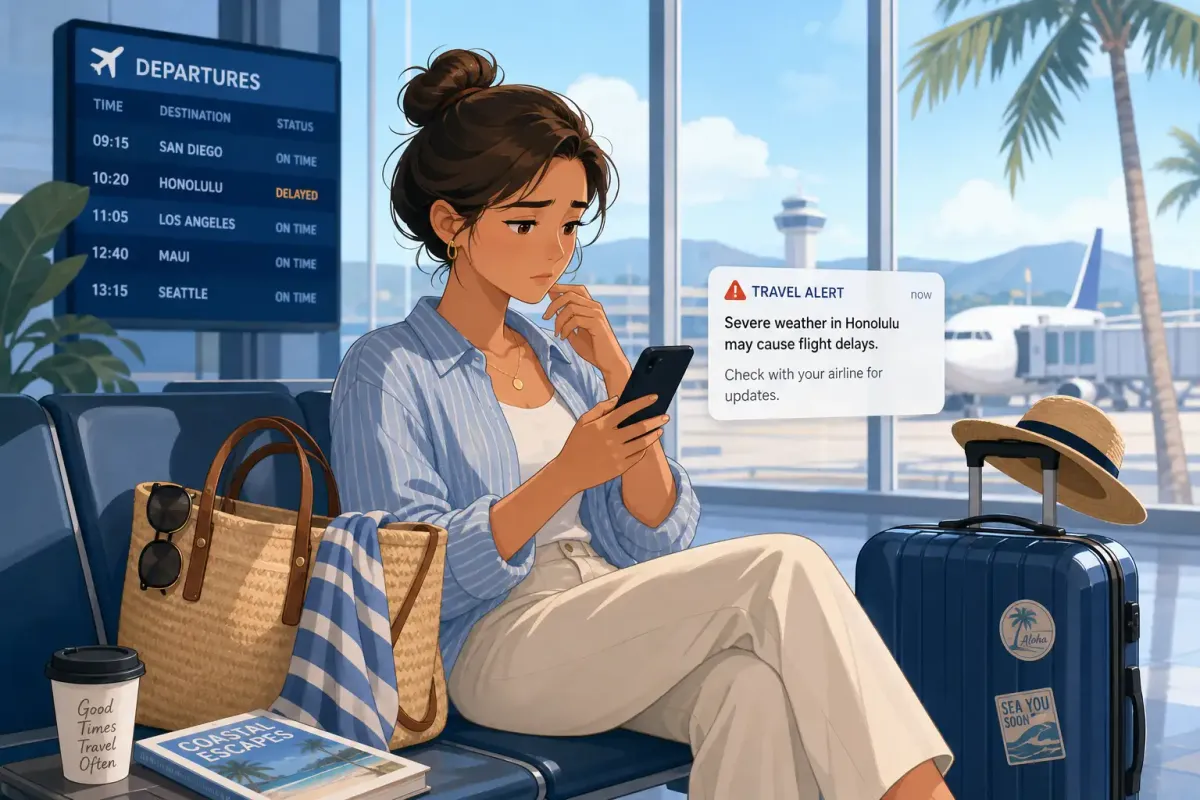
You get a text message 48 hours before your trip: “ALERT: Your flight #UA1427 has been delayed. Please confirm your reservation at [link] to rebook.” The airline name is right. The flight number might even be real. You panic-click, enter your confirmation number and credit card details on a page that looks official, and — congratulations — you just handed a scammer everything they need.
These phishing texts have become so convincing that even frequent travelers get caught. Scammers scrape publicly available flight data or use the fact that most people are flying one of three major carriers and guess right often enough to make the scam profitable. A variation involves fake toll payment texts — “You have an unpaid toll balance. Pay now to avoid late fees” — targeting travelers driving through multiple states on road trips.
The FTC advises: if you get an unsolicited text about a flight, a toll, or a reservation issue, do not click the link. Do not call the number in the text.
What to do instead: Open your airline’s app. Check your reservation there. If there’s a real delay, the app will have it. If you want to call, look up the airline’s phone number on their official website — not the one in the text. Same goes for toll texts: reach out to the state’s toll agency using contact information you find independently.
4. The ETA / ESTA Application Middleman
You’re heading to a country that requires an Electronic Travel Authorization. You search for the application, click a result that looks official, fill out the form, and pay a $79 processing fee. The problem: the real government application costs a fraction of that — or is entirely free — and you just paid a third-party middleman who added zero value.
Rossen Reports highlighted this scam as one of the worst of 2026: “Another scam targets electronic travel authorization applications. Unscrupulous third-party sites charge travelers for forms that are free or far cheaper through official government channels.” These sites often rank above the real government page in search results because they invest heavily in search engine advertising.
What to do instead: Always apply for travel authorizations through the official government website. The URL should end in .gov (U.S.), .gov.uk (UK), .gc.ca (Canada), .gov.au (Australia), or the equivalent official domain for your destination. If you see a .com site offering to process your ETA or ESTA, close the tab.
5. The “Free” Friendship Bracelet
You’re walking through a crowded plaza in Rome, Barcelona, or Paris when a friendly stranger approaches, ties a bracelet around your wrist, and says it’s a gift. The moment you smile and say thanks, the tone shifts. Now you owe them money. If you refuse, they get loud and draw a crowd, and the social pressure to pay — combined with the genuine fear of escalating a confrontation in a foreign country — causes most tourists to hand over cash.
This is one of the oldest travel scams, but it still works because it exploits psychology, not technology. The “gift” creates a sense of obligation, and the sudden aggression after makes you want the interaction to end at any cost.
What to do instead: Keep walking. Don’t slow down, don’t make eye contact. Say “no, thank you” firmly without stopping. If someone places something on you, remove it, hand it back, and keep moving. Head toward a crowded area or a shop with staff if things escalate — scammers avoid witnesses.
6. The “Closed” Attraction and the Helpful Redirect
You’re walking toward a major museum or landmark when someone — often a friendly local or someone in a uniform-like outfit — stops you and says, “Oh, it’s closed today. National holiday. But I know a great place nearby that’s even better.” They’re not being helpful. They’re redirecting you to a shop, restaurant, or tour operator that pays them a commission.
The “closed attraction” scam works because it preys on disorientation. You’re in an unfamiliar city, you don’t know the local holidays, and this person seems to know things you don’t. By the time you figure out the museum was open all along, you’ve already spent fifty euros on overpriced souvenirs at the shop they sent you to.
What to do instead: Check the attraction’s official website for hours before leaving your hotel. If someone tells you it’s closed, thank them, keep walking, and verify on your phone. It’s almost always open.
7. The Rigged Taxi Meter (or the “Broken” One)
You grab a taxi from the airport. Halfway to your hotel, the meter climbs too fast — or the driver claims it’s “broken” and offers a flat rate triple the normal fare. Variations include unnecessarily long routes, claiming your hotel “closed” to redirect you elsewhere, or swapping your large bill for a smaller one and insisting you underpaid.
What to do instead: Research the average fare before you travel. Use ride-hailing apps where available — the price locks in before you get in. If the meter is “broken,” get out and find another cab.
8. The ATM “Helper” Who Skims Your Card
You’re at an ATM having trouble with the machine. A friendly stranger appears to help — pressing buttons for you, or suggesting a different machine. While you’re distracted, they skim your card or memorize your PIN. Sometimes the “broken” ATM was rigged with a skimmer, and the “helper” was part of the setup. Fraudulent charges often appear days later.
What to do instead: Use ATMs inside banks — harder to tamper with. Cover the keypad when entering your PIN. If someone approaches while you’re at an ATM, cancel the transaction, retrieve your card, and leave.
The Five Habits That Protect You From Every Scam on This List
You don’t need to memorize every scam variation. You need default behaviors that make you a hard target. Scammers look for the path of least resistance — here are the five habits that close off those paths.
1. Book direct, always. Airline website. Hotel website. Official rental platform. If you clicked a search ad to get there, back out and navigate to the real site manually.
2. Pay with a credit card. Credit cards offer fraud protection that debit cards and peer-to-peer payment apps don’t. If a vendor insists on wire transfer, gift cards, or a payment app, walk away.
3. Verify before you react. Unsolicited text about a flight delay? Check the airline app. Email about a reservation issue? Log into your account directly — not through the link in the email.
4. Research the company plus “scam.” Before booking with an unfamiliar company, hotel, or rental host, search their name alongside “scam,” “review,” or “complaint.” If there’s a pattern, you’ll find it in thirty seconds.
5. Save analog backups. Screenshots of confirmation numbers. Downloaded offline maps. A shared document with hotel addresses and emergency contacts accessible to someone back home. When your phone dies or you’re in an airport dead zone, these get you through.
Summer 2026 travel scams aren’t sophisticated cyberattacks — they’re psychological tricks dressed up in slightly newer clothes each year. The person targeting you knows you’re tired, rushed, and operating on autopilot. Don’t give them what they’re counting on. A few seconds of verification and the habit of booking directly saves you the hours — and the stomach acid — of undoing a scam.



Discussion
Comments
Share a helpful tip, question, or takeaway from Summer 2026 Travel Scams Are Exploding — 8 Traps to Spot Before You Pay.
0 Comments
Loading comments…