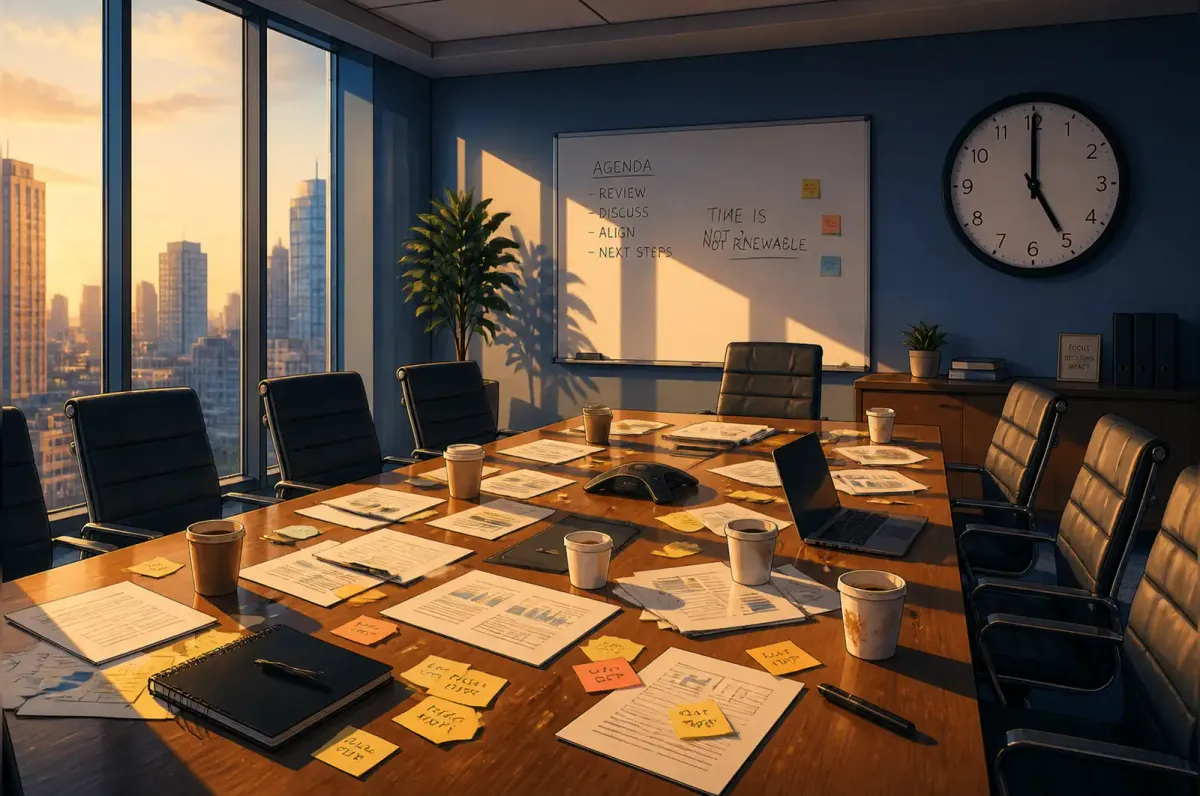
You have 25 meetings on your calendar this week. You attend all of them. You leave each one with a vague sense of having accomplished something, but when Friday arrives, the actual work you needed to finish is still sitting in the same state it was on Monday morning. So you open your laptop on Saturday morning, or maybe Sunday night, and grind through the tasks that should have been done during the week.
This is not a time management problem. It is a calendar design problem, and the data says it is getting worse every year.
The numbers are worse than you think
The average knowledge worker now spends 392 hours per year in meetings, according to Speakwise’s 2026 meeting overload report. That is ten full workweeks, gone. Not spent on projects, not spent on deep thinking, not spent on the actual work you were hired to do. Spent in virtual rooms, staring at muted faces, waiting for your turn to speak.
Microsoft’s 2024 Work Trend Index found that meeting volume has increased 252% since early 2020. The average meeting duration also crept up from 45 to 52 minutes. Remote workers attend an average of 25.6 meetings per week, compared to 14.2 for in-office workers. That is 80% more meetings, and according to Owl Labs’ 2024 State of Remote Work report, it adds up to 13% more total meeting time even though individual remote meetings tend to be shorter.
The kicker: 72% of those meetings are deemed ineffective. Unproductive meetings cost US businesses an estimated $37 billion annually, and the time wasted in pointless gatherings has doubled since 2019 to five hours per week.
Why meetings multiply on their own
Meetings do not stay at a manageable level because they reproduce. A quick sync here, a status check there, a “let’s just hop on a call” that replaces what could have been a two-sentence Slack message. Over time, what started as occasional coordination hardens into permanent structure.
Hubstaff’s 2026 Global Trends and Benchmarks Report found that employees attend about 25 meetings per month, and roughly 70% of those are recurring. The report calls this a “workday design problem, not a personal discipline issue.” You are not bad at saying no. You are operating inside a system that generates meetings faster than you can decline them.
Individual contributors average about four hours of meetings per week. Managers average nine hours, which accounts for nearly a quarter of their work time. But the damage is not just about total hours. It is about distribution. Meetings scattered across mornings, afternoons, and overlapping time zones fragment your focus time into scraps that are too short for meaningful work.
Only 39% of tracked work time qualifies as deep focus. The rest is consumed by meetings, context switching, and the recovery time your brain needs after each interruption. Research from UC Irvine found that it takes an average of 23 minutes to return to full focus after an interruption. If you have four meetings spread across a day, you might never reach deep focus at all.
The hidden cost nobody talks about
Meeting overload does not just waste the time inside the meeting. It wastes the time around it. The 15 minutes before a meeting when you cannot start anything complex because you know you will be interrupted. The 10 minutes after when you are still processing what was said. The mental energy spent context-switching between topics, the cognitive residue that sticks to your brain like lint.
Stanford’s Virtual Human Interaction Lab found that 49% of remote professionals report significant video call fatigue on a weekly basis. This is not laziness. It is genuine exhaustion from the sustained cognitive load of processing nonverbal cues through a screen while managing your own camera presence, muting and unmuting, and pretending you are not also checking your email on a second screen.
The follow-through problem compounds everything. Claryti’s 2025 internal data shows that follow-up completion rates are 34% lower for remote meetings compared to in-person meetings when no tracking system is used. So you spend the meeting, lose the focus time, and then the meeting itself accomplishes less than it would have in person. The worst of both worlds.
What actually works: 8 fixes that do not require permission from HR
Here is the encouraging part: organizations that cut their meeting load by 40% see productivity jump 71%. Not a tweak. A complete shift in how the team operates. And you do not need a company-wide policy shift to start seeing results. Here are eight changes you can make starting this week.
1. Audit your calendar before adding anything new
Before accepting a new meeting, look at your week. Count the existing meetings. If you are already above 15 for the week, every new meeting needs a strong justification. Not “it would be nice to sync” but “we need to make a decision that cannot happen async.”
Hubstaff’s data shows that the sweet spot for individual contributors is under 10 meetings per week. For managers, under 15. Beyond those thresholds, productivity drops noticeably.
2. Replace status updates with written check-ins
Status meetings are the most common type of unproductive recurring meeting. Replace them with a shared document or a Slack thread where team members post updates at a set time. The meeting that used to eat 30 minutes of everyone’s week now takes 5 minutes to read.
The POST framework helps: every meeting invitation should include a Purpose, Outcome, Structure, and Time limit. If you cannot fill in all four, the meeting probably does not need to happen.
3. Use the two-pizza rule ruthlessly
If more than six people are in a meeting, most of them are not needed. Amazon’s famous two-pizza rule exists because large meetings create social loafing, diffused responsibility, and extended discussion that could have been resolved by three people in ten minutes.
For meetings that genuinely need broader attendance, record them and let the uninvited watch later. The recording plus a written summary is almost always sufficient.
4. Block your deep work time like it is a meeting
Your calendar shows meetings as fixed commitments. Treat your focus time the same way. Block two to three hours each morning, mark them as unavailable, and defend them the way you would defend a meeting with your most important client.
The data supports morning blocks. Cognitive performance peaks in the late morning for most people, and that is exactly when most meetings pile up. Protecting that window is one of the highest-leverage changes you can make.
5. Set a default meeting length of 25 minutes, not 30
Google’s research on meeting efficiency found that shorter meetings produce the same outcomes with less fatigue. A 25-minute meeting forces tighter agendas, eliminates the “let’s use the last five minutes to catch up” drift, and gives you five minutes of buffer before your next commitment.
Calendar tools let you set default durations. Change it today. It is a five-second fix that compounds over hundreds of meetings.
6. Create a meeting-free day each week
Some teams designate Wednesdays or Fridays as meeting-free days. The research backs this up: uninterrupted blocks of four or more hours produce disproportionately high output compared to the same number of hours fragmented across the day.
If your team will not commit to a full day, start with a meeting-free morning. Even that makes a measurable difference.
7. Send an agenda or do not send the invite
No agenda, no meeting. This sounds harsh, but the alternative is spending an hour in a room with no clear purpose, which is harsher. A good agenda takes five minutes to write and saves hours of collective time.
Include the specific decisions that need to be made, not just topics to discuss. “Discuss Q3 priorities” is an agenda that produces nothing. “Decide which two of these five projects get additional headcount” is an agenda that produces a decision.
Share the agenda at least 24 hours before the meeting so attendees can prepare. When people walk in already informed, meetings run faster and produce better outcomes. If you cannot articulate what success looks like for the meeting before it starts, that is a signal the meeting itself may not be necessary.
8. Learn to decline without burning bridges
Most people accept meetings out of social pressure, not genuine necessity. A polite decline with a suggested alternative is almost always received better than you expect.
Try: “I cannot make this meeting, but I can review the notes and add my input in writing. If a live discussion is necessary, could we find a 15-minute slot later in the week?” This covers your obligation, protects your time, and gives the organizer an off-ramp that does not feel like rejection.
The meeting paradox
Here is what the data reveals when you step back: the organizations with the fewest meetings tend to be the most productive. Not because they collaborate less, but because they collaborate better. They reserve live meetings for the things that genuinely require real-time human interaction, and they handle everything else through documents, async video, and written communication.
The 252% increase in meeting volume since 2020 did not make us more connected. It made us more exhausted. The 49% of remote workers reporting weekly video fatigue are not people who hate their jobs. They are people whose cognitive capacity is being consumed by a communication format that works worse than the alternatives for most work conversations.
Reclaiming your focus is not about being antisocial or uncooperative. It is about recognizing that your most valuable work happens between meetings, not inside them. Every meeting you eliminate or shorten is an investment in the quality of the work that follows.
Start with this week. Pick one recurring meeting that could be an email, and suggest converting it. Block two hours tomorrow morning. Set your default meeting length to 25 minutes. The data says you will get more done, feel less exhausted, and probably enjoy your job more. Seventy percent of employees in Pumble’s 2026 survey said their job satisfaction would improve with fewer meetings. That is not a niche opinion. It is the majority experience.
Your calendar is a choice. Make a different one.



Discussion
Comments
Share a helpful tip, question, or takeaway from Your Calendar Is a Graveyard of Focus Time: 8 Ways to Kill Meeting Overload.
0 Comments
Loading comments…