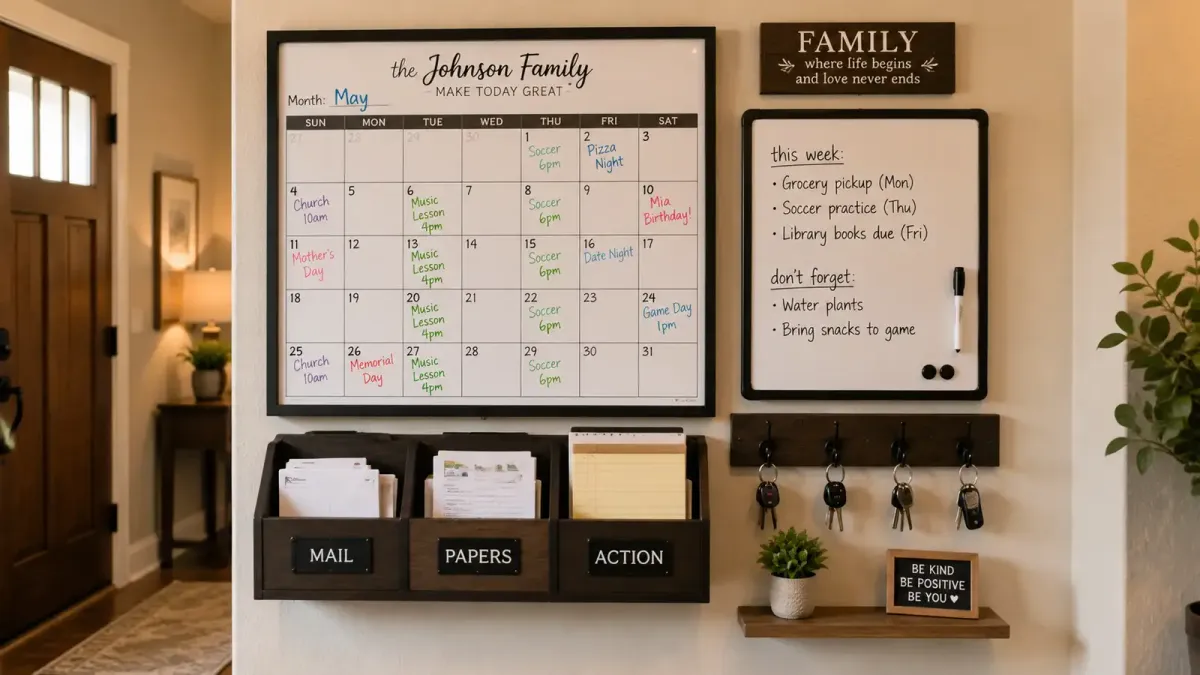
The phrase “family command center” conjures images of Pinterest-perfect walls with color-coded calendars, labeled bins, and motivational quotes in elegant script. That vision lasts about three days before someone writes a dentist appointment in purple marker that bleeds through to next month, the mail pile returns, and the whole thing becomes another source of guilt.
A command center that works isn’t pretty. It’s functional. It solves exactly four problems: where everyone needs to be and when, what needs to get done, what papers need attention, and what can’t be forgotten.
Pick Your Location
The wall next to the door you use most often — not the front door guests use, the door your family actually walks through. For most people, that’s the garage entry, mudroom, or kitchen wall near the back door. If you put it in a hallway nobody walks through or your home office, it won’t be used.
The space doesn’t need to be big. A 3-foot by 4-foot stretch of wall is plenty. Eye level for the shortest person who needs to use it regularly — kids can’t reference a calendar they can’t see.
The Four Essential Zones
Zone one: The calendar. One calendar. Not one for each family member. A single monthly paper calendar big enough to write multiple entries per day, with each person’s activities in a different color. Dry-erase calendars are fine if someone is committed to updating them. Paper calendars in a clear plastic sleeve, marked with wet-erase markers, combine the best of both — you can wipe and rewrite, but a sleeve protects against smudges from sleeves and passing shoulders.
Zone two: The action station. This is where mail, permission slips, invitations, and anything that requires a response goes. It needs three simple slots or bins labeled “To Do,” “To File,” and “To Pay.” The “To Do” bin gets processed weekly — Sunday evening works for most families. The “To Pay” bin holds bills until bill-pay day. “To File” is for things you need to keep but don’t need to act on, and it should be emptied into a filing cabinet once a month.
Zone three: The essentials board. A small whiteboard or corkboard for the things that change weekly: the meal plan for the week, a running shopping list, a note about who’s picking up whom. This is the scratch paper of the command center, and it should look like it — messy, updated constantly, covered in shorthand only your family understands.
Zone four: The out-the-door checklist. A small laminated card near the doorknob with five bullets: Phone, wallet, keys, lunch, backpack/bag. This sounds like overkill until you’ve driven back home three times in one week to retrieve a forgotten item. The checklist eliminates the morning scramble.
What Should Not Be on the Command Center
Invitations from three months ago. Coupons you’ll never use. Photos of the dog. The command center is not a bulletin board for things you don’t want to throw away. It’s an operational tool. Anything that isn’t currently useful gets removed. Sunday evening is a good time for a five-minute reset: update the calendar, clear expired items, file what needs filing.
Digital vs. Paper
Shared digital calendars are great for events that happen far in the future — the school concert in two months, the dentist appointment you booked six weeks out. But for the daily and weekly view, paper still wins. A wall calendar is visible to everyone in the household without anyone needing to open an app, and you can’t mute its notifications.
Use both. Put everything in the shared digital calendar and transfer the month’s highlights to the paper version on the first of each month. The paper calendar is the public interface. The digital calendar is the database.
The Maintenance Habit
A command center fails when updating it feels like a chore. The fix is to build updating into an existing routine. Every Sunday evening, when someone is already in the kitchen making lunches or cleaning up after dinner, take 30 seconds to update the calendar and clear the action station. It takes less time than scrolling through Instagram, and it prevents the Monday morning chaos of trying to remember whether today is the field trip or the early dismissal.
The goal is not an Instagram-worthy wall. It’s a family that knows where everyone is supposed to be without a group text thread at 7:30 a.m.


Discussion
Comments
Share a helpful tip, question, or takeaway from How to Set Up a Family Command Center That Actually Keeps Everyone Organized.
0 Comments
Loading comments…