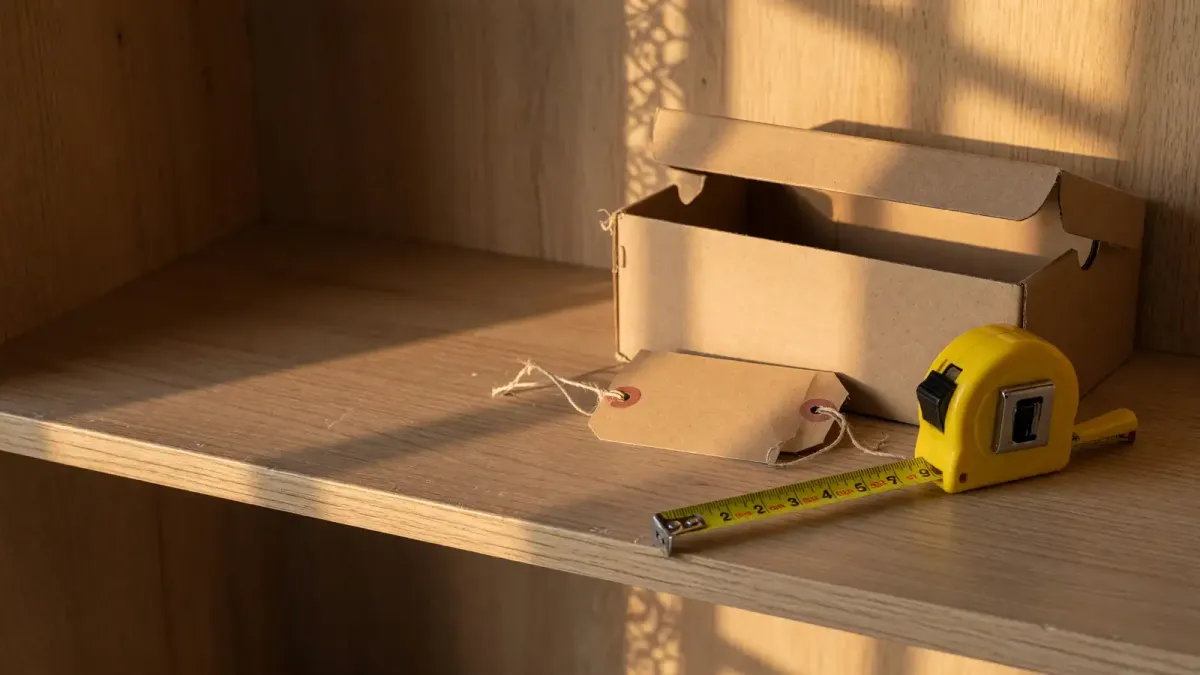
The closet percent and the decade percent are not the same bill. Betty Lin-Fisher’s USA Today story on October 19 says the median cost of a home improvement project rose 76.1% from 2015 to 2025, from $1,200 to an inflation-adjusted $2,113, in a LendingTree analysis. A paid release dated October 15, placed on the Des Moines Register, says a closet renovation can recover 83% of its project cost at resale. One number is a rise in what projects cost. The other is an estimate of what a closet job might return if you sell. Writing both on the same sticky note does not make a budget.
We already measured a laundry gap that was 8 inches against a hamper that was 7.5, in the laundry-closet note. We already treated a pantry recall as a lot code, not a reason to empty the jar, in that recall note. We already had self-storage occupancy as a different room from the spare room, in the 92% note. This week is three more nouns that share the word storage and do not share a unit.
76.1% is a median, and it is already adjusted
USA Today’s figure comes from LendingTree, which analyzed U.S. Census Bureau American Housing Survey data and Bureau of Labor Statistics data. The sentence is specific. The median cost of a home improvement project rose 76.1% from 2015 to 2025. The endpoints are $1,200 and an inflation-adjusted $2,113. “Inflation-adjusted” is doing work. The $2,113 is not a raw receipt from 2025 sitting next to a raw receipt from 2015. LendingTree already moved the older dollar. If you inflate it again in your head, you have counted the decade twice.
A median is the project in the middle of a ranked list. It is not the average of every kitchen and every closet. It is not your quote. Matt Schulz, LendingTree’s chief consumer finance analyst, told USA Today that home improvement costs are increasing in part because the price of most anything is going up, and that the cost of labor and building is likely playing a big role. “Likely” is his hedge. The 76.1% is the analysis. The labor sentence is a reason he offers, not a split of the 76.1% into lumber versus wages.
The same story prints a maintenance average that is not the median project. Routine maintenance on owner-occupied homes is an estimated $1,433 a year on average. Homes built before 1940 rise to $1,706 a year. Homes built from 2022 to 2023 cost $173 on average to maintain. USA Today also says new properties are the cheapest to maintain, with costs falling to three figures for homes built in 2015 and later. The $173 is the 2022-2023 slice. “Three figures” is the wider new-home claim. I am not going to average $1,433 and $173 and call the result a typical year. They are different houses.
If the closet you are sorting is in a pre-1940 house, the maintenance line that matches the age is $1,706 a year, and that line is maintenance, not a closet renovation. If the house is from 2023, the $173 is still maintenance. Neither number is the $2,113 median project. A reader who writes “$2,113 a year” has changed a project median into an annual bill. USA Today did not print that sentence.
83% is a resale estimate, and the page is paid
The October 15 release is not a USA Today staff story. The page says members of the editorial and news staff of the USA TODAY Network were not involved, and that the placement is part of a paid service. The distributor is EIN Presswire. The company speaking is Strickland’s Home, in Wilmington, North Carolina, talking about coastal Carolina homeowners. The 83% is not a measurement those homeowners just received.
The release says a February 2026 National Association of Realtors article recaps the 2025 NAR/NARI Remodeling Impact Report, including an estimate that a closet renovation can recover 83% of its project cost at resale. The estimate, it says, was reported by National Association of the Remodeling Industry members, and closet renovation ranked among the higher projects for estimated cost recovery in that study. “Can recover” is an estimate. “At resale” is a sale. “Reported by NARI members” is who supplied the estimate to the study the February article recapped. The October 15 page is a third telling. I did not open the February NAR article or the 2025 report this morning. I am not going to pretend the 83% got a new survey because a contractor’s release reprinted it.
Cost recovery is not a discount, and it is not a promise you get 83 cents back on the dollar in cash. It is an estimate of how much of the project cost shows up in a sale price, in the study’s method. If you are not selling, the 83% does not pay the invoice. The release itself says as much, in a different sentence: the report highlights a consideration for homeowners who are not planning an immediate move. That sentence is the useful one if the closet is a weekly problem and the house is not listed.
Fred Kumpel, owner of Strickland’s Home, is quoted on storage affecting how a home works every day, and on not simply adding shelves. That is a company quote on a paid page. It is not a finding from the 28% line that sits near it.
Two 64% lines, and neither is a closet
The paid release says 28% of homeowners identified improved functionality and livability as the most important outcome of a remodeling project. After remodeling, 64% said they had a greater desire to be in their homes, and 46% reported increased enjoyment of their living spaces. Those three percents are attitudes after a project, in the research the release is summarizing. They are not cost recovery. A closet that makes you want to be home is not an 83% return. The release prints both, in neighboring paragraphs, which is how they get stapled.
USA Today has its own 64%, and it is a headcount of who did the work. Sixty-four percent of the projects analyzed were completed by a professional. The median professional project cost an estimated $4,103. DIY projects had a median of $845. Same digits as the desire-to-be-home line. Different noun. A recap that says “64% of closet projects are professional and make you like the house more” has merged a paid release’s post-remodel feeling with LendingTree’s share of jobs done by a pro. Neither page said that sentence.
The professional median and the DIY median are also not a recommendation. $4,103 against $845 is a four-to-one-ish gap in the medians LendingTree estimated. I am not dividing them into a clean multiple and telling you to hire or not hire. A professional median can be higher because the jobs in that pile are larger, not only because the labor rate is higher. Schulz’s labor comment does not split the $4,103. The page does not say what share of the professional median is the closet, the roof, or the water heater.
$845 shows up twice, and 11.7% is appliances
The most common single project category in the USA Today account is not a closet. It is a combined group covering water heaters, dishwashers, and garbage disposals. Homeowners added or replaced appliances in 11.7% of all projects tracked. The median cost of that category was $845. That is the same integer as the DIY median. It is not the same pile. One $845 is what DIY projects cost in the middle of the DIY list. The other $845 is the median of an appliance category that can include professional jobs. If your notes say “the typical cheap project is $845, and that means a closet organizer,” you have moved an appliance median onto a shelf.
Nearly 6 in 10 owner-occupied homes had some improvement in the two-year window LendingTree used. The counts are 51.6 million of 86.9 million owner-occupied properties. There were 139.9 million individual projects, or an average of 2.7 projects per improved home. “Nearly 6 in 10” is USA Today’s rounding of 51.6 divided by 86.9. I am not going to reprint it as 60%. 2.7 is an average across improved homes, not a count of closet projects, and it is not a median. A house with one project and a house with six both sit inside that average.
Schulz said it does not surprise him that maintenance and repairs account for the biggest projects. The most common category in the same story is the appliance group, at 11.7%. “Biggest” and “most common” are different rankings. A water heater can be common and still not be the largest dollar project in the set. I am not going to treat his surprise as a second table.
IKEA’s hundreds are 144, and the $200 is a mattress
IKEA Australia’s newsroom post, dated 13 October 2026, is a price cut, not a recovery rate. The dek says a $26 million investment reduces prices on hundreds of products, with savings of up to $200 on some of Australia’s most popular home furnishings. The body says the first wave delivers lower prices on 144 products. Hundreds is the dek. 144 is the first wave. 144 is not a number you round up to hundreds without changing the claim. If a later wave exists, this page does not give its count.
The dollars that are actually printed are a queen mattress, now $200 cheaper, and a popular three-seat sofa, down by $150. “Up to $200” in the dek matches the mattress cut, not a range I can see itemized. Everyday products including hangers, baskets, and kitchen essentials have also been reduced. Wardrobes are in the headline and in the category list. I do not have a wardrobe dollar cut in the prose. A closet plan that subtracts $200 from an IKEA wardrobe because the mattress line said $200 has used the wrong product.
The $26 million is IKEA Australia’s investment figure for the push. It is not a per-household savings number, and it is not U.S. dollars sitting next to LendingTree’s $2,113. Artsiom Tsalko, IKEA Australia’s country growth and marketing manager, is quoted on Australians looking for ways to make their money go further when furnishing. That is the company’s frame. The page also mentions interest rates rising. I am not using that sentence as a rate, because no rate is printed.
The same page’s image captions name dimensions that the price paragraphs do not. SMÅGÖRA is captioned as a wardrobe, white, 80x50x187 cm. SUNDVIK is captioned as a wardrobe, 80x50x172, white. Those are centimeters on a product photo, not a statement that either wardrobe is in the 144. SKUBB is a hanging shoe organiser with 16 pockets. TRONES is a shoe cabinet, 52x18x39, black, sold as a 2 pack in the caption. RISATORP is a basket, 25x26x18. PURRPINGLA is a box set of 3, 20x38x12. If you are measuring a closet, those captions are a measuring list only if you are buying those SKUs. They are not the 83%, and they are not the 76.1%.
A wardrobe that is 80 cm wide is about 31.5 inches. I converted that so it can sit next to a tape in inches. IKEA did not print 31.5. The laundry note on this site already had an 8-inch gap against a 7.5-inch hamper. The same habit applies here: write the unit the page used, then convert beside it, and do not replace the caption with the conversion.
A self-storage loan is a third storage
Inside Self-Storage’s October 14 development roundup uses “storage” for buildings, not closets. Urban Street Development is building Tarpon River Self Storage on a 1.8-acre site in Fort Lauderdale, a five-story building at 201 S.W. 14th St. with 97,862 square feet and 1,070 climate-controlled units. The construction loan is $20 million, arranged by JLL. Extra Space opened a three-story facility at 290 Shrewsbury St. in Boylston, Massachusetts, 103,050 square feet and 797 units, on 6 acres. The company owns or operates 4,410 facilities. A Monroe, Connecticut project at 205 Monroe Turnpike has 99,600 square feet and 679 units.
97,862 and 103,050 and 99,600 are building sizes. They are not closet capacities. $20 million is a construction loan for one Florida project. It is not a household closet budget, and it does not revise the 83% or the $2,113. I am including it because a week of “storage” headlines will put a climate-controlled unit count next to a shoe organiser if you let it. The unit counts do not even match each other: 1,070, 797, and 679, in buildings of similar square footage. Square feet per unit is a division I could do. I am not going to print it as if the developers published a density. They published square feet and unit counts separately.
What to write on the closet label
If the job is organizing what you already own, none of these pages priced the bins. The IKEA captions that include a basket and a three-box set do not include the new price. The USA Today medians are project costs, mostly not shelves. The 83% is a resale estimate from a 2025 report, reprinted on a paid page on October 15. The number that belongs on a label for a sort-and-shelf afternoon is the measurement of the opening, in the unit you will shop in, next to the product caption’s unit. The number that does not belong on that label is 83, or 76.1, unless you are also writing what each percent was counting.
If the job is a renovation quote, the week still does not give you a closet price. It gives you a national median project of $2,113 after LendingTree’s inflation adjustment, a professional median of $4,103, a DIY median of $845, and an older recovery estimate of 83% that assumes a sale. A quote that comes back near one of those medians has not been validated by them. A quote that you reduce by 83% because a release said recovery has subtracted a resale estimate from a bill. Those are different sides of a sale.
The practical split is small enough to do on paper. Write the source, the year the underlying study used, and the unit. 76.1% is 2015 to 2025, median project cost, inflation-adjusted, LendingTree via USA Today on October 19. 83% is estimated cost recovery at resale for a closet renovation, from a 2025 NAR/NARI report as recapped in a February 2026 NAR article, as reprinted in a paid release on October 15. $200 is a queen mattress in Australia on October 13, not a wardrobe. 144 is the first wave, not the word hundreds. If a later page prints a U.S. closet price for this week, it was not one of these four.
Discussion
Comments
Share a helpful tip, question, or takeaway from Closet Recovery Is 83%. The Decade Jump Is 76.1%..
0 Comments
Loading comments…