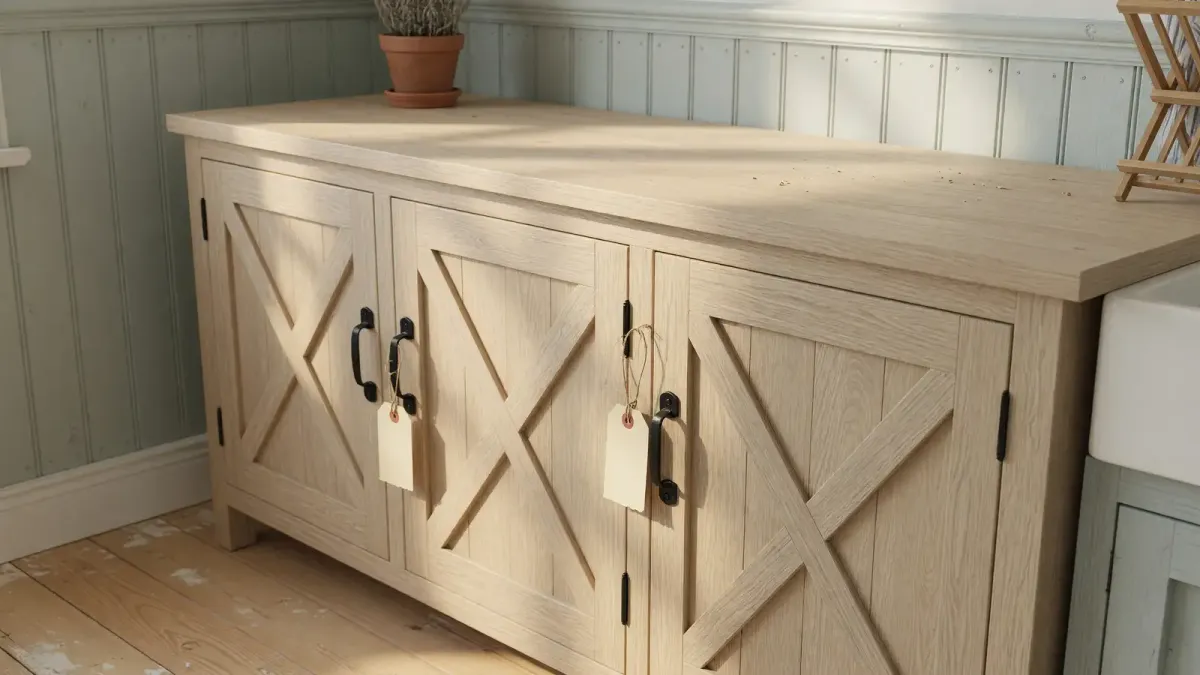
The capacity in the headline is not the capacity in the paragraph under it. Yahoo’s syndication of a TheStreet deals note, originally published October 20, 2026, headlines a farmhouse storage cabinet that “holds up to 300 pounds” and is “on sale for $130.” The body of that same page prices a Vasagle Farmhouse Storage Cabinet and Buffet at $130, down from $144, and never writes 300 pounds next to it. The only 300-pound sentence I could find is a related link to a different cabinet, a Walmart buffet.
If you are buying a sideboard to take the overflow off a closet floor, the number that matters is the one attached to the unit you will assemble. A related-link capacity is a different piece of furniture. The Way Day banner and the bin underneath it were already a different pair of numbers. This is the same kind of label problem, on a product page rather than a sale banner.
The storage cabinet headline is not in the body
The Yahoo title is specific. It names a weight, a retailer, and a sale price. The article under that title, credited to Adam Reeder and marked as first appearing in TheStreet’s Deals section on October 20, describes the Vasagle cabinet in dimensions, materials, and shelf layout. It calls the weight capacity “relatively high.” It does not repeat 300. It does not say 250. It does not say the countertop rating and the shelf rating are the same thing.
“Relatively high” is not a specification. A closet bin that is relatively high compared with a shoebox is not a cabinet that is relatively high compared with a dresser. The phrase tells you the writer thought the cabinet was sturdy. It does not tell you what the manufacturer printed on the carton. I am not going to fill that blank with the headline, because the headline and the body are not doing the same job. The headline is a shopping hook. The body is the description. When they disagree, the description is what you can check against a listing. The hook is what got you to click.
The related line is the one that actually contains the integer. It reads, in the roundup: Walmart’s $230 9-compartment buffet cabinet with a 300-pound capacity is 57% off. That sentence has a price, a compartment count, a capacity, and a percent. It also has a different product name and a different store. The link target is a Noelse buffet page on TheStreet, not the Vasagle Amazon URL used everywhere else in the article. Nine compartments is not two pairs of doors. $230 is not $130. Walmart is not Amazon. If you copy “300 pounds” into a note titled Vasagle, you have copied the neighbor.
I did not open the Amazon listing. The roundup’s own Amazon URL includes the ASIN B0D3XKB9VK and the model string ULSC381W01. Those identifiers are in the link. They are not a weight rating. A shopper who wants the carton rating should open that listing, or the paper that ships in the box, and read the line that says pounds. Until that line is in front of you, the honest entry on the shopping list is “capacity not stated in the roundup body,” not “300.”
$130, $144, and “less than $150” are three prices
The body is clearer about money than about weight, and even the money is three strings.
The subhead says $130, was $144. A later sentence says the cabinet is for less than $150. The close says “at just $130.” Less than $150 is true of $130. It is also true of $144. It is true of $149. It is not a price. It is a ceiling the writer used before the subhead got specific. If a notes app has one cell, the cell should be $130, with $144 in the was column, and “less than $150” should not be a third column pretending to be a third offer.
The discount is arithmetic, and it is mine, not a percent the page printed. $144 minus $130 is $14. Fourteen divided by 144 is about 9.72 percent. I am not going to call that 10 percent off unless I also say I rounded. The page did not print 10 percent, and it did not print 9.72. It printed the two dollar figures. A roundup that says “half off” or “57% off” on a different product is using a different scale. Do not borrow the 57 from the Walmart related link and paste it onto the Vasagle row. Fifty-seven percent off $144 would be a different sale. This page did not claim that sale.
The other prices on the same page are small enough to mis-sort if you are skimming. Chefstory airtight food containers are $21, was $22. That is a dollar. Yizosh kitchen pantry storage is $110, with no was-price in the line I kept. Ristern metal storage cabinet is $70, was $80. Ten dollars on an $80 list is 12.5 percent, again my division, not a printed percent. None of those three is the Vasagle. None of them is the Walmart buffet. A “shop more deals” block is a list of other SKUs. It is not a spec sheet for the cabinet in the headline.
If you are comparing the Vasagle to something already in the room, compare it to a cabinet you have measured, not to the $21 container set. The container set does not tell you whether the sideboard fits the wall.
Five sizes, one sticker
The page says the model is available in five sizes and configurations and three color variants. The $130 and the $144 are printed once. The headline’s 300 pounds is printed once, and not in the body. A five-size family does not get one capacity by being called one model.
I do not have a table that maps each size to a price and a weight. The roundup does not provide one. “With the currently low price, you may want to consider buying one for multiple rooms” assumes the price you just read applies to the configuration you are about to click. It may. It may be the price of the size in the photo. A longer top, a taller case, or a version with more shelves can carry a different carton weight and a different load rating even when the product title stays Vasagle farmhouse. If the listing dropdown changes the price when you change the size, the $130 in the article was a snapshot of one option on October 20, not a promise about the other four.
Color is the easier split. Three colors should not change the load rating if the materials are the same. Size can. Configuration can, if one configuration is a sideboard and another is a taller hutch sold under the same family name. The page says “sizes and configurations,” which is two variables, not one. I am not going to guess which of the five the photo shows. I am going to say that a single sticker cannot be copied onto all five until the listing says the rating is shared.
The buyer quote does not resolve it. One shopper called the cabinet outstanding, a great piece of furniture, very easy to put together, and said it looks great. That is one person, on one unit, with no size named in the sentence the roundup kept. Easy assembly is useful. It is not a load test. Looks great is not 300 pounds.
Nearly 5 feet by 2.6 feet is the only dimension
The dimension sentence is the most usable line in the body, and it is still approximate. The cabinet is “nearly 5 feet long and 2.6 feet high.” Nearly 5 feet is not 5 feet. I can convert 5 feet to 60 inches, and 2.6 feet to 31.2 inches, and both conversions are exact arithmetic on the numbers as written. The word “nearly” means the length is a bit under 60 inches, and the page does not say by how much. A wall that has 60 inches of clear space may still be short if the “nearly” was 59 and the baseboard eats an inch, or it may be fine. Measure the wall. Do not measure the adjective.
Depth is absent. A sideboard that is 60 inches wide and 31 inches high can be 14 inches deep or 20 inches deep, and those are different objects in a galley kitchen. The page does not give depth. It says the piece fits comfortably in almost any kitchen, living room, or bedroom because it is moderately sized. “Almost any” and “moderately” are the same kind of word as “relatively high.” They are not a floor plan.
What the page does specify about the inside is more useful than the comfort claim. Two sets of double farmhouse doors. Behind them, two full-sized shelves. One shelf on each side is adjustable and fully removable. That is a layout: two bays, a shelf in each, one of them able to come out. It is not nine compartments. If you were picturing the related Walmart buffet’s nine compartments, you were picturing the other product. This one is a pair of cupboards.
The materials line has a tension worth keeping, not smoothing over. The cabinet is “relatively lightweight” and also has a “relatively high weight capacity.” Lightweight is about what you carry up the stairs. Capacity is about what you put on the shelves after it is on the wall. Both can be true. A hollow-core case can be light in your hands and still have a posted shelf rating, or it can be light because it should not be loaded like a workbench. The page does not pick. It also says the piece is waterproof, made primarily from engineered wood, with an MDF countertop that cleans with soap and water. Engineered wood and MDF are not the same sentence as a waterproof outdoor bin. “Waterproof” here is the writer’s word for a wipeable top, sitting next to a cleaning instruction that is soap and water. I would not put a wet mop bucket inside it on the strength of that adjective. Wipe the top. Do not hose the carcass.
Cable holes and a wall-mounting kit are the two functional extras. The holes are so you can use it as an entertainment center. The kit is so you can attach it to a wall and prevent tipping. Those are different jobs. A TV on the top changes the load on the case even if you never fill the shelves. The tipping kit is the line I would not skip, especially if the cabinet is “relatively lightweight” and the top is nearly five feet long. A long, light case with a television on it is a lever. The page includes the kit. Use it. The kit does not raise the shelf rating to 300 pounds. It keeps the case from walking off the wall when something heavy goes on the top.
Assembly includes tools and instructions, according to the page. That is a convenience claim. It does not list the fastener count or the time. The buyer who found it easy is one data point. If you are fitting this into a Saturday with the closet project, budget more than the adjective.
The related cabinet is a different object
Put the two products in separate rows. They were already separate on the page. They get merged only if you read the headline and the related link as one thought.
| What the page says | Vasagle row | Walmart related link |
|---|---|---|
| Store | Amazon, in the body | Walmart, in the related line |
| Price printed | $130, was $144 | $230, and “57% off,” with no crossed-out price in that line |
| Capacity | ”relatively high,” no integer in the body | 300 pounds, in that related line |
| Layout | two door pairs, two shelves | 9 compartments |
| Identifier | ASIN B0D3XKB9VK, ULSC381W01 in the URL | a different TheStreet deals URL |
The 57 percent is attached to the Walmart sentence, not to the Vasagle. I am not subtracting 57 percent from $230 and calling the result the sale price. The sentence does not show the before-and-after pair. “$230” might be the list, the sale, or a rounded sticker. The Vasagle pair is explicit: $144 then $130. The Walmart pair is a price and a percent in one clause, which is not enough to reconstruct a checkout. Leave it as printed.
Nine compartments versus two shelves is the layout check you can do without a tape measure on the Walmart unit. If the photo in the Yahoo article shows two pairs of doors, it is not showing nine compartments. If a different photo shows a grid of cubbies, you have left the Vasagle page. A pantry recall that was a lot code, not the jar still on the shelf, was a reminder that the label and the object in the room are allowed to be different things. The 300-pound label and the Vasagle doors are allowed to be different things too.
The roundup also says there is plenty of variety and that you may want one for multiple rooms. That is a sales suggestion. It is reasonable only after the size you clicked still costs $130 and still fits the wall you measured. Buying two because the article was enthusiastic doubles a snapshot. It does not double a verified rating.
What to write on the list before you order
Measure the wall in inches, including the baseboard and anything that sticks out beside the spot. The page’s length is nearly 60 inches, not a guarantee of 60, and the depth was never stated. If the opening is under 60 inches, do not trust “nearly.”
Open the listing that matches B0D3XKB9VK, or whatever ASIN the current page shows, and read the size you are actually buying. Write that size’s price next to $130 and see if they still match. Write that size’s weight rating in pounds. If the listing says 300, you have a source the roundup body did not give you, and you can use it. If the listing says something else, the headline was the related cabinet’s number, and you already knew to suspect that.
Check the wall anchor. The page includes a kit. A long top with a television, or with a row of pantry bins, needs the anchor even if the shelves feel empty. The laundry gap that was 8 inches, not the hamper, was a reminder that the object and the clearance are different measurements. The cabinet height of 2.6 feet is not the clearance above it.
Ignore “less than $150” once you have $130 and $144. Ignore 57 percent unless you are on the Walmart buffet page and that page shows both prices. Ignore 300 pounds until it is printed on the unit you are buying. The headline borrowed it. The body did not earn it.


Discussion
Comments
Share a helpful tip, question, or takeaway from The 300 Pounds Belong to the Other Cabinet..
0 Comments
Loading comments…