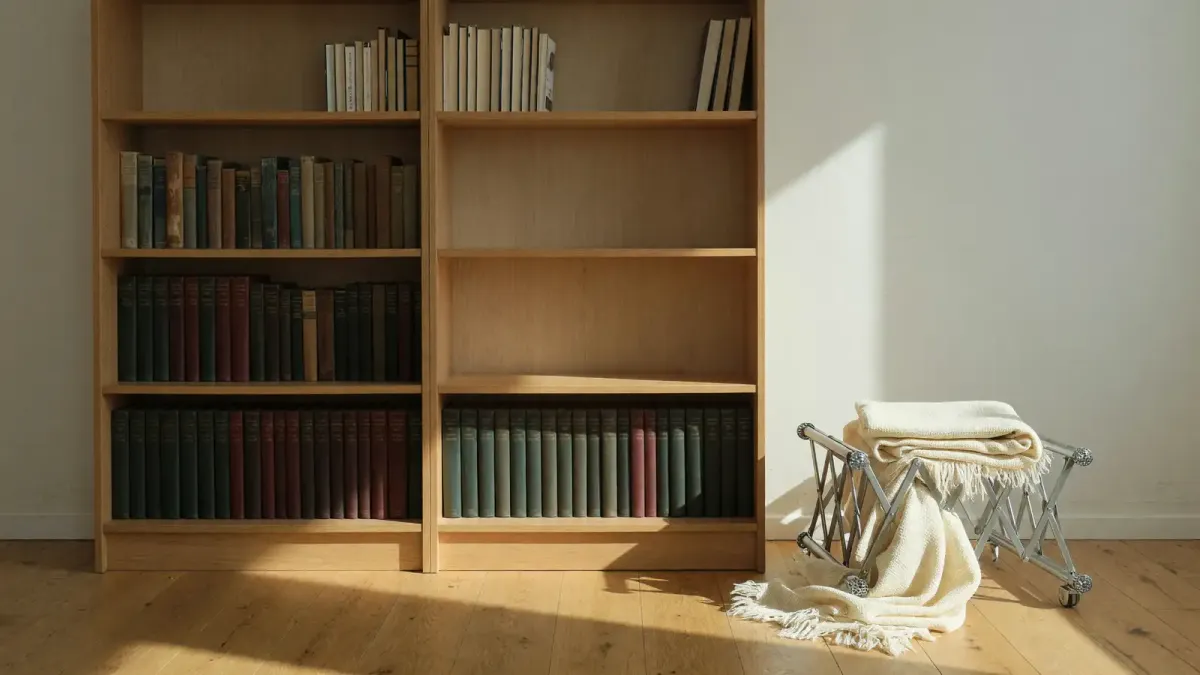
The useful home organization advice this week is not a new bin. Apartment Therapy on Sept. 26 asked organizers what actually keeps a house from filling back up. A Sept. 27 follow-up puts a named organizer on a built-in bookshelf that had already survived the usual styling tricks. The same weekend’s blanket piece spends $7.99 on a pot-lid rack and uses it somewhere the package never mentions. I am treating those three as one argument: stop buying organizers until you know which empty space you are protecting.
We already wrote the under-bed problem in the ten ways to use that space without turning the room into a storage unit. We wrote the cheap list professional organizers actually recommend and the three hidden zones people skip. This is the shelf you can see, the drawer you keep “for someday,” and one kitchen tool doing a living-room job. It is not another closet reboot.
Breathing room is the home organization rule both pieces share
Paul Tis, president of Junk King, tells the Sept. 26 piece that the thing he notices in every well-organized home is breathing room. He does not mean a styled gap for a photograph. He means a shelf, a drawer, or a surface that is not filled just because the space exists. Everyday items have to move in and out without creating a new pile. His shortest version of the fix is also the least fun: have less stuff in the first place.
Jessica Litman of The Organized Mama lands on the same rule from the other direction, four days later, standing in front of a bookshelf. Her fourth tip is white space. Leaving gaps is how you see what you put up. If an object disappears at the back of the shelf, the shelf is already too full, even if it looks “styled.” She also tells the writer to vary how books are stacked so the whole run does not read as one packed block.
I would not treat those two quotes as a design trend. Tis is in junk removal. Litman is in organizing. They are describing the same failure mode: a surface that has no slack. Once there is no slack, the next incoming object starts a pile, and the pile is what people then try to solve with a bin. The bin does not restore the slack. It hides the pile one shelf lower.
If you only steal one move from the overlap, pick one shelf you walk past every day and take enough off it that you can see the back. Do not replace what you removed with a smaller version of the same clutter. The test is whether tomorrow’s mail, or tomorrow’s library book, has a place to land without starting a stack.
The maybe pile needs a date, not a basement
Tis has a second line that is more useful than the breathing-room slogan, because it names the excuse. “I might need this someday” sounds practical until you apply it to every room. That is how closets, basements, and garages stop functioning. His replacement question is whether you actually use the thing, and whether it is worth the space it takes. A maybe pile with no limit is a decision you keep postponing.
The piece gives the postponement a deadline if you cannot make the cut today. Put the undecided objects in a box. Come back in 30 days. Did you need it? Did you miss it? If both answers are no, it goes. That is a smaller ask than a whole-house purge, and it is more honest than a “donate later” bag that lives in the hall for a season.
The exceptions are named, and they are narrow. Holiday decorations, the off-season wardrobe, and diplomas will not be missed in four weeks, and they are not maybe-items. They are known seasonal or keepsake objects. Adam Kutner, vice president of marketing at Storage King USA, puts those in a separate place on purpose: a designated bin in the garage, a closet, the attic, or under the bed. The point of that bin is to keep the daily rooms from holding objects you will not reach for this month. It is not a second maybe pile with a lid.
That distinction matters if you already followed our under-bed guide. Under-bed space is for things you have decided to keep and do not need this week. It is a bad place for the pie crimper you might use and the snowshoes you might wear. Those belong in the 30-day box, where forgetting them is the test. If you park them under the bed, you have given the maybe a permanent address, which is the outcome Tis is warning about.
Start with one drawer, then copy the rule
Nilgun Yigit, owner of Up Closets of Connecticut, tells the same Sept. 26 piece not to buy the organizers first. Start with a pantry or a kitchen junk drawer. The small project is how you find out what “findable” means in your house. Her questions are specific: is it easiest to find things by size, by use, by color, or by season? Once you can answer that for one drawer, take the same answer into the bigger rooms. Do not invent a new system for the closet just because the closet is more intimidating.
Wendy Trunz, partner and head organizer at Jane’s Addiction Organization, is blunter about products. Bins and baskets do not solve a storage problem by being cute, or viral, or even well designed. A system has to match the objects you actually own, the way you want to find them, how easy it is to put them back, and how the rest of the household uses the room. Her own example is a shoe bench that fails because she is the only person who puts shoes in it. The bench is fine. The household did not agree to the bench.
I keep coming back to that shoe bench because it is the failure mode of most organizer shopping. You can buy the right object and still lose, if the other people in the house have a different habit. Yigit’s junk-drawer test is a way to find the habit before you spend. If the drawer only stays sorted when you are the one closing it, the closet version of that system will fail the same way, at a higher price.
Trunz also gives the kitchen a daily reset that is almost too plain to count as organizing advice, which is why it is worth keeping. She wants the counters and the sink clear of dishes at night. In the morning, before anyone leaves, empty the dishwasher so it can take the day’s dirty dishes. She compares the sink area to a made bed: the room looks finished, and the next mess has a place to go. She is not asking for a new caddy. She is asking for the machine you already own to be empty when the day starts. If the kitchen backs up, she says, it overwhelms everybody, because the kitchen is the hub. That matches the houses I walk into. The junk drawer can be a disaster and the house still feels fine. A sink full of last night’s pans makes every other room feel behind.
Litman’s bookshelf is four steps, in that order
The Sept. 27 piece is a before-and-after, and the before is familiar. The writer wanted a tall bookshelf with a rolling ladder, got it, and froze. Grouping objects in threes did not fix it. Stacking books horizontally did not fix it. A half-empty shelf and a box of photo frames on the floor is where Litman starts. The frames on the floor are the tell. The shelf was not actually organized. It was paused.
Step one is to pull everything off and group like with like. Litman’s categories are collections, types of books, colors, or whatever matches the objects. The writer paired silver frames with a matching candlestick and sorted books loosely by topic. The point of the piles is that you can finally see the inventory. You cannot decide what stays on the shelf while the objects are still mixed together.
Step two is books by function, not by color, unless color is genuinely how you search. Litman wants kids’ books on lower shelves so a child can grab them. Fiction can be grouped by genre. A separate to-read group keeps those books from vanishing into the general run. The writer gathered cookbooks, split fiction, nonfiction, and children’s books, and stacked coffee-table books horizontally for texture. Horizontal stacks are a tool here, not the whole method. She had already tried horizontal stacks alone and they had not worked.
Step three is to fill from the bottom and stop overthinking the first pass. Heavier objects go on lower shelves. Smaller, lighter objects sit at eye level. Then you move things until the case feels grounded. The writer says the difference showed up as soon as the weight was at the bottom. That is a physics note dressed up as styling, and it is the part I trust. A shelf that is top-heavy looks temporary even when every object is “curated.”
Step four is the breathing room again, plus permission to leave. Litman’s last line is the one I would tape inside a cabinet: put things up and walk away. Adjust after you have lived with the shelves. The Sept. 26 piece and the Sept. 27 piece are the same instruction in two rooms. A finished-looking shelf that you are afraid to touch is not organized. It is a display you are maintaining. The test is whether you can take a book off and put it back without a restyle.
The $7.99 rack is a slot system, not a blanket basket
The Sept. 26 blanket piece is the only one with a price and a model number, so it earns a closer look. The writer uses the IKEA VARIERA stainless steel lid organizer, listed at $7.99, product 70154800. It is sold to hold pot lids upright in a cabinet. The rack opens accordion-style, with seven pegs on each side and six slots. Rubber feet keep it from skating. The width adjusts.
Thin folded throws go in one slot. Bulkier fleece throws take two slots. The rack can sit on the floor as a display, or go into a deep drawer if you want the blankets out of sight. The writer’s favorite place is outside, next to the chairs around a fire pit. The feet keep the blankets off the patio. When guests show up, the whole rack gets carried out. A basket on the patio floor was the setup she already hated, because the bottom blanket picks up whatever the patio has on it.
I would not buy this for thick quilts. The piece is explicit that the slots are for folded throws, and that a bulky fleece needs two slots, not one. If your “throw” is a comforter, you are forcing the rack. Six slots also caps the collection. That cap is the feature. A basket expands by stacking. This rack runs out of slots, which is a polite way of saying you own enough blankets.
It also fails Trunz’s household test if nobody else will use the slots. A lid rack full of throws only works if the person who grabs a blanket puts it back in a slot, not on the chair. If your house returns blankets to the couch, the rack becomes another object to walk around. Try it with the blankets you already own before you buy a second one for the bedroom. At $7.99 the experiment is cheap. A second rack “for symmetry” is how a one-off hack becomes a product category you did not need.
What I would not do with this week’s list
I would not buy a set of matching bins because Tis said the shelves need air. The air is the absence of objects, not a new container for the objects you refused to decide on. Yigit is direct about the order: learn the sort on a junk drawer, then scale. The drawer is the test patch. Paint and skincare get a test patch for the same reason. A system that only works on a Sunday afternoon, with you as the only user, will not survive a Tuesday.
I would not turn Litman’s four steps into a color-coded library unless color is how you actually search. She lists color as one option among collections, book types, and “whatever makes sense for your stuff.” The writer grouped by topic and function. If your household asks for the cookbook, topic wins. If your household asks for the blue ones, color wins. The Sept. 26 questions from Yigit are the same fork: size, use, color, season. Pick the fork you already use when you are looking for something in a hurry.
I would also not store the maybe box under the bed and call it seasonal. Kutner’s separate space is for objects you have already decided to keep and do not need every day. Tis’s 30-day box is for objects you have not decided on. Mixing them means the snowshoes and the diploma and the unused pie crimper all get the same address, and in a month you will not remember which test you were running. Label the box with the date you packed it. If the date is more than 30 days ago and you did not open it, the test is over.
The three pieces do not agree on tone. One is a roundup of named organizers. One is a bookshelf makeover. One is a person who likes blankets more than she likes minimalism, and says so. They agree on the mechanism. Empty space is the system. A deadline turns a maybe into a decision. A cheap rack with a fixed number of slots beats an open basket that never fills up, because the basket never tells you to stop. That is the week. The rest is walking away from the shelf and letting Tuesday tell you what to move.
Discussion
Comments
Share a helpful tip, question, or takeaway from Home Organization Starts by Leaving Shelf Space.
0 Comments
Loading comments…