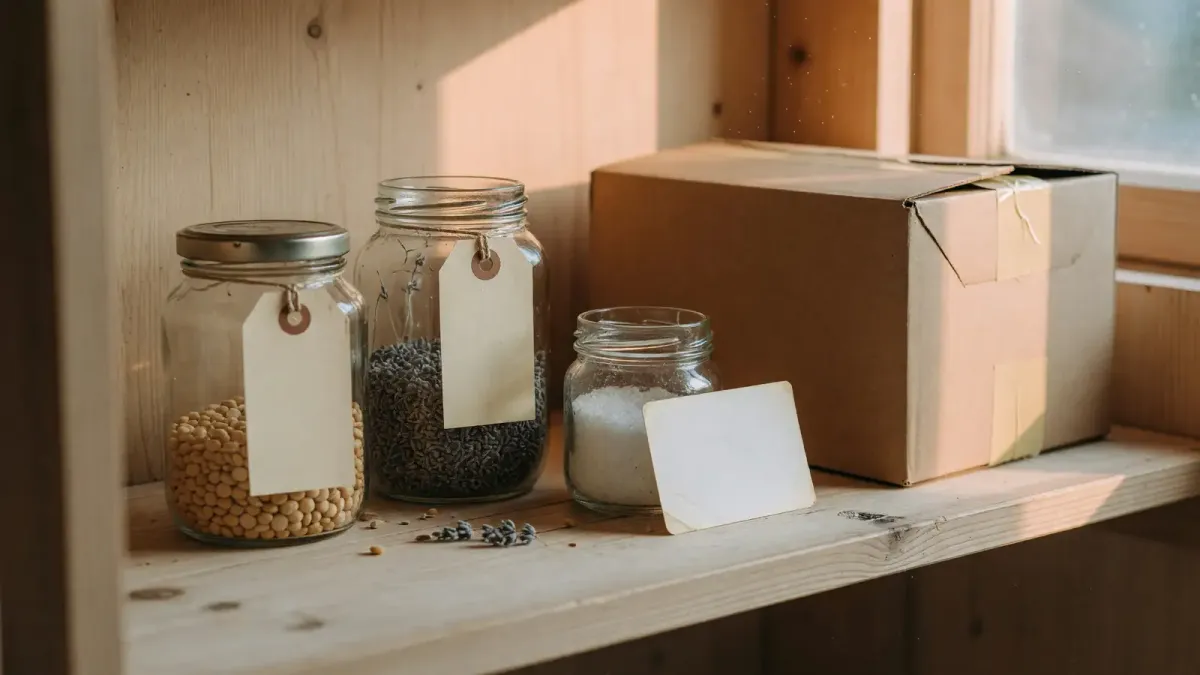
The name on the jar and the field in the recall are not the same line. Duane Beckett’s October 10 piece, syndicated on Yahoo from Student Recipes, walks through five U.S. pantry recalls from 2026. The recalls themselves are older than the article. Cinnamon and flour and applesauce sit in September. The pistachio butter sits in August. The beans sit in March. October 10 is the retelling. If a shelf label says “checked this week,” it has checked a roundup, not a new FDA drop.
We already built a pantry around zones and containers in the step-by-step pantry system. We already treated a gap as a measurement that has to match the object, not the category, in the laundry closet where 8 inches was not 7.5. We already treated empty shelf space as a feature, not a failure, in the piece that starts by leaving shelf space. This week is a different job. The jar can be in the right zone, in the right bin, with the lid facing out, and still be the lot the notice named.
I am not going to turn a recall roundup into a medical guide. The October 10 piece includes sentences about what lead and Salmonella and patulin can do. Those sentences are not the organizing problem. The organizing problem is which printed field you are supposed to compare, and whether your system recorded that field when the jar came in the door.
Five recalls, and none of them share a key
Beckett’s piece says the five recalls are worth knowing so you check the notice. That is a reading instruction. It is not a shelf instruction. A notice can name a lot code, a UPC, a best-by date, an expiration date, a set of states, a set of stores, or every lot of a product because the bins mixed. A pantry that records only the product name has one field. These five notices, as the October 10 retelling prints them, use five different fields.
I am going to keep the dates of the recalls and the date of the article apart. September is not October 10. August is not September. March is not “this pantry week.” If you pull a jar because a headline said “2026 recalls,” you are using the year. The notice is using a lot, or a UPC, or a date on the lid. The year is the bucket the roundup used. It is not the match.
The October 10 page also links each recall to an FDA notice. I am using Beckett’s retelling for the identifiers below, and I am naming the FDA URLs he points at. I did not reopen each FDA page as a second count. If the FDA page has a lot the roundup skipped, this article does not have it. That gap matters most for the flour, which is the recall that refuses to list the lots in the retelling.
The cinnamon match is a lot code, and the map is six states
The FDA notice Beckett links for the cinnamon is the document the October 10 piece is summarizing. In that summary, Galil Importing Corp recalled Lior Cinnamon Ground Seasoning in September after elevated lead. The containers are 90 grams. The lot code is GAP11304. Distribution ran through New York, New Jersey, Pennsylvania, Texas, Florida, and Illinois, from November 2025 through September 2026.
That is three different filters, and only one of them is on a typical pantry label. Size is 90 grams. If your bin says “cinnamon” and the jar is a different weight, you are not done, and you are also not cleared. A 90-gram jar of a different lot is not this notice. A different-size jar of lot GAP11304 is a question the October 10 piece does not answer. I am not going to extend the lot to every size Galil sells.
The state list is a distribution list, not a pantry list. Beckett names six states. If you live in one of them, the jar can still be the wrong lot. If you live outside them, a jar can still have traveled. The notice, as retold, says those six states are where that lot was distributed in that window. It does not say a jar in a seventh state is safe, and it does not say every cinnamon jar in Illinois is GAP11304. The lot code is the match. The state is context for how far that lot moved.
The lead figure in the retelling is 2.18 ppm, from testing by the Maryland Department of Health, later added to a wider FDA public health alert. No illnesses had been reported at the time of the FDA notice. I am not going to convert 2.18 ppm into a household rule. The number is the reason the lot was named. Your job, if the jar is still on the shelf, is to read the lot, not to retest the powder.
A pantry card that says “spices, top shelf, left” cannot answer GAP11304. The card needs a line for the lot, or the jar needs to stay in a “not logged” box until someone writes the lot down. That is a slower system than a pretty label. It is the system this notice actually uses.
The flour recall names three products and withholds the lots
The flour case is the one a neat shelf will get wrong with confidence. Beckett says several baking products were pulled under one GF Blends recall in September: Truly AIP All Purpose Flour, Truly AIP Bread Mix, and EAT G.A.N.G.S.T.E.R. Flat Bread Pizza Mix. He says the recall covers a number of affected lots and best-by dates. He does not print the lots. He does not print the best-by dates.
The FDA page he links is where those lots would have to be read. I am not going to invent a lot code so the section feels complete. If your pantry log has a slot called “flour lot” and the slot is blank, the October 10 article cannot fill it. Neither can a photo of the front of the bag, if the lot is on the back and you never turned it over.
What the retelling does give you is the reason the packaging can lie. The products were made with plantain flour supplied as certified gluten-free. Independent testing later found gluten at levels significantly above the FDA’s 20 ppm threshold. Distribution included the companies’ websites and Amazon, so the bags were not limited to one grocer’s aisle. No adverse health effects had been reported as of September 17, 2026. September 17 is a status date inside a September recall, repeated on October 10. It is not a statement that October 14 is still the status. I do not have a later FDA update in hand.
Beckett’s own line is the organizing line. He says recalls like this are easy to overlook because the packaging may give shoppers confidence that a product fits their diet, when it does not. A pantry system that files “gluten-free” as a zone is filing the claim on the bag. This recall is a case where the claim on the bag and the test did not match, for specific lots the roundup does not list. “Gluten-free shelf” is a category. It is not a clearance.
If you are going to keep a gluten-free zone, the zone needs a second habit: the lot and the best-by get written down when the bag comes in, or the bag does not enter the zone until you have checked the current notice. That is annoying. It is also the only way the September 17 sentence can be used later, when the roundup has already moved on and the bag is still in the house.
The pistachio jar has three fields, and the photo says peanut butter
The August recall is the one with the most complete identifier set in the October 10 retelling, and it is also the one the page illustrates badly. Botticelli Foods recalled bettergoods Pistachio Nut Butter, in Beckett’s summary, as a single lot. The jars are 6.7 ounces. The lot code is LB028ACP04. The UPC is 194346207961. The expiration date is January 28, 2027. Sold only at Walmart, across 19 states.
The page then names Florida, Georgia, Arizona, Colorado, Tennessee, and Washington, and it says “including.” Six names are not 19 states. I am not going to treat the six as the list. If your state is not in those six, you are not cleared by omission. The sentence says the product was sold in 19 states, and then it gives examples. The examples are not a border.
Routine testing by the Florida Department of Agriculture and Consumer Services found Salmonella in three jars. No illnesses or injuries had been reported at the time of the recall. Three jars is a test count. It is not a count of jars in Walmart, and it is not a count of jars in your pantry. The match is still the lot, the UPC, and the expiration date, on a 6.7-ounce jar, from that retailer.
Then the illustration. Under the pistachio section, the Yahoo page caption reads “Peanut Butter in the jar.” The credit line is a Creative Commons peanut-butter photo. The product in the paragraph is pistachio nut butter. A person sorting by the picture will pull the wrong jar, or will leave the right jar because it does not look like the photo. This is the same failure mode as a pantry label that says “nut butter” and stops. The notice has a UPC. The photo has a different food. I would not use that image as a sorting key. I would not use “nut butter” as a sorting key either, if the alternative is reading LB028ACP04.
January 28, 2027 is an expiration date, not a best-by, in this retelling. The applesauce section uses best-by. I am not going to treat those two phrases as interchangeable just because both are dates on a lid. If your log has one column called “date,” you have already collapsed two notice styles into one cell. Split the column, or write the word the notice used next to the date.
Applesauce is a UPC and a best-by. The beans recall is every lot.
The September applesauce recall is Wakefern’s, in the October 10 piece. Wholesome Pantry Organic Unsweetened Apple Sauce, elevated patulin, 23-ounce jars, UPC 04119005677, best-by June 16, 2027. The FDA notice he links is the source of that instruction in his retelling: the product shouldn’t be consumed. I am passing that on as the notice’s line, not as a diagnosis. No illnesses or injuries had been connected to the applesauce at the time of the recall.
What the retelling does not give you is a lot code. If your system only logs lots, this jar will not match, because the match printed here is a UPC plus a best-by date plus a size. The stores are a third filter: ShopRite, Price Rite Marketplace, The Fresh Grocer, Gourmet Garage, and Fairway Market. A jar from a store not on that list is not automatically outside the notice, and a jar from ShopRite is not automatically inside it. The UPC and the best-by are the pair the October 10 piece actually prints.
The March recall is the opposite shape. Falcon Trading Company recalled Organic Black Beans, Organic Chili Bean Blend, and Organic Sunset Soup Mix after pesticide residue turned up in organic black beans bought from a certified organic handler. Those beans also went into the blend and the soup mix, which is why three products share one recall. Because the products were sold in bulk, and different batches could mix in sales bins, the company recalled all lot numbers of the three products. The FDA notice is the page Beckett is summarizing. The notice, in his account, did not name the pesticide. No illnesses had been reported at the time.
“All lot numbers” is the line a lot-based pantry is not built to hear. If you are holding a bag of those beans and the lot is filled in, the lot being filled in does not clear you. The recall, as retold, is not “this lot.” It is every lot of those three names, because the bin could not keep lots apart. A bulk bin is an organizing choice. This recall is what that choice costs when a residue test comes back on one handler’s beans and the scoop has already moved product between bags.
I am not going to tell you the March beans are still the status in October. I do not have an October close-out. I am telling you that a system which files bulk beans by name, and writes “organic” on the bin, has recorded the two words this recall does not use as the key. The key is the product name plus “all lots,” and the pesticide name is missing. A missing pesticide name is not a reason to invent one. It is a reason the bin label cannot answer a question the notice left open.
Write the field the notice uses, or the jar stays in the unsorted box
A working pantry for this roundup is uglier than a labeled one. It has a holding box for anything whose lot, UPC, or best-by was not written down on the way in. The cinnamon does not leave that box until GAP11304 has been compared. The flour does not leave it until someone opens the FDA page and reads the lots the October 10 article skipped. The pistachio jar does not leave it because a photo said peanut butter. The applesauce leaves only if 04119005677 and June 16, 2027 are both on the lid, or both absent. The beans do not get a pass because the lot looks unfamiliar. Unfamiliar is not the test. “All lot numbers” means familiar lots are in too.
None of that is a claim that every jar in a 2026 pantry is in a recall. Five products, five notices, five keys. A shelf of rice and oats and canned tomatoes is not implicated by a cinnamon lot code. The mistake is the other direction: treating “pantry staple” as the category that makes a jar suspect, or treating a pretty zone label as the category that makes it fine. Beckett’s piece is a list of notices. Your shelf is a list of jars. The work is the join, and the join fails when the two lists do not share a column.


Discussion
Comments
Share a helpful tip, question, or takeaway from The Recall Is a Lot Code. The Jar Is Still There..
0 Comments
Loading comments…