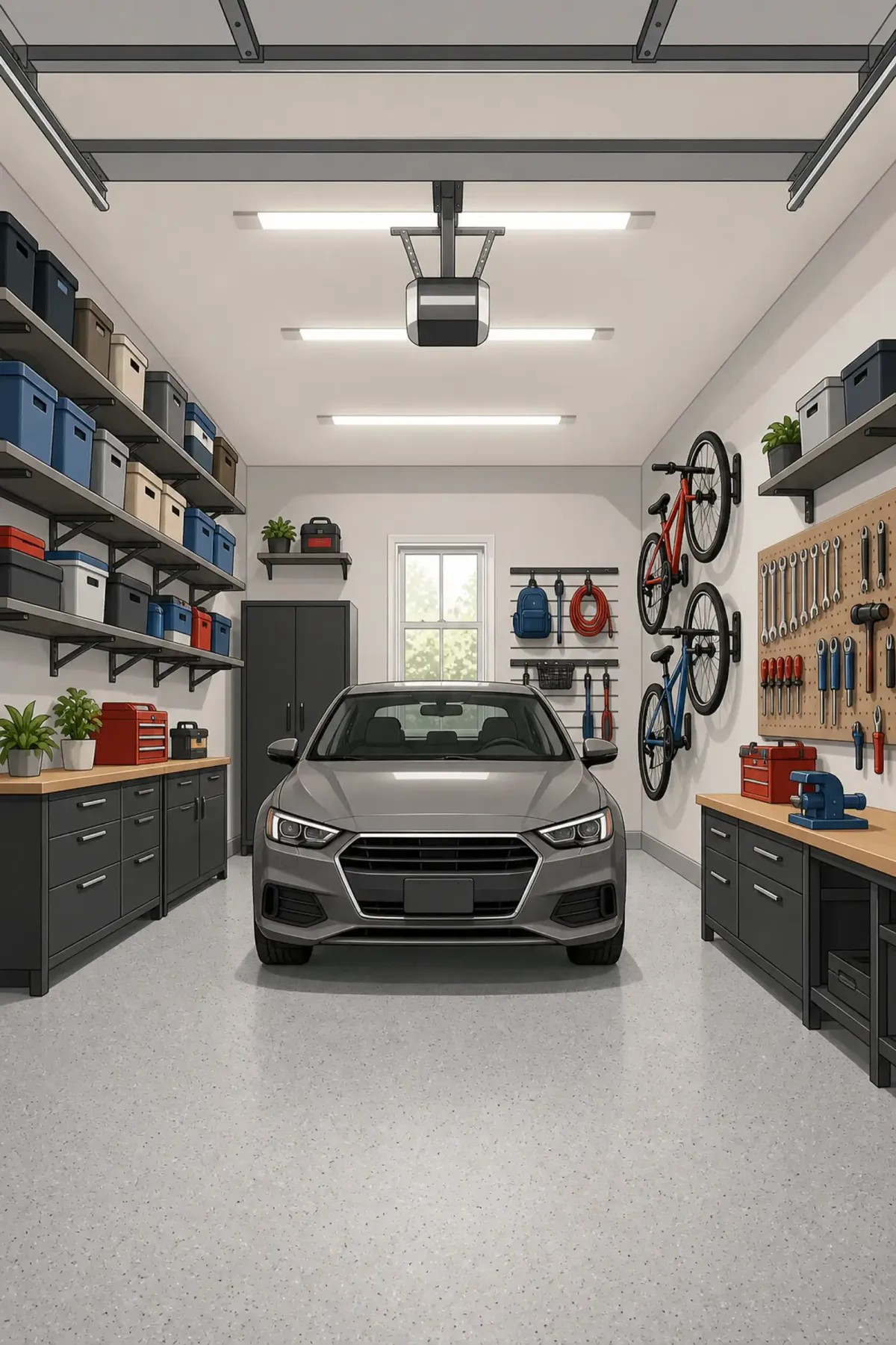
Garages become the default storage for anything that doesn’t fit in the house: holiday decorations, camping gear, tools, sports equipment, paint cans, the second refrigerator. Eventually the car lives in the driveway and the garage becomes an expensive, poorly-organized shed.
Reclaiming your garage starts with the hardest part: deciding what actually belongs there.
The purge
Empty the garage completely — everything onto the driveway. Group items by category: tools, sports gear, holiday decorations, automotive, gardening, “what is this.” Be ruthless about the last category. If you haven’t used it in two years and it doesn’t have a specific future use (replacement roof tiles, for example), it goes.
Hazardous materials — old paint, chemicals, pesticides — need proper disposal. Most municipalities have hazardous waste drop-off days. Don’t just throw them in the trash.
Zone the space
Divide the garage into zones based on how you actually use it:
Car zone. The parking area stays clear. Measure your car and mark the zone on the floor with tape so you know exactly how much space you have for storage around it.
Tool zone. Near the door to the house or the workbench. Pegboard on the wall with tool outlines drawn in marker so everything has a visible home. A rolling tool chest if you have serious tools.
Sports and recreation zone. Balls, bikes, camping gear. Wall-mounted racks for bikes (vertical hooks free up floor space). A bin or bag for each sport so everything stays together.
Seasonal zone. High shelves or ceiling-mounted racks for holiday decorations, seasonal sports gear, items accessed once or twice a year. Label every bin clearly on multiple sides so you can read it from any angle.
Garden zone. Near the garage door for easy outside access. A wall-mounted rack for long-handled tools. A sealed bin for fertilizers and soil amendments (open bags attract pests).
Go vertical
Garage floors collect everything because they’re the easiest surface to drop things on. The solution: get as much as possible off the floor. Wall-mounted shelving (heavy-duty steel, not plastic — garages get hot and plastic shelves warp), slatwall panels with hooks, ceiling-mounted racks, and magnetic strips for small metal tools.
Label everything
This sounds obsessive. It’s not. When every bin is labeled “Camping Gear,” “Christmas Lights,” “Halloween Decorations,” “Paint Supplies,” nobody opens six bins to find what they need. Use a label maker or just painter’s tape and a Sharpie. The key is that the label removes the “I don’t know where it goes” excuse for not putting things back.
The “garage fridge” reality check
That second refrigerator in the garage is probably costing you more than you think. Garage temperatures swing wildly — freezing in winter, baking in summer — and refrigerators work much harder (and use much more electricity) to maintain temperature in those conditions. If it’s mostly holding drinks and overflow freezer items, a chest freezer (more efficient, better insulated) plus a cooler for gatherings might serve you better.
For more home organization tips, see our pantry organization guide and small closet organization guide.


Discussion
Comments
Share a helpful tip, question, or takeaway from Garage Storage Solutions: How to Reclaim Your Garage Without Spending a Fortune.
0 Comments
Loading comments…