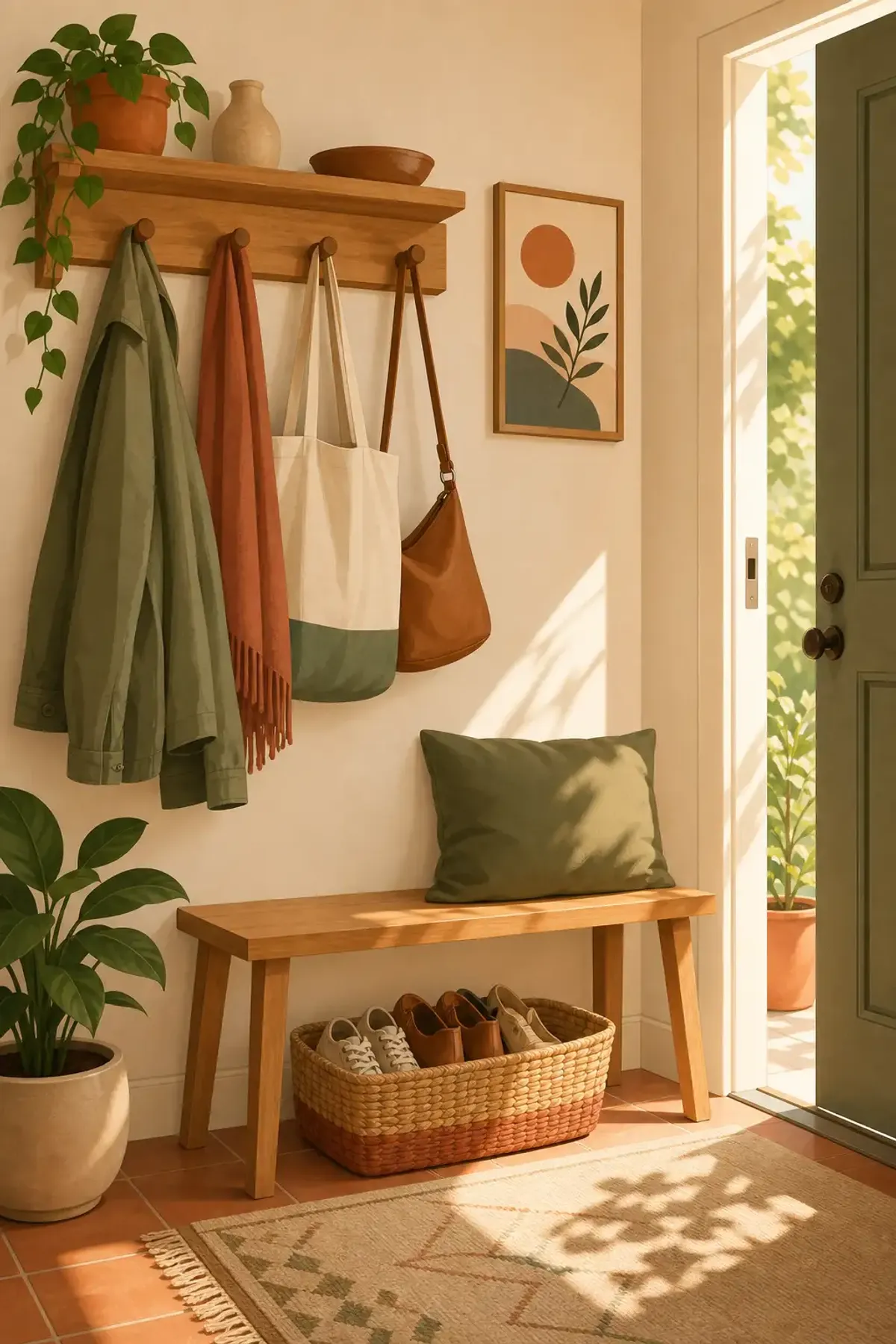
Your entryway has the hardest job in the house. It’s the first thing you see when you walk in and the last thing you touch before leaving. It needs to handle shoes, coats, bags, mail, keys, umbrellas, pet leashes, and whatever else your household carries in and out every day. Most entryways fail at this because they weren’t designed for it — they’re just a patch of floor by the front door.
The five-minute baseline
Before buying anything, clear everything out. Remove every shoe, coat, pile of mail, and random object. You’ll probably find items you forgot you owned. Keep only what you actually use at the door. The fleece jacket you haven’t worn in two years doesn’t need prime entryway real estate.
Then, sort what’s left into categories: outerwear, shoes, bags, mail/keys, pet gear, seasonal items. Each category needs a designated home within arm’s reach of the door. If it’s not within reach, it won’t get put away.
Wall-mounted solutions for any space
Even the smallest entryway has walls. A row of hooks at two heights — adult eye level and kid level — handles coats, bags, and leashes. Mount a narrow shelf above the hooks for a drop zone: keys, sunglasses, mail. The shelf should be shallow (6-8 inches) so it doesn’t protrude into the walking path.
A wall-mounted shoe cabinet (IKEA’s TRONES or HEMNES) is only 7-8 inches deep and stores 6-8 pairs of shoes vertically. It doubles as a surface for a key bowl or mail tray.
The landing strip concept
Professional organizers talk about the “landing strip” — a defined zone, usually a console table or wall-mounted shelf, where everything lands when you walk in and where everything lives so you can grab it on the way out. It needs:
A tray or bowl for keys and wallet. A small organizer for mail — separate slots for incoming, outgoing, and “action needed.” A charging station if your family charges phones by the door. A small basket for items that need to leave the house (returns, library books, items to give to a friend).
Shoe storage that actually works
Shoes by the door multiply. A family of four can accumulate 12-15 pairs in the entryway within a week. The rule: each person gets space for the shoes they wear most often (usually 2-3 pairs). The rest live in bedroom closets. Rotate seasonally.
Open shoe storage — a simple rack or boot tray — is easier to maintain than closed cabinets because there’s no door to open. The friction of opening a cabinet door is enough to make people kick off shoes on the floor instead.
The “one in, one out” hook rule
Each hook holds one item. When all hooks are full, something has to go back to its real home before anything new can hang. This simple rule — enforced ruthlessly — prevents the entryway from becoming an auxiliary closet.
Seasonal swap
At the start of each season, swap entryway items: heavy coats and boots go into storage, light jackets and sandals come out. Keep only current-season gear accessible. If you can’t see your entryway floor in January because of summer flip-flops, the system needs a seasonal purge.
For more home organization strategies, see our professional organizer recommendations and small apartment storage guide.
Discussion
Comments
Share a helpful tip, question, or takeaway from Entryway Organization: 10 Ideas That Stop the Doorway Chaos Before It Starts.
0 Comments
Loading comments…