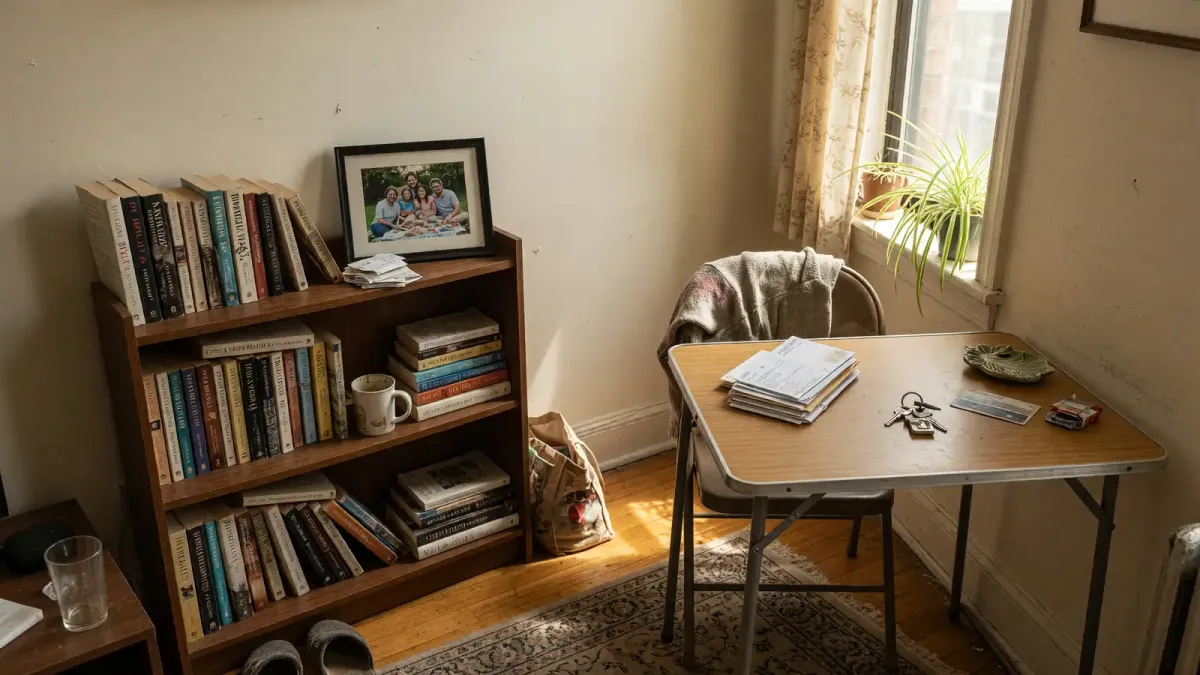
IKEA’s new Store & Organise Report has a number you will recognize if you live with anyone: in 38% of homes, someone is leaving things out on purpose and hoping another person will deal with them. The company calls it a silent protest. The rest of the household calls it Tuesday.
The survey ran across more than 30,000 people in 31 markets. The subtitle is “Finding Meaning in the Mess.” That sounds like a catalog line. The data underneath is more useful than the slogan: people are not failing at minimalism. A lot of them never wanted the empty-shelf version of a tidy house, and they are fighting about the gap.
This is not another list of bins. The report is a map of where clutter actually lives, who is mad about it, and which small layout changes are worth doing before you buy more furniture.
The silent protest is a system, not a personality flaw
The global 38% figure is the headline. The Australian cut is even blunter. More than one in three people there said they had argued with a partner, a child, or another housemate over clutter. Forty-two percent had tried the silent protest. Two thirds had moved someone else’s stuff back to “the proper place” without saying a word.
That is not laziness in a vacuum. It is a badly specified job. One person believes the coffee table is a landing pad. The other believes it is a table. Nobody wrote the rule down, so the house runs on hints.
If you are the person leaving the pile, you are sending a message: this is not only my mess. If you are the person relocating the pile at 10 p.m., you are sending a different message: I would rather do the work than have the conversation. Both strategies fail on the same point. The object comes back.
A cleaner fix than a weekend purge is a 15-minute household meeting with three questions:
- Which surfaces are allowed to hold “in progress” stuff, and for how long?
- Who owns the overflow when the answer is “we both do”?
- What happens to items that miss the deadline — a box by the door, not a speech.
Write the answers on a note in the kitchen. It will look silly. It will still beat another silent protest.
The one-in-one-out rule helps after you have named the surfaces. It does not replace the conversation. If two people keep bringing objects into the same square metre, the rule just turns into a second argument about whose thing leaves.
Minimalism lost the popularity contest
Designboom’s write-up of the same study is the part IKEA’s product teams wanted you to see: 59% of people prefer a characterful home over a manicured one. The sterile white shelf is out of fashion. That matches what a lot of households already did with their hands. They kept the kids’ art, the ugly souvenir mug, the stack of paperbacks.
The trap is treating “character” as a free pass for volume. Character is a few objects that tell a story. Volume is 40 objects that tell you nobody decided.
Two other numbers from the same report are more operational:
- 68% of households keep a dedicated “drawer of doom,” usually full of forgotten cables.
- 34% shuffle clutter between rooms before guests arrive.
The drawer of doom is not a moral failure. Cables outlive devices. Queensland households in the Australian cut were the most likely to hoard chargers for gadgets they no longer own, which is a specific, solvable pile: if the device is gone, the cable can go too, unless it is a standard USB-C or USB-A lead you still use.
The pre-guest shuffle is the expensive one. You are paying in time, twice. You hide the pile. You un-hide it. Nothing has a home, so the house cannot stay “guest ready” for more than an afternoon.
If you only change one habit from this report, change that. Pick a closed landing zone — a lidded bench, a cupboard, even a laundry basket with a lid — and move the shuffle into it. Guests do not need a transformed house. They need not to sit on your mail.
Kitchen counters are still the worst public stage for this. We already walked through why that surface collects everything. The 2026 report adds the social layer: the counter is where the silent protest is most visible, because nobody can pretend they did not see the pile.
Time tax: five minutes, then the rest of the day
The Australian numbers put a clock on the mess. A quarter of Sydneysiders said they lose five minutes a day hunting wallets, keys, and the rest. Half of the national sample said those hunts can wreck the rest of the day.
Five minutes does not sound like a crisis. It is 30 hours a year if you actually do it daily, and that is only the search. The mood hit is the larger cost. You leave the house already irritated, then you take it out on the next small problem.
A boring key dish by the door beats a clever storage wall. Put the dish where your hand already drops the keys, not where a magazine photo put a console table. If the keys currently land on the kitchen counter, the dish belongs there until the habit moves. Fighting your own drop zone is how organizers end up unused in a cupboard.
Same rule for the bag dump. If backpacks hit the floor in the hallway, a hook at that exact height will get used. A mudroom two rooms away will not.
IKEA’s Australian design lead, Ainslie Woodham, said there is no one-size-fits-all approach, and that people are leaving behind the idea that a well-designed home has to look perfect. That is the useful half of the marketing. The other half is still trying to sell you a new unit. You can take the first half and skip the second.
Tiny houses, three cities, one constraint
To launch “IKEA open house,” the company put handcrafted miniature homes in Melbourne, Chengdu, and Beijing. Stockholm artist Christopher Robin Nordström built them. The in-store Open House run stretches from late August into September in participating markets.
The quote worth keeping is Nordström’s: when you build in miniature, every object has to earn its place. A real apartment is not a dollhouse, but the constraint is the same as a small flat. You cannot display every era of your life at once.
IKEA’s public line is that home now has to work as office, studio, classroom, and hideout, often on the same footprint, and that affordability decides whether a “smart storage idea” actually happens. That is not new if you rent. It is a useful filter when you are in the store: if the fix needs a renovation or a $400 cabinet to hide a $12 problem, walk.
What the tiny houses are good for, if you can see one in person, is spotting dead space you already own. Look at:
- The side of the fridge
- The wall above the toilet cistern
- The 20 cm between the sofa back and the wall
- The inside of a closet door
We mapped three of those hidden zones earlier. The report’s contribution is permission. You do not need a new room. You need a few surfaces to stop being staging areas.
Skip anything that only works in the miniature because the dollhouse has no incoming Amazon boxes. Your house has a weekly inbound flow. Storage that cannot absorb a normal week’s deliveries will clog by Thursday.
A weekend plan that matches the numbers
Use the report as a punch list, not as inspiration.
Hour 1 — Name the protest surfaces. Walk the house with the other adult, or with yourself if you live alone and the “other person” is past-you. Mark every surface that currently holds “I’ll deal with it later.” Cap each one at a real number: five pieces of mail, one tote, two mugs. Write it down.
Hour 2 — Drawer of doom. Dump it on a towel. Keep universal cables (USB-C, USB-A, a labeled charging brick). Recycle the rest, including chargers for dead Kindles and mystery barrel plugs. One small organizer is enough. The Guardian’s roundup is full of pretty bamboo trays; a cheap divider that matches the drawer you already have is fine. Do not buy a new aesthetic for a junk drawer.
Hour 3 — Kill the guest shuffle. Choose one closed container near the most visible room. That is the only legal hiding place before people come over. If it does not fit, something leaves the house, not the room.
Hour 4 — One inbound rule. Mail, school papers, and delivery packaging get a tray and a twice-weekly empty. If the tray overflows, the overflow goes out, not onto the counter.
You will not finish the house. You will finish the argument about the house, which is the actual product of the silent protest.
If you live in a small apartment, resist the urge to go shopping after hour 1. Measure the dead spaces first. Most “small space solutions” fail because they are 2 cm too deep for the only wall that could take them.
What the Life at Home report adds, and what it does not
On 7 September IKEA published a separate Life at Home Report 2026. The thesis is that people are treating home as the one place they can still control while the outside world feels unstable. That is a mood, not a storage technique.
It does explain why clutter fights feel bigger than the objects. If home is supposed to be the calm room, a pile of shoes in the hallway is not just messy. It is a broken promise. That is why five minutes of searching can sour a day.
It does not mean you should turn the apartment into a showroom. The Store & Organise numbers already said people want a house that looks like them. Control, in this case, is knowing where the keys are and who is supposed to move the mail. It is not matching throw pillows.
IKEA will keep selling both ideas at once: meaning in the mess, and a new unit to hide the mess. You can use the research and ignore the upsell. The 38% figure is the one to take into the kitchen. If someone in your house is staging a silent protest, the pile is the symptom. The missing rule is the job.
Discussion
Comments
Share a helpful tip, question, or takeaway from IKEA's New Report: 38% of Homes Stage a Silent Protest.
0 Comments
Loading comments…