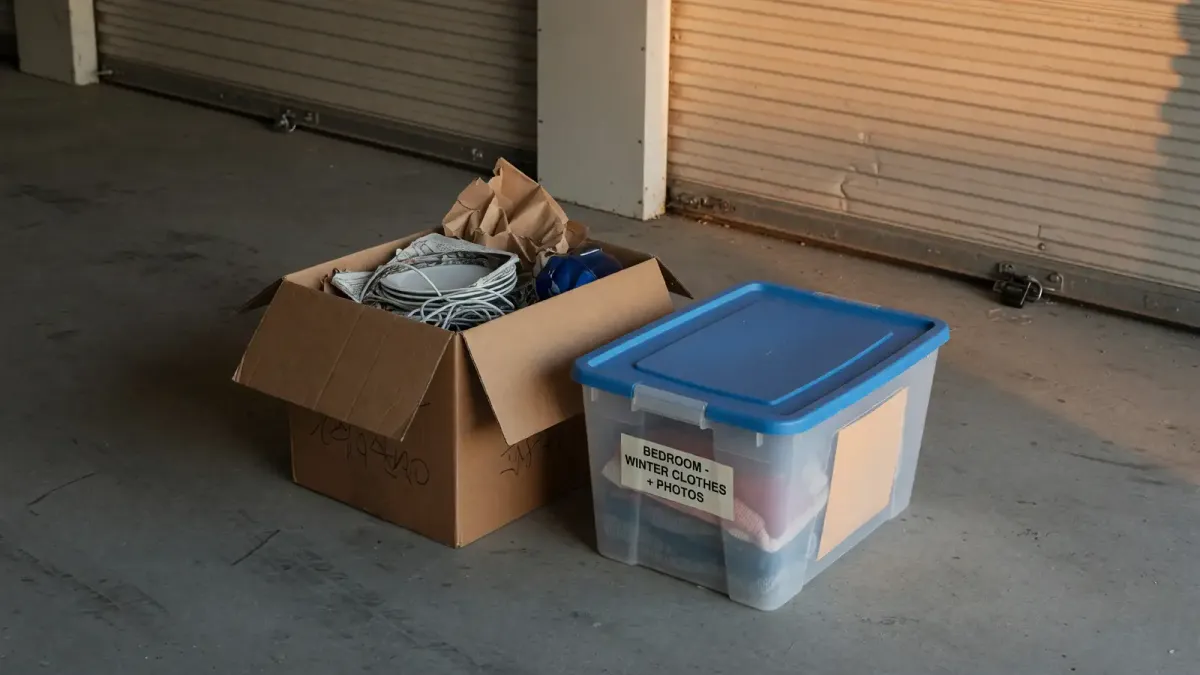
IKEA’s report last week said 38% of homes are quietly staging a protest. The protest has a commercial annex. It is a climate-controlled hallway you pay for by the month.
The New Yorker put the 21 September issue online on the 14th. The reporter walks a 145-unit facility. Units run from twenty-five square feet to three hundred. In the third phase they added mostly ten-by-thirties, because people kept asking for bigger. That sentence should embarrass you if you already have a garage.
Most of what sits in those rooms is not a secret. Garage overflow. Gently used exercise equipment. Out-of-season sports gear. Furniture that lost its room after a move or a renovation. About a quarter of the customers are contractors and small owners storing tools, merchandise, or paperwork a lawyer told them to keep. The smallest unit is about eighty dollars a month. The largest is about three hundred. Then the piece cuts to a city site that does valet pickup. A ten-by-twenty there is seven hundred a month. Occupancy 98%. Eight or ten people in the office doing sales and support. That is not a shed. That is a hotel for stuff you could not throw away.
Five years ago, the article says, self-storage was one of the most profitable slices of real estate. The buildings are still there. The question is whether you need a key to one.
The occupancy number is not a sale
SmartStop Self Storage REIT dropped an 8-K on 9 September. Same-store physical occupancy on 31 August was 92.4%, against 92.7% a year earlier. That is not a collapse. That is a rounding error with a press release. Their thirteen-property Greater Toronto book was 92.9% versus 92.2%. Toronto got slightly fuller. The web rate, the number you see before they talk you into a “special,” went from $1.05 to $0.97.
Read that pair together. Units are still taken. The advertised price came down a bit. If a manager waves a first-month discount at you this week, that is the $0.97, not a sign the industry is empty. Physical occupancy is people actually using the space, not a lease on a dark room. SmartStop bothered to define it that way in the filing. Believe them.
Anselm Wong, CFO of Janus International, said the quiet part at Jefferies on the 9th. Janus sells the doors, the hallways, the access-control stack. Nokē, their connected lock business, is on about half a million devices. Wong’s market picture: high interest rates slowed housing turnover, which slowed the move-in that fills storage. Public operators talk about rates stabilizing. Nobody is claiming a mobility boom. If you are not moving house, you do not get a free pass to rent a second house for the treadmill.
The industry is not dying. It is waiting for you to move, or to fail to sort the basement. Those are different problems.
Do the house before you sign
A storage unit is a decision to stop deciding. The box leaves the hallway. The bill starts. Six months later you cannot name three things in the unit without driving there.
Do this on a Saturday, in this order, before you open a browser tab for Public Storage.
Walk one room with a roll of painter’s tape. Three piles: keep in this room, keep in the house somewhere else, leave the house. “Leave” means sell, give, or trash. It does not mean “temporary in the garage until I am emotionally ready.” The garage is how you get to a ten-by-thirty.
Photograph the keep-in-house pile. If you cannot say which closet it belongs in, it does not belong in the house. IKEA already told you people stage rooms for guests and live in the overflow. Stop staging. Put the extra chairs where you sit, or let them go.
Paperwork is the contractor’s excuse and the family’s too. Scan the tax years you actually need. A banker does not require a plastic tub of 2014 cable bills. If a statute says keep it, keep a labeled box on a high shelf, not a climate-controlled hallway.
Sports gear and the unused bike go on a wall or out. Seasonal clothes get one bin per season, not a unit. If the bin does not close, you own too many coats. That is an inventory problem, not a square-footage problem.
Fall maintenance is a separate list. Do not mix “clean the gutters” with “I cannot look at these boxes.” One is weather. The other is avoidance with a monthly draft.
If after that walk you still have a dining table that will not fit until March, then rent the smallest unit you can, for a written end date, with a calendar reminder. Month-to-month with no end date is how 92% occupancy happens.
Fifty dollars of door, not seven hundred of hallway
You do not need a custom closet. You need vertical surface.
HuffPost’s organizer column on 14 September is a steel pegboard that hangs over a door for about fifty dollars. Magnetic. Hooks, baskets, a shelf if you want one. Closet today, pantry next month. The writer is already eyeing a second one. I do not care which brand. I care that the unused face of a door is free square footage you already pay mortgage or rent on.
Hats, bags, camera bits, wrapping paper, cleaning bottles, extra toiletries. Those are the objects that migrate into a “I’ll sort it later” tub and then into a unit. Put them on the door. If they do not fit on one board, you have two doors. If they still do not fit, you are shopping, not storing.
Kallax-style cubes still work for the stuff that is actually box-shaped. IKEA spent last week putting a Kallax into Skyrim. That is marketing. The cube is still a cube. Use it for the things you touch. Do not use it as a pretty lid on a junk pile.
Contractors are the one honest storage customer in the New Yorker piece. Tools and merchandise and required files. If that is you, a unit can be cheaper than a second bay. If that is not you, you are paying contractor rates for a lamp you do not like.
What the bill actually is
Eighty to three hundred a month at the ordinary facility. Seven hundred for a valet ten-by-twenty in the city example. At $80, a year is $960 before tax and the lock they sell you. At $300, you have spent $3,600 to not have a yard sale. The pegboard is a one-time fifty. A used bookcase from the same weekend is another forty.
Web rates at SmartStop ticked down. That is not a coupon for your guilt. That is a slightly cheaper way to extend the same habit. Occupancy in the low nineties means the buildings are doing fine without your holiday decorations.
Wong’s housing-turnover comment is the one to keep. If you are staying put, you do not have a moving problem. You have a volume problem. Volume is solved by leaving the house, not by cloning the house off-site.
I am not going to moralize about Americans and stuff. The New Yorker already filed that essay. I will say this: a unit you cannot inventory from memory is a second rent. Walk the room with tape first. If the three piles fit, you do not need a keypad.
If you already have a unit
Drive there once with a pad, not with a van you intend to refill. Write every bin on one page. If a bin has no label, it gets opened on the asphalt. Photographs of the interior of each unit wall are cheaper than a second month of “I’ll remember.”
Three outcomes, and only three. Bring it home to a place you already named. Sell or donate it that weekend. Throw it away at the site if they have a dumpster you are allowed to use. “Put it back for now” is how occupancy stays in the nineties.
Give the manager a move-out date before you leave the office. Month-to-month feels polite. It is how $80 becomes $960 while the treadmill rusts in the dark. If you need thirty days’ notice, start the clock while you still hate the bill.
Do not store: anything that leaks, anything that rusts in humidity even when they say climate control, papers you have not scanned, a mattress you will not sleep on again. Do store, if you must: a dining table with a dated return, tools for a job that has a last invoice, the one seasonal bin that actually rotates.
The New Yorker contractor who keeps legally required paperwork in a unit is running a business process. You are probably running a delay. If the pad has more than twenty lines and you cannot name a home for ten of them, you do not have a storage problem. You have a letting-go problem that a keypad will not treat.
Wong said mobility is weak. That cuts both ways. You are not about to need a unit for a move that is not happening. The 92.4% is other people’s unfinished rooms. You do not have to join them because the web rate dropped eight cents.
Discussion
Comments
Share a helpful tip, question, or takeaway from Self-Storage Is 92% Full. Your Spare Room Is the Cheaper Unit.
0 Comments
Loading comments…