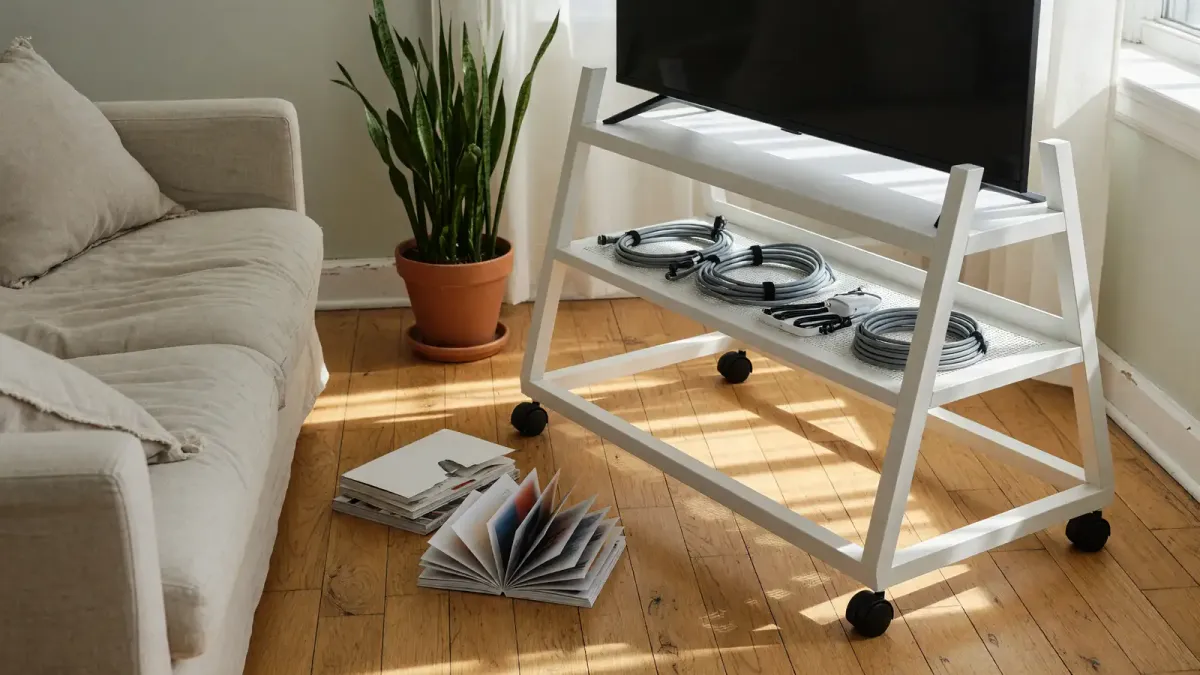
The stand and the checkout page are not the same date. James Monosmith’s Oct. 1 post on Xbox Wire says the YXSTABY collection is available worldwide starting that day, then narrows the sentence: it launches in IKEA stores today, and online later this year, and availability may vary by market. Zoë Sessums at Domino on Oct. 3 prices the rolling TV stand at $150, calls it compatible with sets up to 55 inches, and says the nine-piece collection is in stores now and online next month. If you are organizing a room this weekend, the useful fact is the split, not the collaboration logo.
This is a storage problem wearing a gaming name. The back of the stand is where cords, consoles, and remotes are supposed to live, according to Domino. The rest of the capsule, the same piece says, leans harder into the controller: a rolling side table, controller storage, and a stool inspired by an Xbox thumbstick. You can want the cart and not want the stool. Those are different purchases, and only one of them has a published price in the sources I am using.
If the room is already tight, start with the shelf you are not filling. Leaving shelf space is the earlier argument on this site. A rolling stand does not cancel it. It moves the screen, and it adds one more object that needs a parking spot when the screen is not the point of the room.
Two sentences about “available”
Xbox Wire’s dek is the sentence that will get copied: available worldwide starting October 1. The body, two scrolls down in the same post, is the sentence that tells you whether a website cart will work tonight. Stores today. Online later this year. Markets may differ. Domino, two days later, is more specific about the U.S. retail story it is telling and less specific about the year: in stores now, online next month.
I would not average those into “mid-November” or “before Christmas.” Nobody in these two pieces published a U.S. online go-live date. “Later this year” and “next month” can both be true if next month is still this year. They can also hide a market where the store never got the white frame. Monosmith’s closer is the operational line: for more information, contact your local IKEA.
That is annoying if you wanted a link and a delivery window. It is also the only honest instruction once two outlets have already disagreed on the online month. Before you clear a wall for a mount you do not want, call the store and ask whether the castor stand is on the floor, not whether the collection “launched.” A launch date and a unit in the aisle are different inventory facts.
If the store has it and the site does not, decide whether you can get it home. A stand on casters is still a wide steel frame plus a television if you buy the screen the same day. Domino’s 55-inch ceiling is the limit it states for the stand, not a suggestion that a 55-inch set is light. Measure the doorway before you treat “rolling” as “easy to carry up stairs.” Casters help on a flat floor. They do not help on a turn in a stairwell.
What the $150 rolling TV stand buys
Domino is the price source. $150. Powder-coated steel. Up to 55 inches. Storage at the back for the ugly parts: cords, consoles, remotes, and what Sessums calls other unsightly necessities. She also calls it IKEA’s first rolling TV stand, and she is explicit that you do not need to be a gamer to want the small-space idea. The collection was designed, she writes, around the fact that gaming no longer happens in a dedicated room, or even in one place.
That is the organization claim, and it is narrower than a lifestyle ad. A TV that can leave the focal wall is a different tool from a TV that is the focal wall. In a studio, or in a living room that is also the dining room after 7 p.m., the screen’s job changes by the hour. A mount solves “I do not want a console cabinet.” It does not solve “I do not want the screen staring at the table while people eat.” Rolling does, if you actually roll it.
The back shelf is the part that will fail quietly. Sessums says it gives cords, consoles, and remotes somewhere to live. A somewhere is not a system. If the shelf is deep enough for a console and a power strip, it is also deep enough to become a junk ledge the first week: a spare remote, a dead controller, a cable you are afraid to unplug. The stand does not label anything. You still have to decide what is allowed back there.
I would treat that shelf like a drawer with a lid you cannot see from the sofa. One power strip. The cables for the devices that are on the stand today. Not the cables from the last apartment. Not a board-game box because the shelf looked empty. Empty, on the back of a TV cart, is how you keep the casters from dragging a tangle when you turn the screen toward the kitchen.
The 55-inch line matters for the same reason. Domino does not say the stand looks fine with a 65-inch set if you are careful. It says compatible with TVs up to 55 inches. If your screen is larger, this is not your cart, even if the price is the one you wanted. Do not “make it work” with a bigger set and then blame the casters when the weight sits wrong. The compatibility sentence is the spec. I do not have a weight rating from these two sources, so I am not going to invent one. If the store sheet has a kilo limit, that sheet outranks this article.
Nine pieces, one published price
Xbox Wire counts nine pieces, co-developed, with designers from both teams on every piece. The list it actually names is more useful than the count. A D-pad becomes both a cushion and a decorative platter in shiny stainless steel. A mirrored display box shows a controller from every side, along with figurines and other collectibles. Then a gaming lounge chair, a monitor stand, a TV stand on casters, a side table on casters, and a laptop support with storage and accessories. The thumbstick stool is called out separately, built from the Xbox Wireless Controller’s original 3D files, grip texture included so a person stays put the way a thumb stays put.
Domino’s list is shorter and more domestic: the stand, a rolling side table, controller storage, the thumbstick stool. I am not going to merge the two lists into a catalog with prices. Only the stand has a dollar figure in Domino, and Xbox Wire does not price the line at all. If a store tag disagrees with $150, believe the tag. Affiliate roundups go stale on a Tuesday.
The mirrored box is the piece most likely to wreck a small-room plan. It is built to show objects, not to hide them. A display case in a room that is already short on closed storage adds visual noise on purpose. That can be the right call for a controller you like looking at. It is the wrong call if the job this month is getting chargers off the coffee table. Do not buy the box because it came in the same press release as the stand.
The stainless platter has the same split personality. Xbox Wire says the D-pad form is a cushion and a platter. A platter for remotes is a landing pad, which is useful, and a shiny landing pad, which shows every fingerprint and every crumb. If your actual mess is paper mail and school forms, a platter is not a command center. It is a dish. Put remotes on it or do not buy it. Do not put the mail there and call it organized because the shape is clever.
The laptop support is the piece I would ask to see before assuming it replaces a desk. Xbox Wire says it has storage and accessories. It does not, in the post I read, say it is a sit-stand desk or a dining table. In a studio, people will try to make it one. If the store sample wobbles when you type, it is a lap desk with a marketing name, and your real work surface is still the table you eat on. That is fine. Name it correctly so you do not sell the table.
The side table on casters is the sleeper if Domino is right that the collection is about moving the activity, not building a shrine. A small rolling table can hold the drink and the controller for the hour the screen is pulled closer, then go back against the wall. That is the same logic as the TV stand, at a smaller scale. It is also another set of casters to keep clear of rugs. A thin rug that bunches under a caster will stop the “two-second move” cold. If the room has a rug under the sofa zone, plan the parking spots on bare floor, or accept that you will lift.
The lounge chair is the one I would not buy from a paragraph. Xbox Wire lists it. Domino does not review the sit. A chair is a volume problem in a small room, bigger than a platter and harder to return if you had it delivered whenever online opens. Sit in the store. If you cannot sit in the store, skip it until you can. A $150 cart is a reversible experiment. An armchair you have not sat in is how living rooms fill up with almost-right furniture.
The thumbstick stool is a seat shaped like a joke that the designers took seriously. Ledbetter, Xbox’s head of design for devices, says the team started with the controller and looked at how familiar forms could become furniture. The stool is that idea at full size. It is not a storage ottoman unless a store sample shows a lid, and neither source I am using describes a lid. Do not buy it as a hiding place for blankets. Buy it if you want a stool, and if you have a corner that can hold a stool when nobody is sitting.
Philip Dilé, a product developer at IKEA, says in the Xbox post that gaming deserves a place in the home as thoughtful as any other everyday activity, and that the point was to make it easier to bring that activity into the spaces where people already live. Read that as a brief, not as a promise that nine objects will fit your floor plan. Thoughtful can still mean too many SKUs. You are allowed to take one.
The room does not have to face the screen
Sessums’s complaint is ordinary and worth keeping: she watches a lot of television and still does not want the set to be the focal point of the living room. The stand is her answer, and she is clear about the alternative it avoids. For a studio or a small living room that does several jobs, or if you simply do not want a screen on the wall, it is a way to make the TV disappear without a projector or custom cabinetry.
“Disappear” is doing a lot of work. A 55-inch screen on a steel frame does not disappear. It parks. Parking is the organization win. You need two spots, not one. Spot A is the watching position, with a clear path for the casters and a cord run that reaches a outlet without crossing the doorway. Spot B is the away position, where the screen is not the first thing you see from the table, and where the back shelf is not blocked by a bookcase you cannot roll past.
If you only plan spot A, you have bought a TV stand with wheels you will never use. The wheels are the product. The frame is the part that holds the screen while you use the wheels. Measure both spots before you fall for the $150. Include the depth of the back shelf, not just the footprint of the legs, because the shelf is where the console sticks out. I do not have Domino’s depth number, so this is a tape-measure job in the store, not a number I am going to fake from a photo.
Outlet placement will decide whether the trick works on a weeknight. A rolling stand that has to be unplugged, walked around a sofa, and plugged into a different wall is a project, not a habit. If both spots can share one outlet, or if a single cord reaches both without a trip line, you will actually move it. If not, you will leave it in spot A and the collaboration will have sold you a normal stand that happens to have casters. That is not a disaster at $150. It is a miss if the reason you wanted it was the move.
Sound is the other constraint these posts do not solve. A screen pulled closer is louder relative to the couch, and a screen parked by a shared wall is louder for the neighbor. If the set has a rear port, the back shelf full of cables can sit right against that port. Leave a hand’s width. Do not pack the shelf until the port is blocked and then wonder why dialogue sounds like a cupboard.
What I would do in a small room this month
I would go to the store, not the website, because both dated sources agree the floor is ahead of the cart. I would look at the white castor stand Domino links, article 70638898 on IKEA’s U.S. product path, and I would check the tag against $150 before I trusted a roundup. I would put a tape on the width with a 55-inch set in mind, and I would only buy the screen size Domino’s compatibility line allows.
I would skip the mirrored box unless I already own a controller I want on display. Display is the opposite of the job if the coffee table is the problem. I would skip the stool unless I need a seat and I have seen that it does not pretend to be a bin. I would consider the rolling side table only after the TV stand has a parking plan, because two rolling objects without two parking plans is how a small room starts to look like a loading dock.
The cord rule is the one I would write on a card and tape inside the back shelf. Devices that live on this stand. One strip. No museum of old HDMI cables. When a device leaves, its cable leaves the same day. That is the same discipline as the hidden zones people forget: a pocket of space only works if it has a membership list. The back of a TV cart is a hidden zone with wheels. Wheels make a messy pocket more annoying, not less, because you will see the mess every time you turn the frame.
If the store does not have the stand, I would not “order the whole collection” to feel done. Xbox Wire already told you online is later, and Domino’s “next month” is not a delivery appointment. Use the wait. Clear the two spots. Pull the extra cables out of the current media pile so that, when the cart arrives, you are not introducing a new shelf and an old knot on the same afternoon. Under-bed storage is a different problem, but the mistake is familiar: buying the container before you have thrown out the thing that does not belong in it.
A $150 steel frame will not fix a living room that has nowhere for the screen to go when people are talking. It will fix a living room that has the space and has been pretending a wall mount was the only grown-up option. That is a real fix. It is also a small one. Take the stand if the tag matches and the doorway works. Leave the thumbstick stool for someone who wants a thumbstick stool.
Discussion
Comments
Share a helpful tip, question, or takeaway from The $150 Rolling TV Stand Is in Stores Now..
0 Comments
Loading comments…