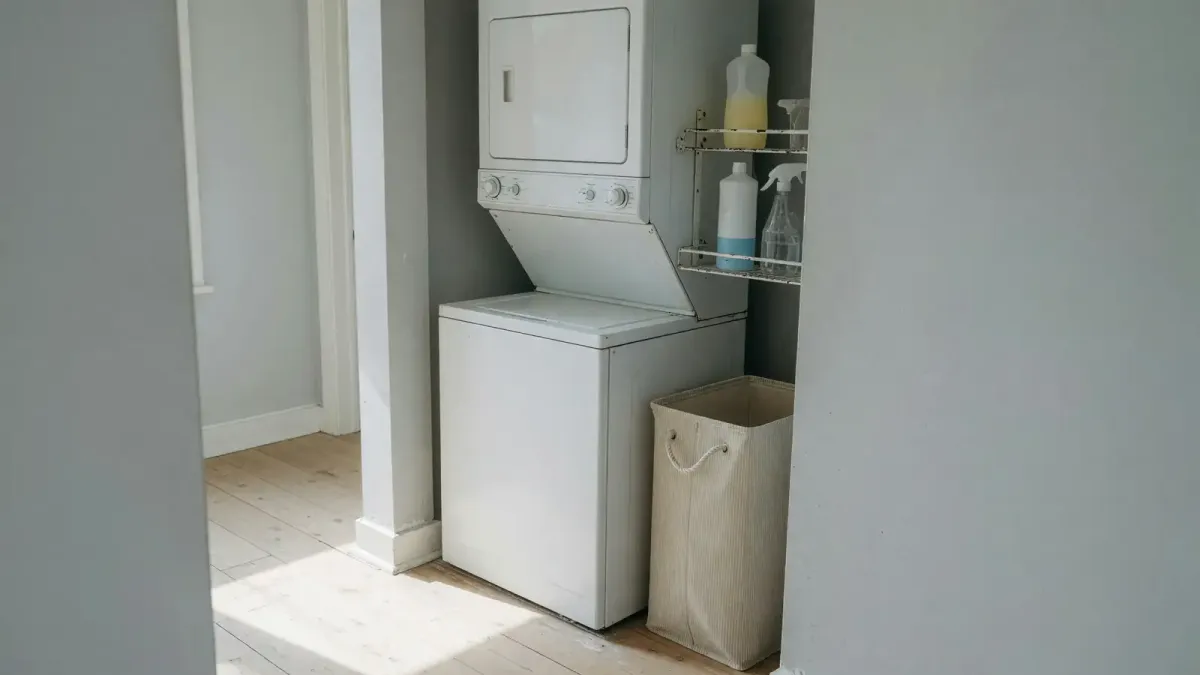
The useful number is the gap, not the before-and-after mood. Apartment Therapy’s laundry closet piece, dated October 7, 2026 in the news index, says the space to the right of a stacked washer and dryer is 8 inches after the machines were pushed to one side. The magnetic organizer that went there is less than 6 inches wide. The slim hamper in the same piece is 7.5 inches wide. Those are three different measurements. Only one of them is a gap in the closet. The other two are products.
Casey Clark’s October 6 piece at Good Housekeeping does not mention a laundry closet. It asks a prior question. Wendy Trunz, partner and head organizer at Jane’s Addiction Organization, tells Clark that October is when people buy bins before they know what is left to store. Olivia Parks, owner and lead organizer at Nola Organizers, makes the same point about holiday boxes, costumes, and the pantry. Measure, then edit, then shop. The Apartment Therapy closet is what that order looks like when the measurement is a seam beside a dryer, not a mood board.
If the shelf in the room is already full, start there instead of at a product page. Leaving shelf space is the earlier argument on this site. A magnetic shelf on a dryer does not cancel it. It occupies a gap that used to hold a plastic bin balanced on the washer’s edge. That is a better failure mode. It is still a shelf, and it will fill.
What the 8 inches actually is
The closet in the Apartment Therapy piece is small, stacked, and doing two jobs. It holds laundry, and it doubles as the linen closet, which is why cleaning rags, bath mats, and miscellaneous items had nowhere that was actually a shelf. The writer had already bought an IKEA over-the-door hanger for a tabletop ironing board and a hanging hamper. That did not fix the side gaps. The gaps between the machines and the walls had become the storage, which is how a closet looks stuffed when the floor plan is fine and the objects are not.
The machines had to move before the 8-inch number existed. The piece says a husband pushed the washer and dryer to one side. I do not have a before-width. I will not invent one. After the push, the right side is 8 inches. That is the number the organizer had to beat. The Nieifi Magnetic Organizer is described as two-tiered and less than 6 inches wide, which leaves more than 2 inches of slack in an 8-inch gap if you take both figures at face value. Slack is how you get the thing in without scraping the wall every time you open the pull-out shelf. It is also how a second object tries to join it. Do not spend the slack on a bottle that does not fit the shelf. The piece already lists what the bottom tier holds: laundry detergent pods, stain remover, dryer sheets, a laundry soap bar, and a stain removal brush. That is a full shelf. The two removable hooks are for gym towels and delicates, not for a third product.
The old object matters because it explains the purchase. The previous storage was a plastic bin balanced between the edge of the washer and the wall. A bin on an edge is not a system. It is a wait for the spin cycle. The magnetic organizer sticks to the machine, so nothing has to be screwed into a rental wall, and nothing has to balance. That is the whole engineering claim in the piece. I do not have a magnet strength, a weight limit, or a note about whether the dryer gets hot enough on that panel to matter. If the product page has those numbers, they outrank this article. If it does not, do not invent a “holds 10 pounds” line and then blame the dryer when a full bottle walks off the shelf.
The hamper is 7.5 inches, and the name is not stable
The second product is where the page disagrees with itself. In the body, the slim hamper is the Odonata Slim Laundry Hamper, 7.5 inches wide, called the narrowest the writer could find, and “a perfect fit.” It has a built-in metal frame, a waterproof PVC coating, and handles on either side. A removable inner mesh bag is for ventilation. The writer plans to use it for clean items only: mop pads, bath mats, towels, rags, and cleaning slippers. The buy line at the bottom spells the brand Odanata. Same price, same link job, one letter different.
I am not going to pick a spelling and pretend the page was consistent. If you search one and get nothing, search the other before you decide the product disappeared. A retailer listing can outlive the blog’s typo, or the blog can be the only place the second spelling exists. Either way, the width is the fact you can check with a tape. 7.5 inches. The piece does not say this hamper went into the 8-inch gap on the right. It says the magnetic organizer went there. The hamper is introduced as storage for clean linens and textiles, in a closet that was already short on a spot for those. “Perfect fit” is the writer’s judgment of the width against the closet she has. It is not a diagram. If your gap is 6 inches, a 7.5-inch hamper is the wrong object even if the review loved it.
The prices are the other check. Nieifi Magnetic Organizer, $28.49. The hamper, $13.99. The writer says both items transformed the closet for under $45. Add the two prices and you get $42.48, which is under $45. That sentence is true as arithmetic. It is not a promise that those prices will be on the listing tonight. Apartment Therapy’s pages are shopping posts. Prices move. If the hamper is $19 when you open the tab, the “under $45” line is a date, not a coupon. Write down the width. Recheck the price.
The material notes are narrower than a recommendation to buy both. Magnetic, so no screws. Fabric hamper, so the writer is not worried about scratching the wall or the machine. A metal frame inside a fabric hamper can still scuff a painted dryer if you drag it. “Not worried” is a feeling. The PVC coating and the mesh bag are product facts. Use those. The mesh bag is the part I would actually decide on before checkout. If you are storing clean mop pads, a waterproof shell plus a mesh liner is a reasonable split between a wet item and the rest of the stack. If you are storing dry towels only, you are paying for a feature you will not use. That is fine. It is not the same purchase as the magnetic shelf.
October’s rule is the order, not a new bin
Clark’s Good Housekeeping piece is a list of eight things professional organizers say they do not do in October. Five of them come from Trunz. The one that collides with a laundry-closet shopping trip is the fifth. People run out and stock up on storage bins. Trunz’s line, as Clark quotes it, is purge first and shop second. Edit the space. Decide what needs to be stored. Then choose the number and size of containers. Buying bins before that edit gives you prettier places to store things you do not need.
The Apartment Therapy closet followed the second half of that sentence and skipped a public inventory of the first. The writer knew the side gaps were the problem, moved the machines, measured 8 inches, and bought an organizer less than 6 inches wide. That is shop-after-measure. It is not a written purge of the rags, the bath mats, and the miscellaneous items that made the closet look stuffed. A magnetic shelf can organize a stain stick and also become the new home for the stain stick you should have thrown out. The piece does not say anyone discarded a product. I will not add a decluttering montage that is not there.
Trunz’s other October refusals are about sequence, and they are more specific than “get organized before the holidays.” Do not pack outdoor cushions, furniture, decor, and pool toys without tossing what is broken and cleaning off dirt, leaves, and debris. Spring is when you will want those things, and spring is a bad time to discover mold on a cushion you stored wet. Do not pile coats and boots on top of summer clutter in the mudroom. Flip-flops, bathing suits, beach bags, pool gear, and camp bags go out first. One season leaves before the next one arrives. Do not fold shorts into the under-bed bags without asking whether they will fit or be used next year. Stained, ripped, or worn-out pieces get discarded. Outgrown items get donated. Only what will realistically be used again gets stored, and it gets a label.
The January line is the one that will get copied without the constraint. “Fall can be the new January,” Trunz says. Do not wait for a New Year’s resolution to touch the space that is already failing. Start with one space and one project. Make a date. Get the support you need. That is a smaller claim than a whole-house reset. A laundry closet with an 8-inch gap is one project. The mudroom seasonal swap is a second project. Doing both on a Saturday because a headline said October is for organizing is how the bins get bought first.
Parks is talking about duplicates, not a new aesthetic
Parks’s three items are shopping rules with a calendar attached. Do not buy holiday decor because it is on the store shelf before you have opened the boxes you already own. Clark writes that it is easy to forget what you have and purchase duplicates. Parks is the named source. The instruction is physical: pull the holiday boxes out, look, then decide if the new thing is a replacement or a second copy. A donation station is where the duplicate goes if you are honest about the first copy. A second wreath is not a system. It is next October’s box, heavier.
The costume rule has a number, which is rarer in this piece than in the laundry closet one. A Halloween pop-up can take more than $100 for a new costume. Parks says she checks what she can reuse, repurpose, or put together before she adds something new. She allows that some people want a new costume every year. The reason to look first is the bin, not a moral about consumerism. Halloween bins overflow. Decorations and costumes are easier to keep organized if the new object had to beat an old one. If you want the new costume, buy it after you have seen the bin, not before. The $100 is Clark’s figure for what the pop-up can cost, not a receipt.
The pantry rule is the kitchen version of the same edit. Before fall soups, baked goods, or Thanksgiving shopping, Parks says check what is buried in the back of the pantry and the cupboards, look at expiration dates, and get rid of what is expired or what you will not use. Then organize what you are keeping so you can see it. That visibility is the point. A cupboard you cannot see will sell you a second cinnamon. The extra food that shows up in fall and through the holidays needs the space you just cleared. If you clear nothing, the new cans go in front of the old cans, and March is when you find the old ones.
None of this requires a labeled product. It requires opening a box you already paid for. That is less satisfying than a $28.49 shelf, which is why the shelf gets the headline and the box stays in the attic. The shelf is still the right buy if you measured a gap and the thing you are storing survived an edit. The box-opening is the right buy if you have not looked since last January.
What neither piece will measure for you
I would not treat “under $45” as the budget for the whole closet. The IKEA over-the-door hanger was a previous purchase. The piece does not reprice it. A household that still needs to move a stacked pair of machines is also a household that may need a second person and a clear path to the door. That labor is not in the $42.48. If the machines are gas, or if the dryer vent is the thing you have been meaning to check, do that before you decorate the side of the dryer with a magnetic shelf. This article is not that job. It is the storage job that starts after the machines are where you can live with them.
The Good Housekeeping list also will not tell you the width of your gap. Trunz is talking about outdoor cushions and summer clothes and the order of bins. Parks is talking about holiday boxes, costumes, and spices. Clark’s frame is October as the month when those jobs get skipped in favor of decorating, raking, and a deep clean that never quite starts. If your problem is an 8-inch seam beside a dryer, their list is the order of operations and the laundry piece is the tape measure. Use both. Do not average them into a capsule wardrobe of organizers.
One more limit, because shopping posts hide it. Apartment Therapy does not publish a weight rating, a return window, or a note on whether the magnet holds on a stainless panel versus a painted one. Good Housekeeping does not publish a bin count. I am not going to fill those blanks with a round number so the article feels finished. Take a tape to the gap. Open the holiday box before the seasonal aisle. If the hamper listing spells the brand the other way, search both, then measure 7.5 inches against the actual opening, not against the sentence that called it a perfect fit.
The closet that was stuffed because the gaps were the shelves can be a closet with one magnetic shelf and one slim hamper. It can also be a closet that is stuffed again by November if the pods, the extra costume, and the second bag of flour all land on the new surfaces. The October rule from Trunz is the part that survives the product links. Purge first. Shop second. The 8-inch gap is how you know the second step had a number.


Discussion
Comments
Share a helpful tip, question, or takeaway from The Laundry Gap Is 8 Inches. The Hamper Is 7.5..
0 Comments
Loading comments…