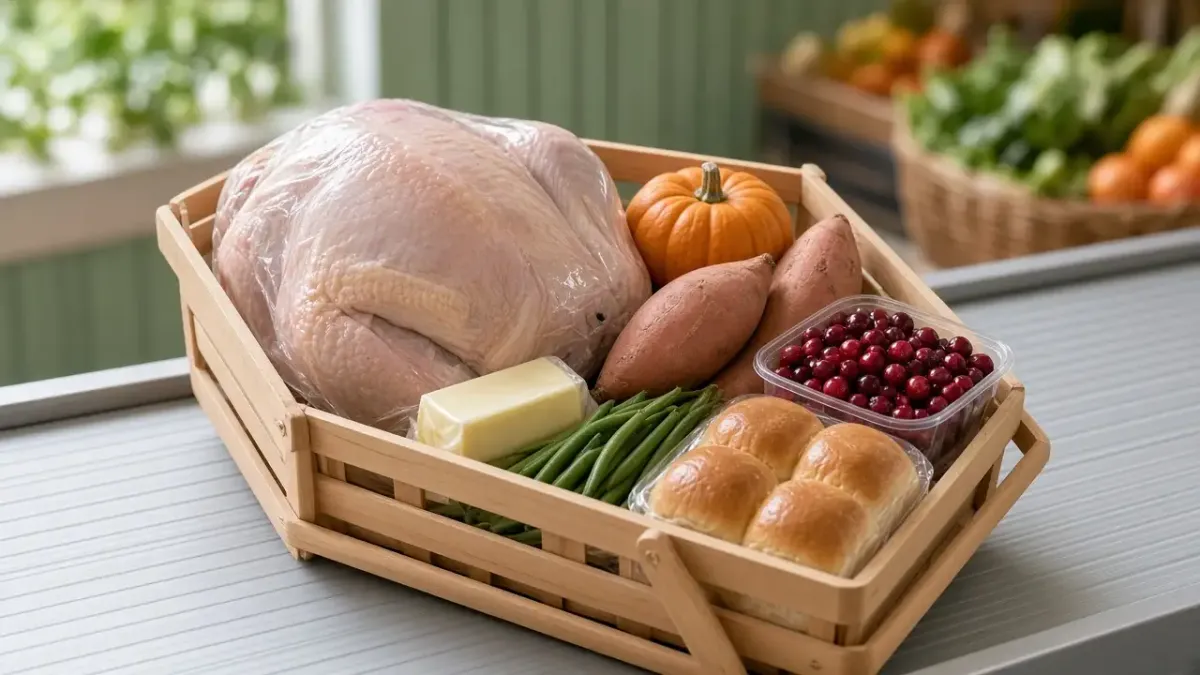
Holiday grocery shopping places a predictable strain on household budgets every November. Planning a holiday feast for ten guests involves dozens of ingredients, from baking staples and butter to fresh vegetables and whole poultry. For three consecutive seasons, elevated grocery prices forced families to trim menus, look for discount codes, or scale back holiday gatherings.
The market dynamic has shifted in November 2026. Major supermarket chains are competing aggressively for grocery market share, rolling out pre-packaged holiday meal deals designed to undercut food inflation and draw foot traffic into physical aisles and digital apps. While shoppers await official 2026 national grocery averages—as USA TODAY reported on November 4, 2026, the American Farm Bureau Federation collects survey pricing through early November and schedules its 2026 findings for November 18—households are measuring current store promotions against established benchmarks. In its 40th annual survey, the American Farm Bureau Federation recorded a classic ten-person dinner cost of $55.18, while the Wells Fargo Agri-Food Institute Thanksgiving Food Report tracked a 2% to 3% decline in overall holiday food costs and highlighted a major price spread between store-brand and national-brand baskets.
Lower national averages do not guarantee an affordable grocery bill. Supermarkets structure their holiday promotions around sharp discounts on whole frozen turkeys while preserving high margins on side dishes, specialty pans, pre-chopped vegetables, and impulse items. Understanding how retailers price holiday bundles allows shoppers to capitalize on promotional discounts without overspending on the rest of the meal.
Thanksgiving meal price benchmarks: 2025 baseline and 2026 expectations
Evaluating holiday food costs begins with objective benchmark data collected across nationwide retail chains. The American Farm Bureau Federation conducts an annual nationwide survey tracking decades of holiday grocery pricing. In its 40th annual survey, the Farm Bureau recorded a benchmark average cost of $55.18 to feed ten people, which works out to $5.52 per guest. That benchmark sat 5% lower than the prior year’s $58.08 total and nearly 14% below the record peak of $64.05 recorded in November 2022. For 2026, the Farm Bureau’s volunteer price-checker shopping window runs November 1 through November 5, with official results scheduled for release on November 18, 2026. Until those figures arrive, that $55.18 baseline remains the standard yardstick for holiday food spending.
The primary factor driving that baseline decline was the wholesale recovery of domestic poultry supply. The Farm Bureau survey found that a sixteen-pound whole frozen turkey averaged $21.50, or roughly $1.34 per pound—a decline of more than 16% from the preceding season. Stable feed grain costs, reduced transportation expenses, and steady flock replenishment allowed commercial growers to supply grocers with ample inventory ahead of the holiday rush. Early 2026 circulars indicate that wholesale turkey supply has remained steady, encouraging retailers to use poultry as an aggressive traffic driver once again.
Geography continues to dictate what households pay at checkout. Regional benchmark numbers from the Farm Bureau show wide variations in the base cost of a ten-person meal:
- The South recorded the lowest regional average at $50.01.
- The Midwest followed at $54.38.
- The Northeast averaged $60.82.
- The West recorded the highest regional total at $61.75.
When shoppers expand their menu beyond the classic basket by adding a four-pound boneless ham, Russet potatoes, and frozen green beans, the Farm Bureau expanded baseline climbs to $77.09.
The Wells Fargo Agri-Food Institute examined holiday baskets across both national brand-name products and private-label store brands. Their benchmark Thanksgiving Food Report found that an all-store-brand holiday menu for ten people costs approximately $80, while an identical menu built with national name-brand goods costs $95. That $15 price difference equals a 16% markup for brand labels on identical food staples. The Wells Fargo analysis also noted that while whole turkey prices fell 3.7% for name brands, peripheral side dishes showed mixed movement. Store-brand dinner rolls dropped by up to 22%, and name-brand frozen vegetables fell 15%, but general food-at-home price levels for unrelated items like beef and eggs kept overall grocery receipts elevated.
Comparing the retailer meal bundles: Walmart, Aldi, and Target
In late October 2026, the country’s three largest discount grocers introduced pre-packaged holiday meal deals designed to undercut inflation concerns. Each retailer structured its promotional bundle with different item counts, guest limits, and shopping conditions.
+----------------+---------------+----------------+----------------+--------------------+
| Retailer       | Total Price   | Guest Capacity | Cost Per Guest | Primary Centerpiece|
+----------------+---------------+----------------+----------------+--------------------+
| Walmart        | $35.00        | 10 people      | $3.50          | Whole Butterball   |
| Aldi           | Under $39.00  | 10 people      | Under $3.90    | 16-lb Whole Turkey |
| Target         | $30.00        | 6 people       | $5.00          | Butterball (10 lb) |
+----------------+---------------+----------------+----------------+--------------------+
The Walmart Holiday Meal Basket announcement, published on October 28, 2026, revealed a twenty-six-item holiday basket priced at $35 to feed ten guests. This breaks down to $3.50 per person, representing a 12% price cut compared to Walmart’s equivalent 2025 promotion while expanding the bundle by 18% in item count. The basket features a whole Butterball frozen turkey priced at 97 cents per pound, canned vegetables, sweet potatoes, boxed stuffing mix, ingredients for green bean casserole, and ingredients to bake a homemade pumpkin pie with dairy whipped topping. Walmart made this bundle available in physical stores and via digital cart ordering through December 24, 2026, with free Express Delivery offered on the meal basket through November 30, 2026.
Aldi USA announced on October 14, 2026, a competing holiday meal basket priced under $39 for ten guests, working out to less than $4.00 per person. Aldi structured its bundle around the traditional shopping list tracked by the Farm Bureau survey. The basket includes a sixteen-pound whole turkey, fresh sweet potatoes, fresh cranberries, carrots, celery, canned peas, dinner rolls, and complete pumpkin pie ingredients including whole milk and heavy whipping cream. Aldi distinguishes its deal by avoiding loyalty programs, coupons, digital clipping requirements, or minimum spending thresholds. The promotional pricing remains active in stores through November 25, 2026.
Target Corporation announced on October 22, 2026, a package positioned specifically for smaller gatherings. Target’s bundle costs $30 and serves six people, which amounts to $5.00 per guest. Valid from November 8 through November 29, 2026 (excluding stores in Alaska and Hawaii), the meal contains nine specific brand-name and store-label items:
- A Butterball premium whole turkey up to ten pounds
- A three-pound bag of Good & Gather Russet potatoes
- Two 14.5-ounce cans of Del Monte French-style green beans
- One 10.5-ounce can of Campbell’s condensed cream of mushroom soup
- One 6-ounce container of Good & Gather French fried onions
- One 14-ounce can of Ocean Spray jellied cranberry sauce
- One 6-ounce box of Stove Top stuffing mix for turkey
- One 12-ounce jar of Heinz homestyle turkey gravy
- One two-count package of Favorite Day take-and-bake baguettes
Alongside this six-person bundle, Target introduced a separate price promotion on Good & Gather frozen whole turkeys at 79 cents per pound beginning in November, giving shoppers a low-cost centerpiece option outside the pre-set meal deal.
Selecting between these packages depends on group size and cooking preferences. Walmart offers the lowest price per serving for large groups at $3.50 per plate. Aldi provides fresh produce, including whole carrots, celery, and cranberries, instead of canned substitutions. Target delivers a convenient package for small households that want recognizable name brands like Campbell’s, Heinz, and Stove Top without purchasing ten-person bulk quantities.
The loss-leader mechanism and the convenience basket trap
Supermarket chains use whole frozen turkeys as loss leaders. A loss leader is a product priced at or below its wholesale acquisition cost to attract shoppers into the store. When Target sells whole turkeys at 79 cents per pound and Walmart sells Butterball turkeys at 97 cents per pound, the retailers sacrifice profit on the main protein. Their financial goal is to capture the remainder of the customer’s shopping list, where gross margins range from 35% to 55%.
Shoppers who rely on automated one-click bundles frequently fall into a convenience basket trap. Retailers design digital carts to bundle twenty to thirty items with a single tap. This setup creates three distinct financial leaks:
- Unneeded pantry duplication: A pre-configured bundle adds table salt, ground black pepper, granulated sugar, all-purpose flour, and canned chicken broth to the order. Most households already store these pantry staples. Paying for duplicate spices and baking goods inflates the actual cost of the meal.
- High-margin impulse additions: Online checkout interfaces recommend roasting pans, cooking twine, meat thermometers, aluminum foil rolls, and specialty basting brushes right before payment processing. A single disposable aluminum roasting pan costs $4.50 to $7.00 at retail, which can equal 20% of the entire budget for the food.
- Pre-cut produce markups: Retailers place bagged, washed, and pre-diced celery, onions, and peeled butternut squash directly beside the holiday displays. Pre-diced mirepoix mixes cost between $3.50 and $5.00 for a ten-ounce container. Buying whole celery stalks and loose yellow onions yields three times the volume for less than $2.00, requiring only ten minutes of manual knife work.
To avoid these retail traps, treat promotional meal announcements as a reference menu instead of an obligatory bundle. Pick up the loss-leader bird and basic produce items at the promotional price, and choose items individually based on what your kitchen requires. Readers managing strict monthly food spending can review our breakdown on saving money on groceries in 2026 for ongoing pantry management principles.
Brand name vs store brand: calculating the real spread
The Wells Fargo Thanksgiving data highlighted a $15 gap between brand-name and store-brand baskets for a ten-person meal. That spread grows wider when hosts purchase premium ingredients or double the recipes for large gatherings. The grocery industry uses distinct manufacturing and packaging processes that determine whether private-label substitutions make sense.
Commodity staples show zero chemical or functional variation between store brands and national brands. Under federal standards enforced by the Department of Agriculture and the Food and Drug Administration, commodity goods must adhere to identical purity and composition requirements:
- Granulated white sugar: Pure sucrose behaves identically in pies and glazes regardless of whether the bag carries a national trademark or a supermarket private label. The store label typically costs 30% less per pound.
- All-purpose white flour: Unbleached flour from a store label delivers the same protein content (10% to 11.5%) as name-brand alternatives for pie crusts and roux-based gravies.
- Pure butter: USDA Grade A salted and unsalted butter contains a minimum of 80% butterfat by law. Store brands cost between $3.20 and $3.80 per pound, while premium national brands command $5.00 to $6.50 per pound. Buying three pounds of butter for holiday baking yields $6.00 to $9.00 in direct savings from this single category.
- Evaporated and sweetened condensed milk: Canning standards ensure uniform moisture levels and milk fat content. Substituting private labels saves 40 to 70 cents per can.
Side dish components present the steepest brand price premiums. The Wells Fargo report revealed that private-label dinner rolls dropped 22% in price in its benchmark survey, while brand-name baked goods remained flat. A package of twelve national-brand dinner rolls costs between $4.29 and $4.99, whereas store-brand brown-and-serve rolls sell for $1.99 to $2.49.
Similarly, canned green beans, canned whole kernel corn, and canned pumpkin puree carry significant brand markups. A fifteen-ounce can of brand-name pumpkin puree retails for $2.79 to $3.19. The store-brand equivalent sells for $1.49 to $1.89. Both contain 100% pure Dickinson pumpkin puree. Buying two cans for holiday pies saves nearly $3.00 with identical culinary texture and spice absorption. For broader strategies on eliminating brand premiums across weekly grocery trips, see our guide on smart grocery shopping tactics.
A three-week shopping timeline to beat price spikes
Rushing to the supermarket two days before Thanksgiving guarantees long checkout lines, picked-over produce shelves, and impulse purchases caused by time pressure. Spreading holiday purchases across three strategic trips keeps spending predictable and preserves access to promotional inventory.
+---------------------------+-----------------------------------------------+----------------------------------+
| Timeline Phase            | Targeted Grocery Categories                   | Storage & Prep Instructions      |
+---------------------------+-----------------------------------------------+----------------------------------+
| Phase 1: Nov 5 - Nov 12   | Canned pumpkin, broth, flour, sugar, butter   | Dry pantry storage; freeze butter|
| Phase 2: Nov 13 - Nov 18  | Frozen turkey, frozen vegetables, roll dough  | Keep in freezer; schedule thaw   |
| Phase 3: Nov 22 - Nov 25  | Fresh herbs, celery, sweet potatoes, dairy    | Crisper drawers; chill dairy     |
+---------------------------+-----------------------------------------------+----------------------------------+
Phase one runs through the second week of November. Focus entirely on shelf-stable pantry dry goods, canned ingredients, and freezer staples. Purchase canned pumpkin, chicken broth, cranberry sauce, stuffing cubes, baking spices, brown sugar, and flour. Store-brand butter freezes without quality loss for up to nine months; purchasing four pounds during early November promotional sales locks in discounted pricing before holiday demand peaks.
Phase two covers the middle of November, between ten and twelve days prior to Thanksgiving. This is the optimal window to acquire the frozen turkey. Purchasing early ensures selection of the desired weight range (twelve to sixteen pounds) before bins hold only oversized twenty-plus-pound birds. Store the bird in your home freezer until the thawing schedule begins. Whole turkeys require approximately twenty-four hours of refrigerator thawing for every four to five pounds of bird weight, maintained at a refrigerator temperature between 38°F and 40°F:
- A 12-pound turkey requires 3 full days of refrigerator thawing (start Sunday night).
- A 16-pound turkey requires 4 full days of refrigerator thawing (start Saturday night).
- A 20-pound turkey requires 5 full days of refrigerator thawing (start Friday night).
Phase three takes place during the three days leading up to Thanksgiving. Reserve this final short trip for highly perishable produce: fresh parsley, rosemary, thyme, sage, celery, sweet potatoes, and heavy whipping cream. Purchasing fresh produce close to the holiday prevents wilting, browning, and food waste.
Practical kitchen strategies to lower your total spend
Managing food costs requires practical execution inside the kitchen. Several straightforward adjustments keep expenses manageable without diminishing the quality of the meal.
Conduct a physical pantry audit before drafting your grocery list. Check the back of kitchen cabinets for existing baking powder, baking soda, ground cinnamon, nutmeg, salt, and olive oil. Inspect open bags of rice, bread crumbs, and broths. Cross off every item already on hand. Buying an extra jar of ground poultry seasoning or pure vanilla extract wastes $4.00 to $8.00 on products that sit partially used for months.
Calculate serving sizes accurately to avoid purchasing surplus food. The hospitality standard for whole bone-in turkey is 1.25 pounds of raw bird per guest. This allocation accounts for bones, giblets, shrinkage during roasting, and a reasonable portion of next-day leftovers:
- 6 guests: 8 to 10 pound turkey
- 10 guests: 12 to 14 pound turkey
- 12 guests: 15 to 16 pound turkey
- 16 guests: 20 pound turkey, or two 10-pound turkeys
Buying a twenty-two-pound bird for eight people forces the host to pay for eight extra pounds of poultry that often ends up discarded.
Use a collaborative potluck model. Hosting a Thanksgiving meal does not require funding every course alone. When hosts provide the roasted turkey, homemade gravy, and mashed potatoes, guests are happy to contribute side dishes, dinner rolls, appetizers, cranberry sauce, and pies. Assigning specific items prevents duplicate cranberry cans or unwanted dishes while dividing the total grocery expenditure among multiple households.
Pay with debit cards or dedicated cash savings to avoid credit cards with carrying balances. Carrying holiday grocery purchases on high-interest credit cards turns an affordable meal into an expensive recurring debt. For an examination of how food spending interacts with revolving card interest, read our analysis on grocery credit debt and store spending patterns.
Summary checklist for a budget-friendly Thanksgiving
Preparing an affordable holiday meal comes down to disciplined planning, deliberate product substitution, and avoiding retail marketing traps. Follow these core steps:
- Check your local store flyers for loss-leader whole turkey pricing, targeting under $1.00 per pound.
- Compare Walmart ($35 for 10), Aldi (under $39 for 10), and Target ($30 for 6) bundles against your specific head count.
- Decline pre-selected one-click digital carts to avoid paying for staple ingredients already stored in your pantry.
- Buy store brands for baking commodities, canned vegetables, butter, and dinner rolls to capture 15% to 22% in immediate savings.
- Space purchases over three weeks to prevent rushed shopping trips and impulse spending.
- Size your whole bird to 1.25 pounds per attendee to eliminate expensive poultry waste.
- Distribute desserts, appetizers, and specialty beverages to attending guests through a structured potluck plan.
Implementing these steps allows households to serve a complete holiday dinner that meets tradition while protecting personal finances from unnecessary seasonal strain.
Disclaimer: This article provides general consumer budgeting and grocery shopping information. It does not constitute formal personal financial, tax, or investment advice. Price estimates and bundle availabilities reflect corporate announcements and regional retail surveys active in November 2026 and may vary by store location.


Discussion
Comments
Share a helpful tip, question, or takeaway from How to Cut Thanksgiving Dinner Costs in 2026.
0 Comments
Loading comments…