
You know that feeling when you walk into your home and everything is where it should be? No piles of mail on the counter, no jackets draped over chairs, no mysterious objects collecting dust on the bathroom shelf. It sounds like a fantasy, but people who maintain organized homes say it comes down to a handful of habits they do every single day. None of them take more than five minutes.
The problem most people face isn’t that they don’t know how to organize. It’s that they treat organization as a weekend project instead of a daily practice. You spend eight hours on Saturday reorganizing the pantry, and by Wednesday it looks like a tornado hit it again. The cycle repeats because the root issue was never the system. It was the lack of small, consistent actions that keep the system working.
Here are six habits that professional organizers and people with consistently tidy homes swear by. Pick one or two to start, and watch what happens over the next few weeks.
The five-minute evening reset
Every organized home has some version of this: a short routine done before bed that returns the living space to a baseline state. It’s not deep cleaning. It’s not scrubbing floors. It’s putting things back where they belong.
The routine might look like this: clear the kitchen counter of dishes and random objects, fold the blanket on the couch, stack the mail into a tray, hang up the jacket you wore that day. Five minutes. Maybe ten if you’re thorough.
Clutter accumulates gradually. A single coffee cup on the counter isn’t a problem. But that cup stays, and tomorrow there’s a water bottle beside it, and by Friday there are seven items occupying space that was clear a week ago. The evening reset breaks that accumulation cycle before it starts.
Professional organizer Rachel Rosenthal, who runs Rachel Organizes in Washington DC, told Southern Living that her clients who maintain organized homes all share one trait: they don’t leave a room empty-handed. You’re heading to the bedroom? Grab the glass that’s been sitting on the coffee table. Walking to the kitchen? Take the book that’s been on the armchair since Tuesday. It takes seconds, and it prevents the slow creep of objects into spaces where they don’t belong.
The one-minute rule
This one is deceptively simple: if a task takes less than one minute, do it immediately. Don’t set it down and promise yourself you’ll handle it later. Handle it now.
The one-minute rule covers things like hanging up your coat instead of draping it over a chair, putting the cereal box back in the pantry instead of leaving it on the counter, wiping down the bathroom sink after you use it, tossing junk mail directly into the recycling bin instead of adding it to a pile.
Those small tasks take sixty seconds each. If you defer them, they pile up into a thirty-minute decluttering session on the weekend. Worse, while they’re sitting there, they create visual noise that makes your home feel cluttered even when it’s technically clean.
The one-minute rule also fights a specific psychological trap: the “I’ll do it later” mindset that turns one unwashed dish into a full sink by evening. Research on habit formation from the University of Nottingham shows that the friction between deciding to do something and actually doing it is the biggest barrier to small tasks. By making it a rule (if it’s under a minute, you do it now), you eliminate the decision-making step entirely.
Designated homes for everything
This habit is the foundation that makes all the others possible. Every item in your home needs a specific place where it lives. Not a general zone. A specific spot.
Keys go in the bowl by the front door, not on the counter. Remote controls go in the drawer under the TV, not on the couch. Cleaning supplies go under the kitchen sink, not in a bag in the closet. When every item has a home, putting it back takes zero thought.
Professional organizers call this “assigning addresses.” The concept is borrowed from warehouse management, where efficiency depends on workers knowing exactly where every product is stored. Your home works the same way. If you have to think about where something goes, you’re less likely to put it back. If the answer is obvious because the item has a clear, designated spot, the action becomes automatic.
This also means you need to be honest about storage. If you don’t have a logical place for something, that’s a signal you either need to create one or get rid of the item. A kitchen drawer crammed with random gadgets has no system. A drawer with dividers for utensils, measuring spoons, and oven mitts has designated homes for everything in it.
Start with the items that end up on your counter or floor most often. Those are the ones without proper homes. Assign them a spot, and the clutter in those areas drops immediately.
The two-minute decluttering sprint
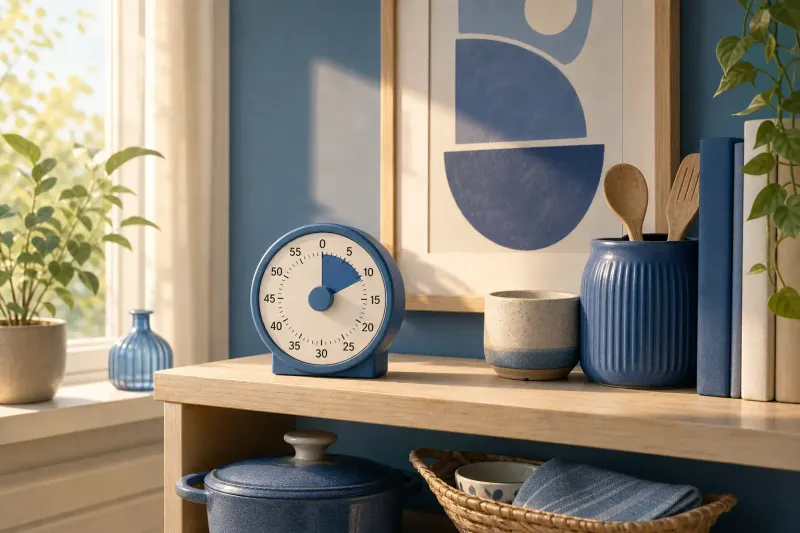
Borrowed from productivity frameworks, the two-minute decluttering sprint is exactly what it sounds like: set a timer for two minutes and declutter one small area. A single drawer. One shelf. The top of your nightstand. The glove compartment of your car.
The power of this habit isn’t in the two minutes of work. It’s in the consistency. Two minutes a day adds up to over twelve hours a year. That’s twelve hours of maintaining order instead of twelve hours of weekend-long organizing marathons that leave you exhausted and resentful.
The key is scope. Don’t try to organize the entire garage in one session. Pick one drawer, one shelf, one surface. When the timer goes off, stop. You’ll come back tomorrow and do another two minutes somewhere else. Over weeks, every surface in your home gets attention without any single session feeling overwhelming.
This approach also prevents the perfectionism spiral that derails most organizing efforts. You open a closet intending to spend fifteen minutes and end up three hours deep, surrounded by a bigger mess than when you started. The two-minute rule keeps the scope tight and the momentum going.
The one-in-one-out rule
This is the habit that keeps your home from filling up again after you’ve organized it. For every new item that enters your home, one existing item leaves. Buy a new shirt? Donate one. Get a new kitchen gadget? Toss the old one. New book on the shelf? Pass one along to a friend.
The rule works because it forces a constant evaluation of what you own. You can’t mindlessly accumulate because every addition requires a subtraction. It’s a built-in check against the slow buildup that undoes all your organizing work.
Some people apply this rule strictly to specific categories: clothes, books, kitchen items. Others extend it to everything. The strict version is easier to start with because the categories are clear and the decisions are simpler. Do I like this new shirt more than the old one I just bought it to replace? Yes? Keep the new one, donate the old.
The one-in-one-out rule also shifts your mindset from acquisition to curation. Instead of asking “do I want this?” at the store, you start asking “is this worth losing something I already own for?” That subtle change in perspective reduces impulse purchases and keeps your home from growing beyond what you can comfortably maintain.
The five-minute morning tidy
The evening reset handles the day’s accumulation. The morning tidy handles the overnight. Make the bed, put away anything that migrated to the bedroom overnight, and do a quick pass through the main living areas before you leave the house.
This habit matters because it sets the tone for your entire day. Coming home to a space that’s already in order feels entirely different from coming home to one that needs work. The morning tidy ensures you always come home to the first scenario.
It also catches things the evening reset might have missed. Maybe you left a book on the coffee table last night, or there’s a jacket on the dining chair that got overlooked. The morning pass catches those strays before they become permanent residents.
The morning tidy doesn’t need to be thorough. It’s a quick sweep, not a deep clean. The goal is to reset the main spaces (kitchen, living room, entryway) so they look intentional when you walk in the door that evening.
Why these habits work together
None of these habits is revolutionary on its own. Put them together, though, and they create a system where clutter never gets a chance to accumulate. The evening reset prevents overnight buildup. The morning tidy catches strays. The one-minute rule handles individual items in the moment. The two-minute sprint maintains specific areas. The one-in-one-out rule controls the volume of stuff entering your home. And designated homes make putting everything back effortless.
The real insight from professional organizers isn’t about bins and labels. It’s about consistency. A perfectly organized closet means nothing if you stop maintaining it for two weeks. These habits are designed to be low-effort and high-frequency, which is the only combination that works long term.
How to start without overwhelm
The biggest mistake people make when trying to get organized is attempting everything at once. You watch an organizing video on a Sunday afternoon, feel inspired, and try to overhaul your entire home before bedtime. By Monday, you’re exhausted and nothing has changed.
Instead, pick one habit and commit to it for two full weeks. The evening reset works well as a starting point because it affects the most visible spaces in your home and gives you immediate visual results. You’ll see the difference the first morning you walk into a kitchen that’s already clean.
After two weeks, add a second habit. The one-minute rule pairs naturally with the evening reset because it prevents the daytime accumulation that the evening routine then has to clean up. Together, they keep your home in a constant state of near-readiness.
The two-minute decluttering sprint is a good third habit because it addresses the deeper clutter that the first two habits can’t reach. The evening reset puts things back where they belong, but it doesn’t sort through the junk drawer or clear out the closet shelf that’s been collecting random objects for months. The two-minute sprint handles those projects in small, manageable chunks.
The one-in-one-out rule is best introduced once the other habits feel automatic. It requires a different kind of thinking, a pause before purchasing that questions whether the new item is worth the disruption. It’s a habit that protects all your other organizing work by preventing the inflow that would undo it.
The morning tidy is the easiest habit to add because it takes the least time and pairs with something you already do: getting ready for your day. If you make your bed every morning, extend that routine to include a quick pass through the kitchen and living room. The additional time is usually under three minutes.
Common obstacles and how to handle them
Even with the best habits, you’ll hit obstacles. Here are the most common ones and what to do about them.
Other people in the household. If you live with family or roommates who don’t share your organizing habits, you’ll feel like you’re fighting a losing battle. The solution isn’t to nag or lecture. It’s to create systems so easy that even a reluctant participant can follow them. Labeled bins, clearly visible hooks, and open storage make it obvious where things go. When the system is intuitive, even the messiest person in the house can work with it.
Seasonal transitions. Your home needs different things in summer versus winter. The coat that hung by the door in January doesn’t belong there in July. Seasonal transitions are when clutter spikes because items move between active and storage status. Build a seasonal reset into your calendar: spend twenty minutes at the start of each season swapping out seasonal items and reassessing what you actually need.
The sentimental pile. Everyone has objects they keep because of emotional attachment, not practical use. The ticket stub from a first date, the sweater from a grandparent, the kids’ artwork from preschool. These items don’t follow the one-in-one-out rule because they’re not about utility. Designate one box or shelf for sentimental items. When it’s full, something old has to leave for something new to enter. This gives you a boundary without forcing you to abandon the memories.
Decision fatigue. Organizing requires hundreds of small decisions: keep or donate, this spot or that spot, important or trash. Decision fatigue is real, and it’s why marathon organizing sessions leave you drained. The two-minute sprint and the one-minute rule are designed to minimize decisions by establishing simple criteria. For the evening reset, the question is just “does this item belong here?” If yes, leave it. If no, move it to its home. That’s one decision, not thirty.
The compound effect
What makes these habits powerful isn’t any single one of them. It’s the compound effect of doing them consistently over time. A five-minute evening reset, done daily, adds up to over thirty hours a year of maintaining your home. That’s thirty hours of preventing mess instead of thirty hours of cleaning up after it.
The two-minute decluttering sprint, done daily, means every surface in your home gets attention over the course of a few months. You never face a weekend-long organizing project because there’s never enough accumulated clutter to justify one.
The one-in-one-out rule means your home stays roughly the same size forever. You add and remove items at the same rate, so the total volume of stuff never grows beyond what your space can comfortably hold.
These habits don’t require willpower or motivation. They require systems. And once the systems are in place, maintaining your home becomes as automatic as brushing your teeth: something you do without thinking because it’s just what you do.
Start with one habit this week. The evening reset is the most impactful for most people because it affects the largest visible area of your home. Once that feels automatic, add the one-minute rule. Then layer in the others. Within a month, you’ll notice the difference not just in how your home looks, but in how it feels to walk through the door at the end of the day.
Discussion
Comments
Share a helpful tip, question, or takeaway from 6 Daily Habits That Keep Your Home Organized Without Burnout.
0 Comments
Loading comments…