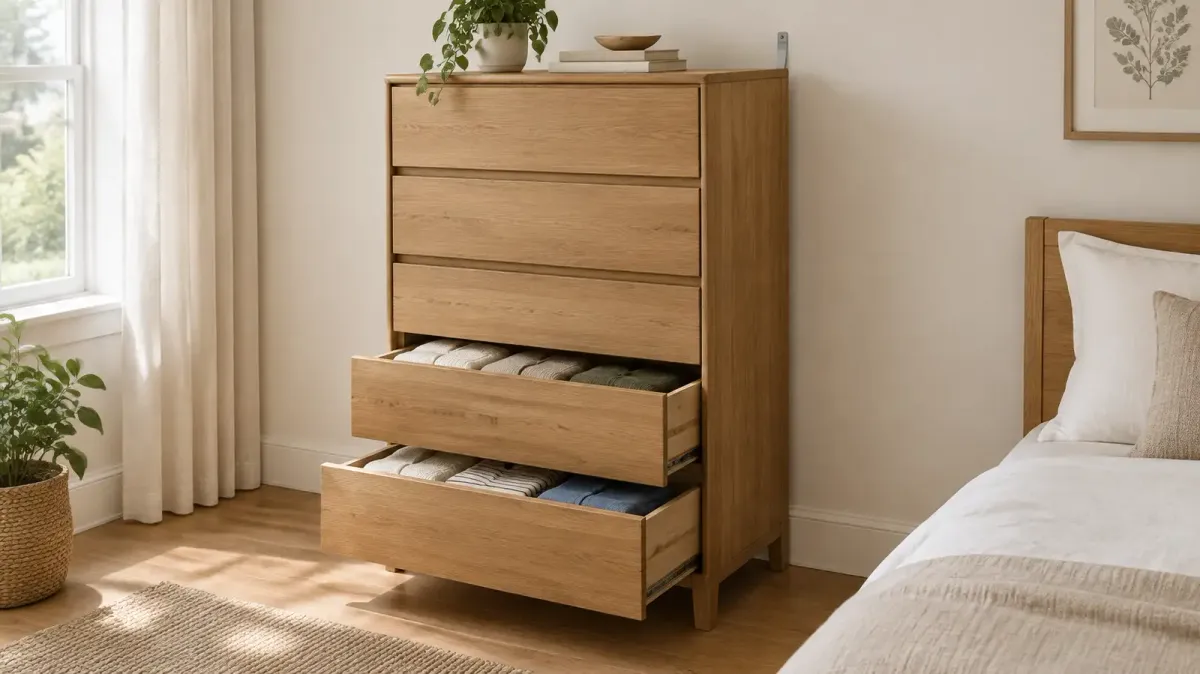
Tall bedroom dressers help clear floor clutter in tight rooms, but vertical storage introduces physical balance risks that many homeowners overlook. On November 5, 2026, the U.S. Consumer Product Safety Commission issued Recall 27-068 for approximately 1,392 units of HAUOMS eight-drawer dressers sold online by Jiastfeng. The recalled units violated mandatory federal stability rules under the STURDY Act. Standing nearly five feet tall on a base less than 28 inches wide, these cabinets can topple forward when unanchored, creating severe entrapment dangers for young children.
Organizing clothing vertically frees up needed floor space, yet gravity works against tall, narrow furniture. When you fill multiple upper drawers with folded garments and open them simultaneously during morning routines, the center of mass moves past the front edge of the cabinet base. Keeping your bedroom orderly requires both smart internal space management and proper physical stabilization. By pairing thoughtful drawer weight distribution with secure mechanical wall anchoring, you can maximize your storage without putting your household at risk.
What the November 2026 dresser recall revealed
The November 5, 2026 CPSC announcement concerning HAUOMS eight-drawer dressers provides a textbook example of how furniture geometry influences bedroom safety. Imported by Zhengzhoushi Rupiao Electronic Commerce Co., Ltd. (operating as Jiastfeng) and sold on Amazon between May 2025 and September 2026 for around $150, the affected dressers carry packaging SKU AJ_DJ504298_1. The units measure approximately 59.1 inches high, 27.6 inches wide, and 15.8 inches deep, with an empty weight of roughly 112.4 pounds.
Those exact dimensions explain why the product failed federal stability rules. A height-to-depth ratio of nearly four to one means that even a minor forward tilt causes the cabinet to lose its balance point. While no injuries had been reported prior to the recall, federal regulators mandated an immediate stop-use instruction for unanchored units. Consumers were directed to write the word RECALLED in permanent marker across the top, front, and sides, remove the drawers, take verification photos, and email [email protected] to receive a full refund before throwing the frame away.
This recall followed another recent action on October 29, 2026, when CPSC issued Recall 27-049 for 138 units of SOOWERY eight-drawer fabric dressers (SKU SOO-8DD-G01). That piece featured a lightweight metal skeleton with fabric pull-out bins, standing 35.4 inches high and 47.2 inches wide. Even though fabric dressers seem softer and lighter than solid wood, unanchored fabric storage towers also fall under mandatory stability testing if they meet basic clothing storage dimensions.
Many people turn to vertical dressers when dealing with small closet organization challenges, assuming that modular furniture sold by online retailers has already undergone foolproof safety vetting. In reality, marketplace sellers frequently import ready-to-assemble units that skirt engineering standards. As an organizer, verifying that your furniture meets current safety benchmarks is the first step before folding a single shirt.
Understanding STURDY Act stability rules
Federal oversight of clothing storage units changed fundamentally with the implementation of the STURDY Act (Stop Tip-overs of Unstable, Risky Dressers on Youth Act), codified under 15 U.S.C. 2056f. Enforced by the CPSC through 16 CFR Part 1261, this rule adopted the ASTM F2057-23 standard as a mandatory national safety regulation.
Under this legal framework, any freestanding clothing storage furniture must pass three standardized physical tests if it meets three specific baseline metrics:
First, the unit stands 27 inches (68.6 centimeters) or higher.
Second, the empty unit has a mass of 30 pounds (13.6 kilograms) or greater.
Third, the unit provides an enclosed storage volume of at least 3.2 cubic feet (90.6 liters).
If a piece of furniture meets those three conditions, regardless of whether it is built from solid oak, composite particleboard, or steel frames with fabric bins, it must pass three rigorous mechanical stability evaluations:
The first test measures stability with multiple open drawers. Technicians load all drawers with weighted simulations of clothing and extend every drawer or pull-out tray at the same time. The dresser must remain upright on level flooring without wobbling or tilting forward.
The second test applies dynamic horizontal force. Testers push and pull the top or designated handholds with a 10-pound horizontal force over five seconds, holding the force steady for ten seconds. This replicates a toddler tugging on a drawer pull or leaning against the side.
The third test simulates real carpet conditions combined with a child climbing on the furniture. The unit is placed on a test surface that replicates plush residential carpeting and padding. With drawers loaded, testers hang a 60-pound weight on the outer edge of the most unstable open drawer. The dresser must withstand this heavy downward load without tipping over.
Beyond physical tests, compliant storage units must include permanent warning labels placed in clear view inside an upper drawer or interior panel. These labels warn that tip-over accidents cause serious injuries and fatalities, direct owners to anchor the furniture directly into wall studs, and instruct users never to place televisions or heavy electronics on top of clothing dressers.
Why tall vertical dressers tip during normal home organizing
According to safety data compiled by the federal Anchor It! campaign, children aged five and younger account for over 80 percent of all furniture tip-over fatalities. Roughly 44 percent of all fatal incidents occur in bedrooms. The reason bedrooms represent such a concentrated risk area stems directly from how clothing dressers are organized and used.
From a physics standpoint, a dresser acts as a lever system resting on a narrow base. When a dresser sits empty against a wall, its center of gravity rests near the middle of its depth, well behind the front feet. However, home organization habits alter that balance point in four distinct ways:
First, laundry habits often concentrate heavy fabrics near eye level. People naturally place everyday items, like heavy cotton jeans, denim jackets, and thick winter sweaters, into middle and upper drawers so they do not have to bend down every morning. Placing 25 pounds of dense denim in the top two tiers of a 59-inch dresser raises the cabinet center of gravity toward the top third of the frame.
Second, opening drawers extends the lever arm. High-quality ball-bearing drawer slides allow drawers to extend out 12 to 14 inches. When two or three upper drawers are open simultaneously, the weight of the drawers and the clothing inside shifts forward into empty air. If the forward weight exceeds the counterweight of the base and back panel, the unit pivots on its front feet.
Third, plush carpet creates an automatic forward lean. Standard bedroom carpeting rests on foam padding ranging from 0.375 to 0.5 inches thick. When you place a heavy dresser against a baseboard, the rear feet often sit on carpet that is compressed by the carpet tack strip near the wall, while the front feet rest on softer, thicker pad foam. This tiny height difference tilts the entire cabinet slightly forward, reducing the force needed to cause a rollover.
Fourth, children naturally treat open drawers as ladders. When a toddler wants a toy, a hair accessory, or a shirt placed out of reach, they pull out the bottom drawer and step onto the front lip. Stepping on an open drawer exerts downward torque that easily overcomes an unanchored frame.
Organizing tall bedroom dressers for stability
Editorial analysis of bedroom storage patterns shows that safe organization begins with deliberate weight distribution. Treating all drawers as interchangeable compartments is a common organizational mistake. To maintain physical stability, your loading plan should reflect the structural realities of vertical furniture.
Follow a strict bottom-heavy loading protocol across your storage tower. Reserve the lowest one or two drawers for your heaviest personal items. This includes heavy winter blankets, extra bed linens, denim pants, thick hooded sweatshirts, and spare bath towels. Placing heavy fabrics at the floor level creates a ballast effect, keeping the overall center of mass anchored low to the ground even when upper compartments are opened.
Middle drawers should house medium-weight garments. Long-sleeve shirts, cotton t-shirts, workout clothes, and light casual trousers fit well in the middle tiers. Use fabric drawer dividers or shallow acrylic bins to keep these garments folded upright in file-folding rows. File folding prevents you from digging through stacked piles, which often leads to pulling drawers out farther than necessary.
Upper drawers must be restricted to lightweight essentials. Underwear, socks, scarves, belts, sleepwear, and lightweight jewelry belongs in the top tiers. Never store stacks of heavy hardback books, weighted paper organizers, metal tool kits, or handheld electronics in the upper third of a tall dresser.
If your bedroom closet cannot hold bulky winter coats and off-season bedding, avoid cramming them into the top of your dresser. Instead, redirect excess textiles into under bed storage ideas, which take advantage of dead horizontal floor space without creating vertical tip hazards. Moving bulky items under the bed frees up dresser drawers so you never need to overstuff them.
Resist the urge to decorate the top surface of a tall dresser with bulky items. Placing heavy ceramic lamps, heavy storage baskets, vanity mirrors, or entertainment screens on a tall chest creates extreme top-heavy leverage. Keep the top surface clear, or limit items to light paper trays, small fabric trays for pocket items, and small frameless photos.
Step by step guidelines to anchor frames into wall studs
No amount of careful drawer loading replaces permanent mechanical anchoring. Even a perfectly packed dresser can tip if someone stumbles against an open drawer or if multiple drawers slide forward during an earth tremor or floor vibration. Anchoring a tall dresser takes less than thirty minutes and requires basic household tools.
To anchor your furniture properly, gather a reliable electronic stud finder, a bubble level, a cordless drill with pilot drill bits, a screwdriver, and a certified anti-tip furniture strap kit. Choose anchor kits featuring steel aircraft cables or woven nylon straps rated for at least 300 pounds of tensile load, paired with forged steel mounting brackets. Avoid plastic zip-tie brackets, which degrade, turn brittle over time, and snap under sudden shock loads.
Begin by locating the wooden wall studs behind your dresser. Turn on your stud finder and sweep horizontally along the wall at the height of the dresser top. Mark the center of each detected stud with a pencil. In standard North American residential construction, wall studs are spaced 16 inches apart on center (or occasionally 24 inches). For maximum safety, you should secure a tall dresser to at least two separate wall studs.
Next, mark your bracket attachment points on the furniture frame. Never screw an anchor bracket into thin cardboard or fiberboard backing panels. Brackets must be mounted directly into the solid wood or engineered hardwood frame of the dresser, such as the top rear horizontal rail or the solid side vertical stiles. Drill pilot holes into the furniture frame using a drill bit slightly smaller than your bracket screws to prevent wood splitting, then fasten the brackets tightly using the heavy-duty wood screws provided in the kit.
Position the corresponding wall brackets on your pencil marks over the wall studs. The wall bracket should sit approximately one to two inches below the furniture bracket. This downward angle ensures that when the tether is pulled taut, it pulls the top of the dresser backward into the wall instead of upward. Drill pilot holes at least two inches deep directly into the center of each wooden stud. Drive 2.5-inch or 3-inch steel wood screws through the bracket and drywall into the solid wood stud.
Slide the dresser into its final position against the wall. Thread the steel cable or nylon strap through both brackets and tighten the adjustment buckle until there is zero slack. Check the cabinet with your bubble level to confirm the unit sits flat without twisting. If your baseboard trim prevents the dresser feet from touching the wall, install wood spacer blocks between the wall bracket and the wall stud, or adjust your strap tension so the furniture remains rigid without bending the brackets.
Renter-friendly anchor options and lease compliance
Renters frequently avoid anchoring tall furniture because they worry about losing their security deposits over drywall holes. However, leaving a tall dresser unanchored in an apartment is an unnecessary gamble. Modern lease agreements and local residential housing codes increasingly protect tenant rights regarding child safety devices, and repairing anchor holes upon move-out is simple and inexpensive.
Standard anti-tip kits use screws that leave holes roughly one-quarter inch in diameter in the drywall. When your lease ends, you can patch those holes in five minutes with lightweight spackling paste, a putty knife, and a sanding sponge. Most landlords consider small screw holes for wall-mounted safety anchors to fall under normal wear and tear, especially when safety hardware protects the property from falling furniture damage.
If your dresser sits in a spot where wall studs do not line up with the corners of your furniture frame, you have reliable structural alternatives. You should never use standard plastic push-in drywall anchors, which easily pull out of gypsum plaster under a 50-pound dynamic load. Instead, use heavy-duty steel toggle bolts or strap toggles rated for 80 to 100 pounds of shear weight.
A toggle bolt passes through a drilled hole in the drywall, after which a spring-loaded steel wing opens behind the wall surface. As you tighten the bolt, the wide metal wing clamps firmly against the interior drywall paper, distributing the holding force across a wide surface area. While solid wood studs remain the gold standard for tip prevention, heavy-duty toggle bolts provide dependable secondary support when studs are inaccessible.
If you live in a rented studio or temporary housing where drilling is strictly prohibited by a formal lease addendum, avoid tall vertical chests altogether. Swap out narrow 60-inch towers for wide, low three-drawer dressers that stand under 30 inches tall. You can also implement decluttering systems like the two-foot rule decluttering method to downsize your wardrobe so all your everyday clothing fits into closet shelving and low storage units without creating tip risks.
Routine safety inspections and daily drawer habits
Safety is not a one-time project that ends when you tighten the anchor strap. Over months of everyday use, structural connections can loosen as drawers are pulled and floors settle. Establishing simple inspection habits keeps your bedroom organization secure over the long term.
Schedule a quick hardware check every six months, perhaps aligned with daylight saving time adjustments or seasonal wardrobe rotations. Push gently on the top edge of your tall dresser to verify that the anchor straps remain snug and rigid. If you notice any slack, pull the adjustment buckle tight. Check the screws holding the brackets into the wall and furniture frame; if vibrations have loosened a screw, tighten it with a handheld screwdriver.
Inspect the internal drawer hardware on each tier. High-grade drawer runners include mechanical safety stops that prevent a drawer from pulling all the way out of the carcass. If a plastic or metal drawer stop breaks, a full drawer can slide off the track onto your toes, shifting weight abruptly and damaging the frame. Replace damaged slides promptly or install aftermarket drawer stop wedges.
Finally, establish clean daily habits for everyone in your household. Make it a strict household rule that only one drawer may be opened at a time. When putting away clean laundry, open a drawer, deposit the folded garments, and push the drawer completely shut before opening the next tier. Teaching children and family members to close drawers immediately removes the stair-step hazard entirely.
By respecting the balance mechanics of tall bedroom dressers, adhering to federal safety standards, and anchoring every vertical frame into solid framing, you can enjoy a tidy, clutter-free bedroom without compromising the safety of your home.

Discussion
Comments
Share a helpful tip, question, or takeaway from Organizing Tall Bedroom Dressers: Stability and Safety.
0 Comments
Loading comments…