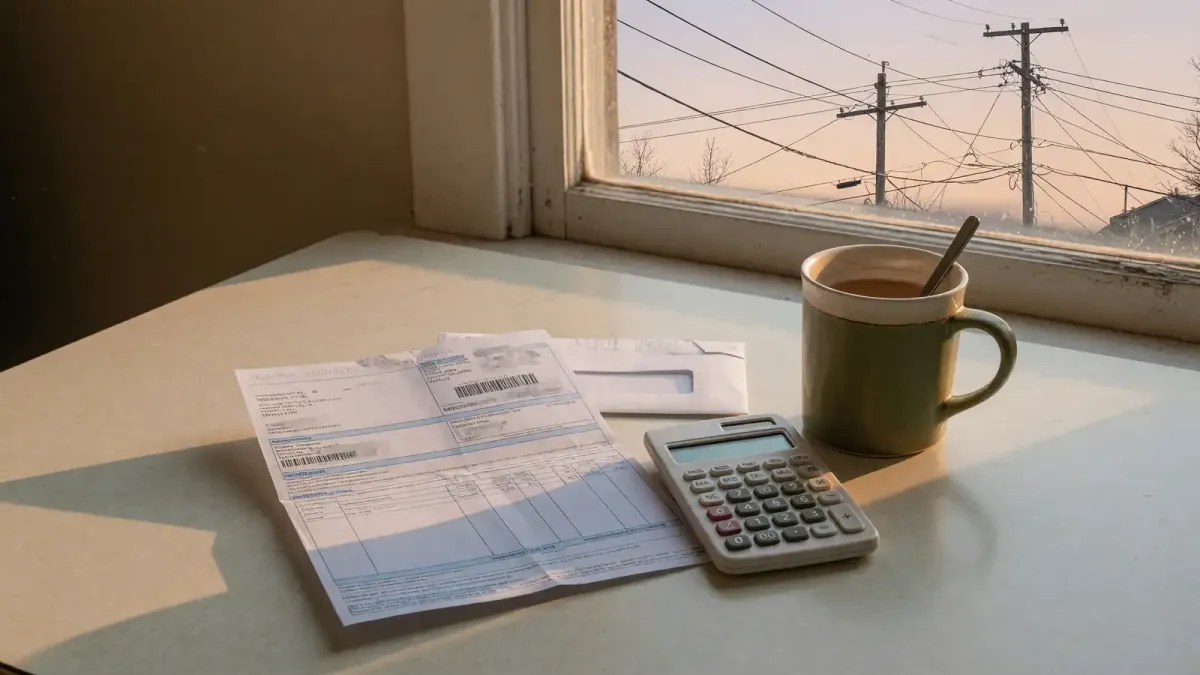
The number on the electric bill is not one number. It is supply plus delivery plus fees, and this week two different stories landed on the same line: a New Hampshire rate spike you can see in dollars, and a federal fight over who pays for the next wave of AI data centers.
I already wrote about summer tricks that shave a kilowatt-hour. Those still work. They do not touch the part of the bill the utility sets with a formula, and they do not wait for Congress.
What showed up in New Hampshire
Valley News reported on September 21 that New Hampshire bills jumped because supply rates rose. Supply is the electricity itself. Delivery is the poles, wires, substations, and the people who keep them standing. Community-power programs can shop for a cheaper supply contract. They still ride the investor-owned utility’s wires. You cannot “use less” your way out of the delivery rate. Unitil’s Vicinanzo said the quiet part: they are building and operating poles, wires, and substations, and that cost sits in delivery.
Last summer the state’s Public Utilities Commission approved a new rate-making process for Eversource. Instead of coming in each year to prove that capital projects were “prudent, used, and useful,” the utility can now move rates on pre-approved formulas. Consumer advocate Donald Kreis and state officials asked the New Hampshire Supreme Court to look at that decision. Opponents of the rule said it could turn into automatic fee increases without a real hearing.
If you do not live in New Hampshire, do not skip this. Formula rates and “multi-year” plans are spreading because utilities hate the old rate-case calendar and commissions are understaffed. The local version of this fight is whether your commission still has to look you in the eye before the delivery charge moves.
Pull last year’s bill and this month’s bill. Circle three lines: supply (or generation), delivery (or distribution), and anything labeled “adjustment,” “reconciling,” or “storm.” If supply moved, you might have a community-choice or competitive-supply option, depending on the state. If delivery moved, calling the utility’s “efficiency tips” line will not reverse it. That is a regulatory filing.
The House voted 417 to 3
CBS News dated the House vote to September 16. The Ratepayer Protection Act passed 417-3. Leadership fast-tracked it, which means they needed a two-thirds vote and they got more than that. The Associated Press described the bill as a modest first start: state utility regulators would have to consider a standard under which utilities charge data centers — “large-load customers” — the full cost of new generation and transmission built to serve them. States keep the actual ratemaking power. The federal bill is a shove, not a new national rate.
Rep. Gabe Evans of Colorado introduced it. CBS noted several Republicans in competitive races piled on as cosponsors in recent weeks. Affordability and AI are campaign words this fall. That does not make the 417-3 count fake. It does mean the bill was written to be easy to vote for: it tells states to think about a standard. It does not set the cents per kilowatt-hour.
The International Energy Agency estimated last year that U.S. data-center electricity use could more than double from 2024 levels by the end of the decade. Other estimates put the facilities above 10 percent of U.S. power demand by 2030. Those are forecasts, not your bill. What is already real is the local backlash: counties fighting substations, towns arguing over water, and commissions staring at interconnection queues they did not staff for.
If a hyperscale campus plugs into your utility, someone pays for the new gas peakers, the new line, and the extra capacity that sits idle if the campus later builds its own generation. The old default in a lot of states was: smear it across the class. Households are a large, quiet class.
The Senate did not take the easy vote
CNBC reported on September 17 that Senate Republicans tried to pass the same bill by unanimous consent. Sen. John Husted of Ohio asked for a quick vote without a roll call. Sen. Martin Heinrich of New Mexico, the top Democrat on Energy and Natural Resources, blocked it. His objection was not “data centers are fine.” It was that the bill leans on voluntary commitments from states and developers and would not actually prohibit anyone from parking the cost on nearby residents.
Heinrich’s block, CNBC wrote, made it all but certain the bill would not clear Congress before the election. The Senate was due to leave town in two weeks. So the House got a press release. The Senate got a standoff. Your October bill does not wait for either.
I would not sit around for a federal statute to shrink a delivery charge. Even a stronger bill would still run through state commissions, and those dockets take months. Treat Washington as a signal that the issue is live. Treat the commission docket as the place money moves.
Supply, delivery, and the tricks that still work
Here is the household version, without the campaign language.
Supply / generation: this is the commodity. In restructured states you may be able to join a municipal aggregation or pick a competitive supplier. Read the contract length and the exit fee. A teaser rate that explodes in month 13 is not savings. If you are still on the default utility supply, compare it once a year against the aggregation offer, not every week.
Delivery / distribution: this is the monopoly. Usage helps a little if the charge has a per-kWh piece, and it does nothing for the customer charge. Weatherization, a heat-pump water heater, and sealing ducts still cut kWh. They do not repeal a formula rate. I walked through the summer list in the electric-bill piece. Do those. Then go read the tariff PDF anyway.
Community power / aggregation: New Hampshire’s article is a clean example. The town can buy supply. The investor-owned utility still owns the wires. People get mad when the “community” rate looks high, then find out half the bill was never on the table.
Demand charges: mostly a commercial problem, but some utilities are floating residential demand pilots. If your tariff grows a “peak kW” line, running the dryer, oven, and EV charger at 6 p.m. will hurt more than the same kilowatt-hours at 11 p.m. That is not a data-center tax. It is a rate design that happens to show up in the same years data centers are eating peak capacity.
Time-of-use: if you can shift laundry and charging, do it. If you work nights and cook at 7 p.m. no matter what, TOU can raise the bill. Run the utility’s calculator with your actual interval data, not the brochure family of four.
What you can do this month that is not a petition
Pull the bill PDF, not the app screenshot. Write down supply cents/kWh, delivery cents/kWh, and the customer charge. Do the same for the bill from 12 months ago. If you cannot find the tariff name on the bill, it is usually on page 2 in 8-point type.
If you are behind: Rep. Paul Tonko’s office, in a September slate of affordability bills, cited a grim pair of numbers: roughly 1 in 6 households behind on energy bills, and 14 million Americans with utility debt severe enough that it has been or will soon be sent to collections. Those bills also float a percentage-of-income idea: cap eligible bills at 6 percent of household income for 60 months, with federal money to keep the rest of the class from eating the discount. That is proposed law, not a program you can enroll in tomorrow. What you can enroll in, in most states, is LIHEAP, plus the utility’s own hardship rate if they have one. Call before the disconnection notice. After the notice the options shrink.
If you are current and angry: comment on the open rate case. Commissions post dockets. A 150-word comment that says “my delivery charge went from X to Y and I cannot shop it” is more useful than a paragraph about AI. Ask whether new large-load customers are on a rider that holds other classes harmless, and whether the utility has to post a bond or a parent guarantee so a canceled campus does not leave you paying for a substation.
If you rent: you still pay, either as a separate bill or in rent. You usually cannot pick the supplier. You can still file the LIHEAP application and you can still document unsafe heat. Landlords love to say the tenant’s usage is the problem. Delivery increases are not usage.
If you own an EV or a heat pump: those raise kWh on purpose. That is not a failure. Ask the utility whether a whole-home or EV-specific TOU rate exists, and whether the transformer at the pole needs an upgrade you will be assessed for. A surprise “line extension” invoice is a different species of bill shock from a data center 40 miles away, and it is one you can sometimes negotiate before the work starts.
Credit-card float is a bad plan for utilities. We already covered how the grocery card turns into revolving debt and how a Fed hike hits APRs first. A past-due electric bill plus 20 percent APR is how a $40 increase becomes a $400 hole.
What the federal bills do not do
They do not freeze your rate. They do not pick between gas, nuclear, and renewables. They do not make Amazon write you a check. Evans’s bill asks states to consider charging large loads for the new kit. Heinrich says that is too soft. Tonko’s Data Center Fairness Fee Act would have EPA charge owners based on consumption and send money to states and tribes for LIHEAP and grid upgrades, a tax-and-transfer instead of a tariff design. His State Energy Oversight Act would put $50 million a year, fiscal 2027 through 2031, toward staffing public utility commissions so they can model this stuff. Understaffed commissions rubber-stamp formulas. That is not a metaphor. That is how the New Hampshire process got as far as it did.
I keep seeing people treat “the data centers did it” as a complete explanation. Sometimes they did. Sometimes the utility was going to replace 40-year-old poles anyway and the campus is a convenient villain. The way to tell is the docket: look for a large-load rider, an interconnection study, and a cost-allocation exhibit. If those pages do not exist, you are guessing.
Also ignore anyone selling a $29/month “energy rate audit” over Facebook. The tariff is public. The hardship program is public. The congressional bill is public. A stranger with a QR code cannot reclassify you as a data center.
A boring checklist, because that is what works
- Save 12 months of bills as PDFs.
- Split each bill into supply, delivery, customer charge, taxes.
- Note whether you are on default supply, a competitive contract, or an aggregation.
- If delivery jumped, search your commission site for the utility’s last rate order and any large-load rider.
- If you cannot pay, apply for LIHEAP and the utility hardship rate the same day. Do not wait for collections. Tonko’s 14 million figure is what “I’ll deal with it later” turns into.
- If you can pay, still send the short docket comment. Commissions count unique customer statements more than they admit.
- Keep doing the kWh work (thermostat, water heater, leaky ducts) because the per-kWh piece is the only lever you hold without a lawyer.
The House vote was loud. The Senate block was quieter. The New Hampshire supply rate is already on the page. Congress can argue about voluntary commitments through November. Your due date is printed in bold.
Discussion
Comments
Share a helpful tip, question, or takeaway from Your Power Bill Jumped. The Data Center Fight Is Why..
0 Comments
Loading comments…