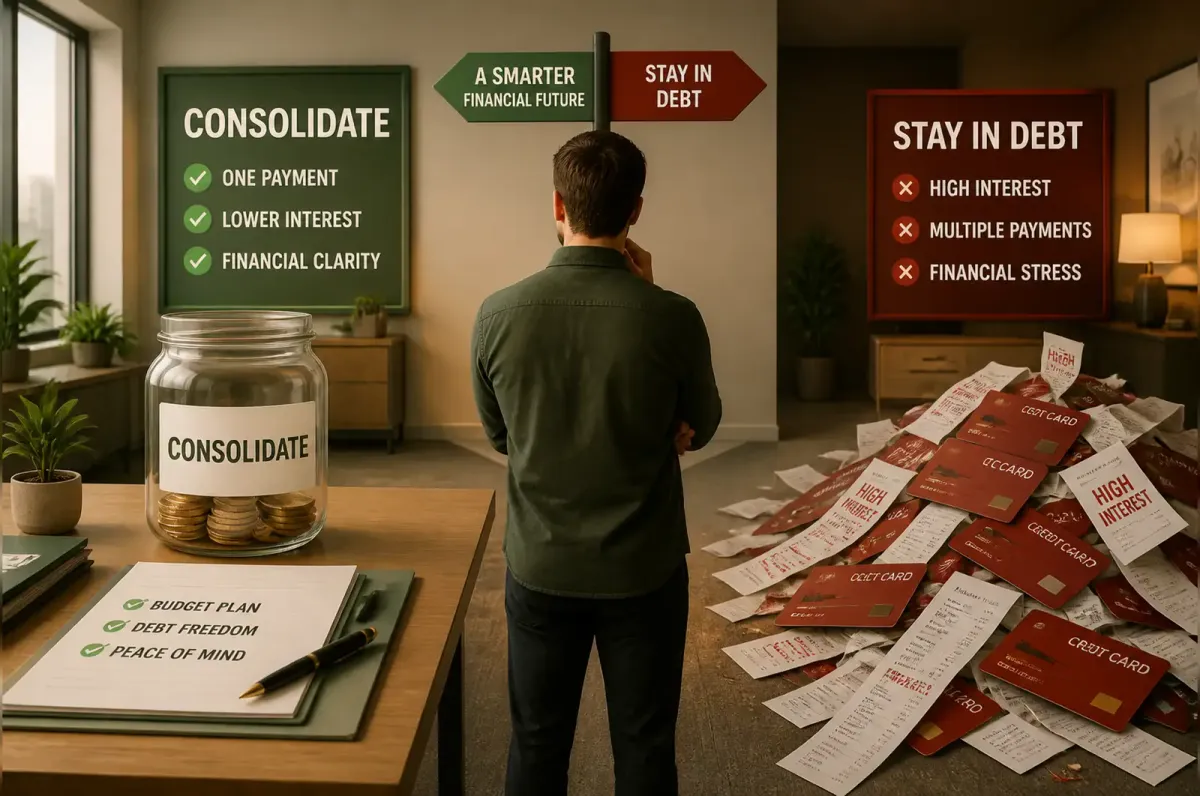
Nearly 15,000 people entered debt-management plans with Money Management International in the first half of 2026, the highest six-month figure the nonprofit has recorded since it started tracking in 2017. The average balance they carried was roughly $40,000.
If that number surprises you, consider this: the New York Fed reported that 13% of all credit card balances were at least 90 days delinquent in the first quarter of 2026. That hasn’t happened since 2011, when the country was still digging out from the financial crisis.
Debt consolidation is not a magic eraser. It rearranges what you owe into a structure that might be easier to manage, but it only works if the underlying spending habits change. The wrong approach can make things worse. The right one can genuinely get you out of debt years faster.
This guide walks through the three most common consolidation strategies, the data behind each, and how to figure out which one fits your specific situation.
The debt crisis in numbers
The national average credit card balance among people carrying unpaid debt was $7,886 in the third quarter of 2025, according to LendingTree’s analysis of over 400,000 credit reports. That’s up 2.8% from the previous year.
Forbes puts the per-American average at $6,595, with millennials aged 29 to 44 carrying $6,961 on average. These aren’t catastrophic numbers on their own, but they compound. A $7,000 balance sitting at 22% APR costs you about $1,540 a year in interest alone. That’s money that goes nowhere.
The biggest issue is that the people most likely to need help are the ones least equipped to get it on their own. According to the CNBC and SurveyMonkey Quarterly Money Survey, 51% of Americans come up short by as much as $250 each month. When your budget is already underwater, adding a consolidation payment on top of everything else can feel impossible.
And yet, the alternatives are worse. Letting balances spiral at 20%+ APR while making minimum payments means you could be paying for a decade or more. That’s the trap that drives people toward consolidation in the first place. The minimum payment on a $7,000 balance at 22% might be around $175 a month, but only about $47 of that goes to principal. The rest is interest. At that rate, you’re looking at five years and over $3,500 in total interest before the balance hits zero.
The math gets worse as balances grow. Someone with $20,000 in credit card debt at the average rate is paying roughly $4,400 a year in interest. That’s a used car’s worth of money vanishing every twelve months while the balance barely budges. Understanding this math is the first step toward deciding whether consolidation is worth pursuing.
Debt management plans: how they actually work
A debt management plan, or DMP, is the strategy Perez used to pay off more than $100,000 in credit card debt over three and a half years. You work with a nonprofit credit counseling agency that negotiates lower interest rates with your creditors, then you make one monthly payment to the agency, which distributes it across your accounts.
But there’s a catch: you close your credit cards as part of the plan. You don’t get to keep using them. The monthly payment is typically steep, often over $2,000 for someone with a large balance. And you’re committing to a plan that lasts three to five years.
The interest rate reduction is where DMPs earn their keep. Counselors can often negotiate rates down to single digits, which means more of each payment actually goes toward the principal instead of servicing interest. For someone drowning in high-APR debt, that alone can be transformative.
Money Management International reports that nearly half of new clients entering DMPs already had personal loans before they reached out. That tells you something important: the do-it-yourself approach frequently isn’t enough. People try personal loans, run the credit cards back up, and end up in a worse position than before.
If you’re considering this route, the National Foundation for Credit Counseling maintains a directory of accredited agencies. Start there, not with the first Google result for “debt help.”
Personal loans: the DIY approach and its traps
Personal loans are the most common self-directed consolidation tool. You take out a fixed-rate installment loan, use it to pay off your credit cards, and then make one monthly payment at a lower interest rate. On paper, it’s clean and logical.
The share of consumers with personal loans rose from 31% in 2017 to 38% in 2025, according to Experian. Competitive rates start around 7%, which sounds great compared to the 20%+ APR on most credit cards. But the devil is in the details.
Nearly half of MMI’s new clients already had personal loans when they sought professional help, carrying an average balance of nearly $19,000 on those loans alone. In other words, the personal loan didn’t solve the problem. It added another payment to the pile while the credit card balances crept back up.
This happens because personal loans don’t address the behavior that created the debt. You pay off the cards, the cards now have zero balance, and suddenly they look like free money again. The psychological trap is powerful, and it catches a lot of people.
Personal loans work best when you have a clear payoff timeline, a realistic budget that accommodates the monthly payment, and the discipline to keep the paid-off cards locked away or closed. If you can’t check all three boxes, a personal loan alone is likely to leave you right back where you started.
Zero-APR balance transfer cards: the surgical tool
A zero-APR credit card lets you transfer an existing balance and pay no interest for a promotional period, typically 12 to 24 months. During that window, every dollar you pay goes straight to reducing the principal. It’s the fastest way to make progress on a manageable balance.
The key word is “manageable.” Financial experts, including those quoted in the USA Today reporting, recommend zero-APR cards for borrowers with relatively good credit and no more than $5,000 or $6,000 in debt. Above that threshold, you’re unlikely to pay it off before the promotional rate expires, and the new rate could be higher than what you started with.
There’s also a transfer fee, usually 3% to 5% of the balance. On a $5,000 transfer, that’s $150 to $250. Factor that into your math. And if you miss a single payment, many issuers will revoke the promotional rate entirely, kicking you back to the standard APR with no warning.
This strategy demands precision. You need to know exactly how much you can pay each month, set up autopay to avoid the missed-payment trap, and have a plan for what happens to any remaining balance when the clock runs out. For people who can execute that, it’s the cheapest option available. For everyone else, it’s a ticking clock.
How to pick the right strategy for your situation
The right strategy depends on your balance, credit score, and habits.
If your total credit card debt is under $6,000, you have decent credit, and you can realistically pay it off within 18 months, a zero-APR balance transfer card is probably your best move. The math is simple and the savings on interest are substantial.
If your debt is between $6,000 and $30,000 and you have steady income but can’t pay it off quickly, a personal loan with a fixed rate and fixed term gives you structure. The critical requirement is that you stop using the credit cards. Close them, freeze them, do whatever it takes. The loan only works if the spending stops.
If your debt exceeds $30,000, or you’ve already tried a personal loan and the balances crept back up, a debt management plan through a nonprofit credit counseling agency is worth exploring. Yes, you close the cards. Yes, the payments are steep. But the interest rate reductions are real, and having a counselor negotiate on your behalf removes the temptation to manage it yourself.
For anyone dealing with multiple debts at high interest rates, consider also looking at smart budgeting strategies to build a foundation before choosing a consolidation path.
What to do before you consolidate anything
Regardless of which strategy you choose, three steps come first.
Write down every debt you owe. The balance, the interest rate, the minimum payment, and the due date. Most people have a vague sense of what they owe, but the actual number is almost always higher than they think. You cannot make a good decision without seeing the full picture. Use a spreadsheet, a notebook, or a free app like digital declutter tools adapted for finances. The point is to have everything in one place where you can see it clearly.
Calculate your real monthly budget. Not what you think you spend, but what you actually spend. Track every transaction for a month. The 51% of Americans who come up short by $250 monthly aren’t spending recklessly. They’re spending obliviously. Small amounts leak out in subscriptions, dining, and impulse purchases that don’t feel significant individually but add up to hundreds. Once you know where the money goes, you can decide whether a consolidation payment fits into your actual life or just your hoped-for life.
Talk to a nonprofit credit counselor before you take out any new debt. The National Foundation for Credit Counseling can connect you with someone who will review your situation without trying to sell you anything. A 30-minute conversation might save you from a consolidation strategy that makes things worse. The counselor can also spot whether your situation calls for a different approach entirely, like negotiating directly with creditors or exploring hardship programs your card issuers already offer.
One last thing: if you do consolidate, resist the urge to celebrate by spending. The paid-off cards feel like a fresh start, but they’re actually a responsibility. The whole point of consolidation is to break the cycle, not to reset it with a clean slate and the same habits.
Debt consolidation is a tool. Like any tool, its value depends entirely on how you use it. The data from 2026 makes one thing clear: more Americans need help than ever, and the ones who get it through structured programs are the ones who tend to actually get out of debt. The ones who try to hack it alone keep ending up back at the starting line.



Discussion
Comments
Share a helpful tip, question, or takeaway from Debt Consolidation in 2026: When It Works and When It Backfires.
0 Comments
Loading comments…