The useful organizing advice this week is not a shopping list. It is a set of places for things that are either arriving or leaving. Isabelle Aron at the Guardian on Sept. 23 asked professional organisers where the mess actually starts. House Beautiful on Sept. 25 asked a different set of organizers what they do with toys, mail, and the clothes that are out of season. The Yahoo syndication of an Apartment Therapy piece on Sept. 26 is the habit version: start small, then revisit the system when the household changes.
We already wrote the purge list, the ten things organizers get rid of first. We also wrote the small-apartment storage roundup. This is neither. A donation station does not tell you what to throw away. It tells you where the thrown-away thing sits until the car trip. A square container does not organize a pantry. It stops you buying a shape that wastes the shelf. If you only do one thing from this week, pick the station or the shape. Do not buy a new set of bins and call it a system.
The donation station is a place, not a mood
Lesley Spellman, who co-founded the Declutter Hub with Ingrid Jansen, told the Guardian that a designated space for things headed to the charity shop is the part people skip. Without it, you get random piles in three rooms, and each pile feels like a decision you already made. You did not. You made a maybe. The station is the difference between a maybe and a bag that has a destination.
I would not romanticize the basket. A donation station that sits in the hall for four months is just a second closet with a nicer story. Spellman’s condition is the useful one: you gather until you have enough to make the trip. “Enough” is a volume you can carry, not a feeling of readiness. If the basket is full and the shop is open Saturday, Saturday is the system. If the basket is full and you keep walking past it, you have furniture.
Beth Penn of Bneato Bar, in the House Beautiful piece, runs a harder version of the same idea. She keeps an empty cabinet for the toys and gifts that are not going to get a home. When the bag in that cabinet is full, it goes to trash or donation. Her line, as reported, is that she purges often, and often without the kids’ permission. I am not going to pretend that is gentle. It is a boundary. The cabinet exists so the unwanted object never merges into the room where the wanted objects live. Once a plastic truck has a shelf, it has a claim. The cabinet refuses the claim.
Penn’s reason for the cabinet is the part I would keep even if you hate the “without their permission” line. She says you are not always in control of who gives children things, and for some relatives the gift is the love language. You can accept the visit and still not accept a permanent address for the object. The cabinet is how you do both. It is not a lecture at the door.
Lucy Mansey, founder of Organised by Lucy, gives the kids a version they can run. She asks for ten things they are playing with, ten they have not thought about, and ten they are happy to let go of. Then she decides what goes to a charity shop or to friends. That is a different station. Penn’s cabinet is adult judgment. Mansey’s tens are a game with a number, which is why a six-year-old can play it and a toddler cannot. Simon Wigzell, founder of Let’s Get It Sorted, has a four-year-old and a six-year-old and uses a song before bed so the tidy-up is the game. I would not buy a special tidy-up soundtrack. I would use a song they already know and stop when the song stops, so the task has an end. Open-ended “let’s just finish this corner” is how a bedtime becomes a negotiation.
The Guardian writer also describes her own setup: fabric baskets in built-in cupboards, loosely sorted into blocks and soft toys, and a seagrass basket in the kitchen that gets a nightly swoop. That is a parent’s workaround, listed with shop links, not an organizer’s rule. I am treating it as one household’s example. The rule underneath it is the same as the donation station. Loose categories beat a labeled grid a child cannot read. A nightly swoop beats a Sunday project you keep postponing.
Round containers are a tax on the shelf
Vicky Silverthorn, founder of You Need A Vicky, has the sentence I would tape inside a cabinet. Never buy round ones. Square edges slot together. Round jars look like a shop display and leave crescent gaps you cannot store anything in. She points to a range called Fitt at the Organizing Warehouse, and she does not label hers because they are clear. If you can see the rice, the label is a craft project.
Silverthorn and Wigzell disagree about lids, and I would not flatten that into one method. Wigzell says Tupperware is the worst thing in the kitchen. His fix is to put the lid on everything and stack, which wastes height and saves the hunt. He says it is not the best use of space, and that he can see what he needs. Silverthorn also stores containers with the lids on. If that is not your kitchen, she points at Joseph Joseph’s nesting set. Mansey goes the other way for pots and pans: do not store them with the lids on. Store the lids separately. She likes Joseph Joseph organisers that stick to the inside of a drawer or cupboard so the lids are not eating the shelf. Wigzell’s audit question sits next to that: do you really need six frying pans?
Those are three different objects. Food boxes, pan lids, and the pans themselves. The shared mistake is buying a container for a container. If the lid hunt is the problem, lids-on stacking is a reasonable ugly fix. If the shelf is the problem, nesting and a lid rail are the fix. If you own six frying pans, no rail will save you. Do the audit before the hardware.
Mansey’s spice advice is the same geometry. If you have the drawer, an organiser in the drawer beats a cupboard where the back row is a rumor. If you do not, a large turntable, or the stepped rack Wigzell likes, so each level is visible. A lazy Susan shows up again in House Beautiful. Faith Roberson of Organize With Faith says that after 13 years she still will not give hers up. She uses it for condiments that disappear at the back of the fridge, for detergent above the washer, and for vitamins. I would not buy one for every cabinet. I would buy one for the shelf where things expire because you cannot see them.
Wigzell’s dead-space fix is cheaper than a new pantry. Ikea’s metal shelving inserts add a layer in a deep cupboard so you are not stacking tins into a cave. The same line makes clip-on baskets. Joseph Joseph, again, makes a hook that sits under a shelf for clingfilm and foil, which is the roll that always ends up horizontal on top of the cereal. Spellman wants baking trays upright, not stacked, in a holder, with cake tins allowed to share it. Horizontal stacks are how the tray you need is always on the bottom.
I am not going to turn this into a brand guide. Joseph Joseph is in the Guardian piece because several organisers already use it. If a no-name square box slots the same way, the brand is not the point. The shape is. Round is the tax.
Shoes, mail, and the water bottles
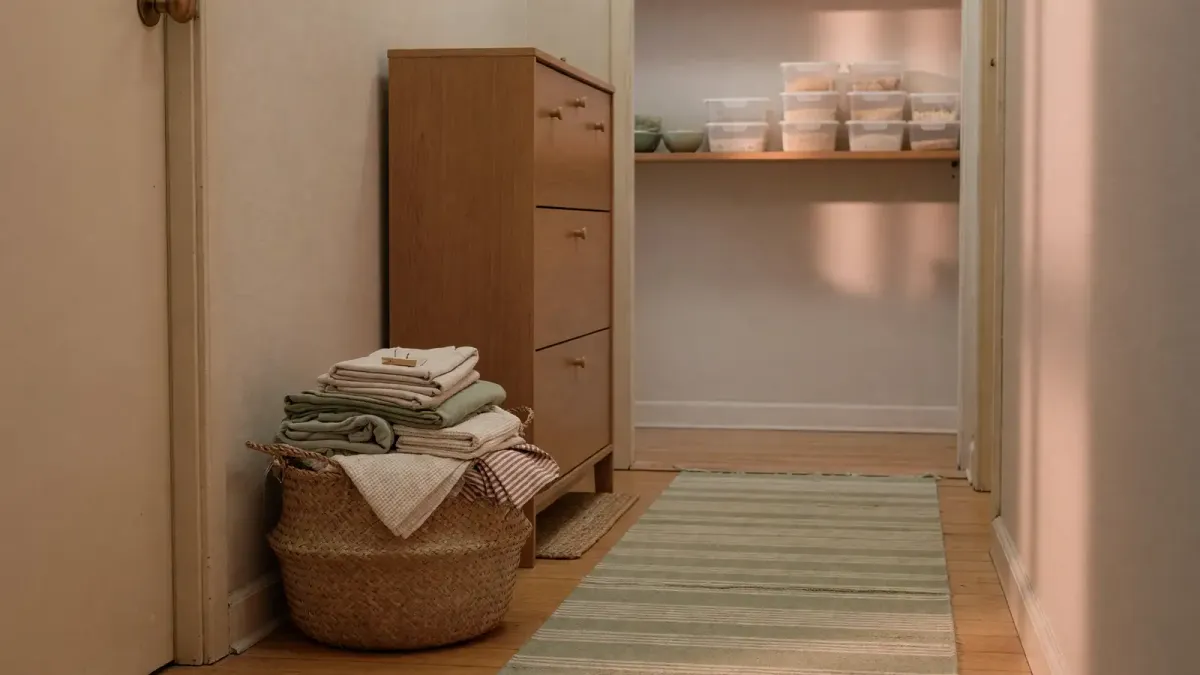
Mansey’s hallway rule is strict in a way that saves the rest of the house. Only the shoes you are wearing day to day live downstairs. Everything else goes elsewhere. She names under the bed, which we have written about as storage that does not turn the room into a unit. Wigzell’s version is a slimline shoe cabinet with drawers that open at the front so the shoes slot in. People assume they cannot fit furniture in a hall. A cabinet the depth of a shoe is not a wardrobe. It is a door you can close.
The mail version of the same rule is an in-tray, not a personality. Wigzell wants one open tray by the door, on the desk, or next to the fruit bowl. Then half an hour once a week to move paper into a filing cabinet or an expandable folder. Spellman is not in that paragraph, but her donation station is the same shape: one place, a scheduled exit. House Beautiful’s mail section is thinner. It says packages and letters need a process for putting away or trashing, or they become the house. I agree with the direction and I would use Wigzell’s half-hour, because “have a system” without a clock is how the tray becomes a second pile.
Paperwork is where people keep the wrong years. Wigzell told the Guardian that a lot of household manuals are for machines you no longer own, including the toaster and the kettle. Scan what you must keep. For bank statements, his number is two years. I am not a tax adviser, and I am not turning that into a legal retention rule. It is one organiser’s working number for the paper that is clutter rather than a record. If your accountant wants longer, the accountant wins. The toaster manual does not.
Water bottles are the small version of the shoe problem. Spellman says people own several, and stacking them upright in a cupboard is how they fall. Keep the lids in their own tub. Lids left screwed on trap moisture. She is talking about mould in a bottle, which is a cleaning problem, not a wellness plan. The organizing point is the split: bottle here, lid there, both in a place you chose. The Yahoo piece uses the same image from the other side. The writer’s tidy friend does not have a congregation of bottles by the sink. The friend also told her never to open the closets. I like that caveat. A calm counter is not evidence that the cupboard behind it is a system. Rosemont’s warning, below, is what the closed closet usually is.
Wires get one pass and then a home. Silverthorn: sort them, recycle the rest, and do not put them in the bin. She points at Recycle Your Electricals. Wigzell keeps the survivors with Velcro ties so they do not unspool in the drawer. Labels are optional. If you cannot name the cable, it was a candidate for the recycle bag, not for a label maker.
Toys, art, and the cabinet they do not see
Mansey’s ten-ten-ten game and Penn’s secret cabinet are the two ends of toy control. Use the game when the child can sort. Use the cabinet when the object arrived from someone else and was never going to earn a shelf. Eisland, the organizer in the House Beautiful roundup (the extract does not give a first name, so I am not inventing one), does a third thing: storage that looks like it belongs to the child. A French linen farmhouse bin from a vintage shop, under the bed, for a daughter who crafts. That is not a method you can copy from a link. It is a reminder that a bin the child likes will get used, and a bin that looks like a facility will not.
Art is the object parents feel guilty about and then leave on a sideboard for weeks. Mansey’s fix is a rotating wall, not an archive. A pegboard, or a shower-curtain wire with wooden pegs, so the new drawing replaces the old one. The old one can go in a folder or it can go. The sideboard is the failure mode, because a drawing on a sideboard is neither displayed nor stored. It is waiting, and waiting is how a kitchen becomes a gallery you did not agree to.
Bath toys are a drying problem pretending to be a storage problem. Mansey likes a Munchkin basket that sticks inside the bath so the toys drip into the tub instead of sitting in a bucket of water on the floor. The Guardian listed it at £18.49 at John Lewis that day. I have not checked today’s price, and I would not send you to buy it if a colander you already own can hang and drain. The principle is the drain, not the brand. A bucket with a solid bottom is a mould farm. That is housekeeping, not a medical claim.
Toiletries fail the same way shoes fail. Silverthorn’s line is blunt: three drawers of spare bottles means you need a word with yourself. Spares can exist. They should not occupy the drawer you open every morning. A bottom drawer, or a cupboard that is not the sink, is the spare shelf. Everyday items can live in a caddy so the sink is a sink. I would apply Penn’s cabinet logic here too. A gift set you will not use does not get a prime drawer because it was a gift.
Closets, seasons, and the system you will have to redo
Debbie Rosemont, who runs Simply Placed, told the Yahoo piece the sentence that explains the friend who will not open her closets. If you keep adding and you never organize, you end up with no place to put things away. The calm room and the jammed closet are the same household. Adam Kutner, vice president of marketing at Storage King USA, is selling storage, so I am reading him as a vendor with a useful distinction rather than as a neutral judge. Seasonal items, keepsakes, and things you do not need every day can live in a garage, a closet, an attic, or under the bed. The rooms get quieter. You still own the stuff. That is a trade, not a victory. If the off-site bin is a place you forget, you have paid rent on a decision you were avoiding.
Roberson’s seasonal swap is the home version of Kutner’s point, without the storage unit. She pulls winter or summer clothes at the start of the season and says it feels like new clothes. Out-of-season pieces go in fabric boxes in the closet. Silverthorn hates vacuum bags in plain sight, and she hates them in a wardrobe too, except for giant coats and ski-wear. Her substitute is Muji’s plain fabric boxes. I would not treat “feels like new clothes” as a reason to keep a size you have not worn in three years. The swap is a calendar. The donation station is what you do when the calendar item no longer fits.
Hangers are the boring version of the same geometry argument as the round jar. Silverthorn wants slimline non-slip rubberised hangers. Knitwear gets a curved hanger because a traditional shoulder stretches a smaller garment. Silk camisoles slide off an ordinary hanger onto the floor, which is how a wardrobe becomes a pile. I am not convinced you need a special hanger for every shirt. I am convinced a slippery hanger is why the camisole is always on the floor and then gets “lost.”
Nilgun Yigit, owner of Up Closets of Connecticut, has the buying rule I would put ahead of any of these products. Do not buy the organizers first. Start with a pantry or a junk drawer. Notice whether you find things by size, by use, by color, or by season. Then scale. A house full of matching bins, bought before you know your own sort, is how people end up with round containers and a label maker and a drawer they still avoid.
Rosemont’s second point is the one that ages the rest of this article. Life changes, so the system has to be reviewed. The donation station that worked when the children were small is the wrong size when they are not. The hallway shoe rule fails if someone starts working from home and the hall is now also the office. Mansey’s answer to that particular mess is a product called Office in a Box, from Stackers, listed at £120 at John Lewis in the Guardian piece. It sits on the table, opens to a laptop and a notepad, and closes at the end of the day so the living room is not a desk. I have not used it. The £120 is a price on a page, not a quote I checked. The behavior is the part worth stealing: work has a container, and the container closes. A closed lid is a donation station for the workday.
I would not add a seventh product to a week that already has too many affiliate links. The Guardian piece is a shopping article wearing an advice article’s coat. The organizers’ rules survive without the Dunelm basket and the John Lewis caddy. You need a station for things that are leaving, square containers instead of round ones, and a downstairs limit on shoes and mail with a weekly exit. You also need a closet you are willing to open. A closed closet is not organized. It is hidden. If the system you built in the spring no longer matches who lives in the house, Rosemont is right, and the redo is the job, not a failure of the first attempt.

Discussion
Comments
Share a helpful tip, question, or takeaway from A Donation Station Beats Another Round Bin.
0 Comments
Loading comments…