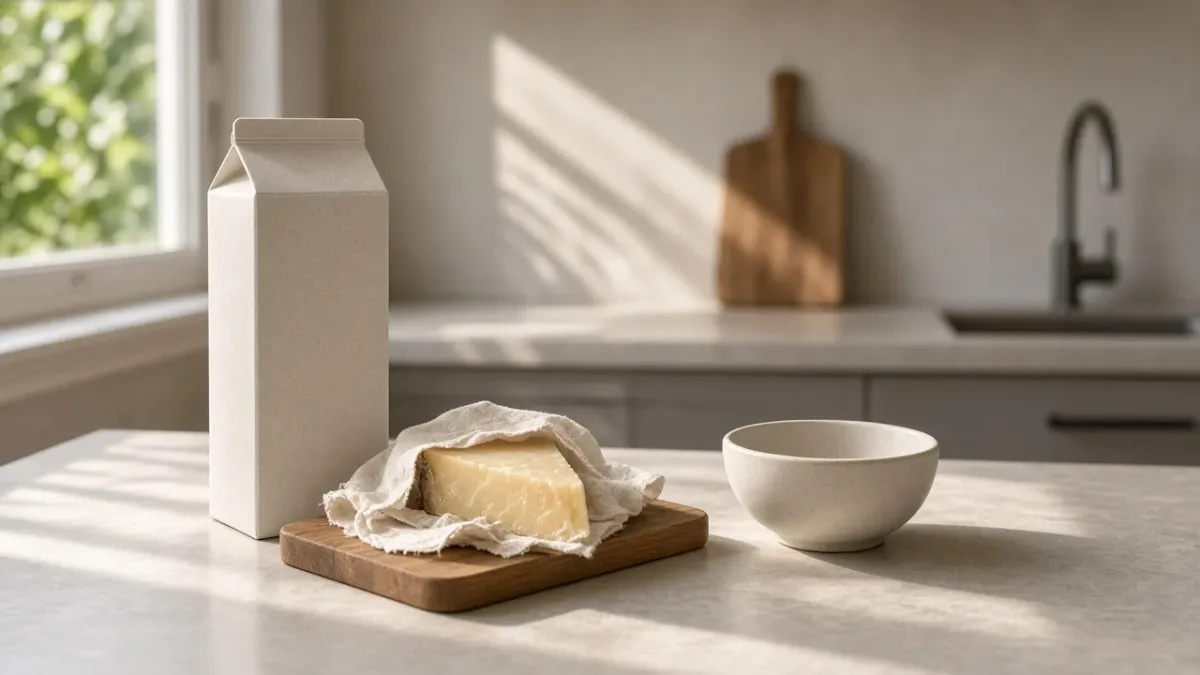
Two company announcements posted by the U.S. Food and Drug Administration this week ask for different kinds of kitchen checks. One covers a dietary supplement that may contain undeclared milk. The other covers raw cheddar that may be contaminated with Listeria. They are not the same kind of problem, and the notices do not ask shoppers to do the same thing.
This is not medical advice. The details below restate the company announcements as posted by FDA. People who think they are having an allergic reaction, or who are pregnant, older, or immunocompromised and have eaten a recalled food, should contact a clinician rather than rely on a household article.
FDA’s own boilerplate, printed on both pages, matters before any lot number does. When a company announces a recall, market withdrawal, or safety alert, FDA posts the company’s announcement as a public service. FDA does not endorse either the product or the company. The phone numbers and refund language below are the companies’ words, carried on those FDA pages.
What the two notices actually cover
On November 13, 2026, bioQuad Life Sciences of Yorba Linda, California, announced a recall of two lots of OsteoDenx dietary supplement capsules because they contain undeclared milk. FDA lists the same date as the publish date. The product type on the summary line is dietary supplements. The reason line is short: contain undeclared milk.
On November 10, 2026, Family Farmstead Dairy in Worcester, New York, announced a recall of all cheddar cheese products because of potential contamination with Listeria monocytogenes. FDA’s publish date matches the company date. The product type is food and beverages. The named items are raw mild cheddar and raw sharp cheddar.
@FDArecalls posted the OsteoDenx title on November 14, 2026 UTC, linking the FDA announcement. The cheddar notice went up from the same account on November 10, linking the Family Farmstead announcement.
A supplement carton in a bathroom cabinet and a cheese wedge in a deli drawer will not be found by the same five-minute sweep. That is the practical point. The notices name different rooms, different date codes, and different remedies.
OsteoDenx: two lots, two carton sizes
bioQuad says people who have an allergy or severe sensitivity to milk run the risk of a serious or life-threatening allergic reaction if they consume the product. The announcement does not describe a contamination event in the sense of a pathogen growing in the capsules. It describes a labeling failure. The capsules contain lactoferrin derived from cow’s milk. That ingredient was identified during a routine FDA inspection. Distribution has stopped until corrected cartons are available.
No illnesses have been reported to date, according to the company announcement. That sentence is easy to over-read. It is not a finding that the product is safe for someone with a milk allergy. It is a statement that the company had not received illness reports when the notice was posted.
The product was distributed nationwide. It reached consumers through online orders at bioquad.com and Amazon.com, through resellers, and through a dental clinic in Redwood City, California. The sales window on the page runs from November 1, 2024 to November 11, 2026. A carton bought last year is in scope if the lot matches. So is one bought this month, up to November 11.
OsteoDenx comes in a paperboard carton of 30 or 60 capsules. The lot number and expiration date are printed on the side panel of the carton, not on a bottle label the page does not mention. The affected combinations are specific.
The 30-capsule carton weighs 17.85 grams and carries UPC 8 57294 00722 8. Two lots of that UPC are recalled: LOT#0524100, expiration 05/2027, and LOT#0625041, expiration 08/2028.
The 60-capsule carton weighs 35.7 grams and carries UPC 8 57294 00734 1. The same two lots and the same two expiration dates apply.
A matching UPC with a different lot is not listed. A matching lot on a different brand is not listed. The notice is narrow on purpose. Checking the side panel is the whole identification step the company describes.
Customers who purchased the affected lots may request a full refund or a replacement in corrected packaging. Consumers who are allergic or sensitive to milk should not take the product and may discard it. Those are two different instructions sitting next to each other. The discard line is aimed at people who should not consume milk. The refund or replacement line is aimed at customers who bought the affected lots. The page does not say that a person without a milk allergy must throw the capsules away, and it does not say that discarding the product is the only way to get money back.
Questions go to (714) 660-1031, Monday to Friday, 9:30 a.m. to 5:00 p.m. Pacific Time, or to [email protected]. Emails received after business hours or on weekends will be answered the next business day. The media contact named on the page is Sreus Naidu, at the same phone number and email. The recall is being made with the knowledge of the FDA.
The dental-clinic channel is the easy one to miss. A sample handed out after an appointment does not look like an Amazon order, and it may not have a receipt. The lot number is still on the side panel if the carton was kept. If only loose capsules remain, the page does not give a way to identify the lot from the capsule itself. That gap is in the notice: identification is described for the carton, not for a pill organizer.
Farmstead cheddar: a date cutoff, not two lot codes
Family Farmstead’s notice is broader inside one product line and narrower in geography. The company is recalling all cheddar cheese products because of potential contamination with Listeria monocytogenes. The announcement uses the standard risk language for that organism: it can cause serious and sometimes fatal infections in young children, frail or elderly people, and others with weakened immune systems. Healthy individuals may suffer only short-term symptoms such as high fever, severe headache, stiffness, nausea, abdominal pain, and diarrhea. Listeria infection can cause miscarriages and stillbirths among pregnant women.
That paragraph is the company’s description of the organism, posted by FDA. It is not a diagnosis, and this article is not adding symptoms, incubation times, or treatment steps the notice does not contain.
The November 10 decision follows the company’s October 15, 2026 recall of certain raw cheddar products due to potential contamination with E. coli O26:H11 and O45:H2. The November page does not reprint the October lot list, the October retail list, or any illness count from that earlier action. The only fact available here is that the company describes the new recall as following that October recall. Anyone who still has cheddar from the earlier notice should treat the November language as an expansion of what the company is now pulling, not as a replacement explanation of the October event.
Distribution was through retail stores in New York, New Jersey, Vermont, New Hampshire, Massachusetts, Pennsylvania, Rhode Island, Connecticut, Delaware, Virginia, West Virginia, and Tennessee. The page does not say the cheese was sold nationwide, and it does not name online marketplaces. A shopper outside those states is not cleared by silence. The notice simply does not claim distribution there.
The products named in the table are raw mild cheddar, 8 ounces, plastic wrapped, and raw sharp cheddar, 8 ounces, plastic wrapped. For both, the lot-code line reads: all lot codes dated 10/16/27 and prior. Later in the notice the company says all cheddar products with an expiration date of 10/16/27 and prior are being recalled. The table says “lot codes dated.” The later sentence says “expiration date.” Both dates on the page are 10/16/27 and prior. A package dated after 10/16/27 is not listed. A package with no readable date is not given a special rule.
No other Family Farmstead Dairy products are included in this recall unless specifically identified by the company. Milk, other cheeses, or a differently named item from the same dairy are outside this notice unless the company identifies them. That sentence is a boundary, not a quality certificate for everything else in the case.
Consumers who purchased affected cheddar may return it to the place of purchase or contact Family Farmstead Dairy. The phone number is (607) 397-4044, Monday to Friday, 8:00 to 5:00. The email is [email protected]. Unlike the OsteoDenx notice, this page does not offer a choice between discard and a replacement carton. The consumer path it names is return or direct contact.
The page does not say that no illnesses have been reported. It also does not say that illnesses have been reported. Leaving that sentence out is the accurate reading.
How the remedies differ
Putting the two notices side by side keeps the kitchen check from turning into one vague “throw out dairy” rule.
OsteoDenx is a labeling problem on two lots of one brand, sold nationwide over nearly two years, including online and through one named dental clinic. The hazard the company names is undeclared milk, specifically lactoferrin from cow’s milk, found in an FDA inspection. The people the notice tells to stop are those allergic or sensitive to milk. The commercial remedy is a refund or a replacement in corrected packaging. Distribution is paused until those cartons exist.
Family Farmstead cheddar is a pathogen-potential recall of an entire cheddar line, limited to 8-ounce plastic-wrapped raw mild and raw sharp, with dates of 10/16/27 and earlier, sold at retail in 12 states. The company ties the decision to an October 15 recall for two named E. coli strains, without restating that earlier notice. The consumer step is return or a phone call, not a corrected-label replacement.
A household that has both items needs both steps. Matching a UPC and then stopping is how the cheese gets left in the drawer. Checking cheddar dates and then assuming the supplement is fine is how an undeclared allergen stays in the cabinet.
A kitchen pass that follows the pages
Start with the supplement, because the identifier is a side-panel lot, and lots are easier to lose than a cheese date.
Look for a paperboard OsteoDenx carton of 30 or 60 capsules. Read the side panel. Write down the UPC, the lot, and the expiration before calling. The recalled pairs are UPC 8 57294 00722 8 or 8 57294 00734 1, with LOT#0524100 (05/2027) or LOT#0625041 (08/2028). If the carton is from the Redwood City dental clinic, the same side panel still applies. If the capsules were poured into another container, the notice does not provide a visual check of the capsule. In that case the company contact is the path the page leaves open, not a guess about color or size.
If someone in the household has a milk allergy or a severe milk sensitivity, the announcement says they should not take the product and may discard it. That instruction is not limited to a confirmed lot match in the way a refund request is. The risk sentence is about consuming a product that contains undeclared milk. If the lot cannot be confirmed and a milk allergy is in the house, calling (714) 660-1031 during Pacific business hours is the step the notice supports. Do not invent a home test for lactoferrin. The page does not describe one.
Then open the cheese drawer, but only if the purchase could have come from the 12 listed states. Raw mild or raw sharp Family Farmstead cheddar, 8 ounces, plastic wrapped, with a lot code or expiration of October 16, 2027 or earlier, is what the table and the later sentence name. Return it to the store or call (607) 397-4044 on a weekday between 8:00 and 5:00. Other Family Farmstead products stay put unless the company has specifically identified them.
Do not taste a suspect cheese to see if it seems off. The notice does not say the hazard is visible, and Listeria is not a smell test. Do not feed the recalled cheddar to a pet as a way to avoid wasting it. The page does not authorize that, and the risk language is about infection, not about a quality defect a healthy adult can shrug off.
Keep the carton or the cheese wrapper until the refund or the return is done, if the store or the company asks for the lot. The OsteoDenx page says customers may request a refund or replacement. It does not say the carton must be mailed back before any conversation. The cheddar page says consumers may return the product to the place of purchase. A wrapper with no date cannot prove the cutoff either way. Photograph the side panel or the date code before the store takes the package, so the number is not only on a receipt the clerk keeps.
What these notices do not say
They do not say every milk-derived supplement is recalled. They do not say every raw cheddar in the Northeast is recalled. They do not publish a case count for the November cheddar action. They do not tell retailers how many units shipped. They do not rank one notice as more urgent than the other in a single FDA score. Each page stands on its own summary line.
They also do not replace the label on a product that is not named. A different bone-health capsule, a different farm’s cheddar, or a Family Farmstead item the company has not identified, is outside these two announcements. Expanding a recall in conversation is how a useful notice becomes a rumor.
The October 15 E. coli recall is real in the sense that the November 10 announcement says it happened and names the two strains. This article does not restate lot codes from that October action, because those codes are not on the November page. If a package might belong to the earlier recall, the company’s phone number on the November notice is the contact the current page provides.
FDA’s posting role is administrative. The agency is carrying the company text. Questions about a refund still go to bioQuad or Family Farmstead, at the numbers above, not to a general FDA comment line as a substitute for the company remedy. FDA’s recall pages do list a general contact number, 1-888-INFO-FDA, but the remedy steps in these announcements are the company steps.
Why the dates are the whole story
OsteoDenx’s sales window closes on November 11, 2026, two days before the announcement date. A carton bought on November 12 is outside the distribution sentence as written. A carton bought in 2025 is inside it if the lot matches. Expiration dates of May 2027 and August 2028 mean the affected lots are not short-dated leftovers. They can still be in a cabinet next year. That is why a recall posted in November 2026 is not only a this-week shopping problem.
The cheddar cutoff runs the other direction. Anything dated after October 16, 2027 is not in the “and prior” line. Anything dated on or before that day is. An 8-ounce raw cheddar with a 2026 date is prior to 10/16/27. So is one dated early in 2027. The plastic wrap and the raw mild or raw sharp name still have to match. A later-dated wedge is not swept in by the word “all” once the date sentence has drawn the line.
Read the side panel and the date code before clearing a shelf. The notices are specific enough that a broad purge throws out food the companies did not recall, and a glance at the brand name leaves the listed lots in the house.
If a milk-allergic person already took OsteoDenx from a listed lot, or if someone in a higher-risk group already ate the listed cheddar, the next step is a clinician, not a second reading of the lot table. The announcements describe risk. They do not manage a reaction.
Discussion
Comments
Share a helpful tip, question, or takeaway from November FDA Recalls: OsteoDenx Milk Allergen and Farmstead Cheddar.
0 Comments
Loading comments…