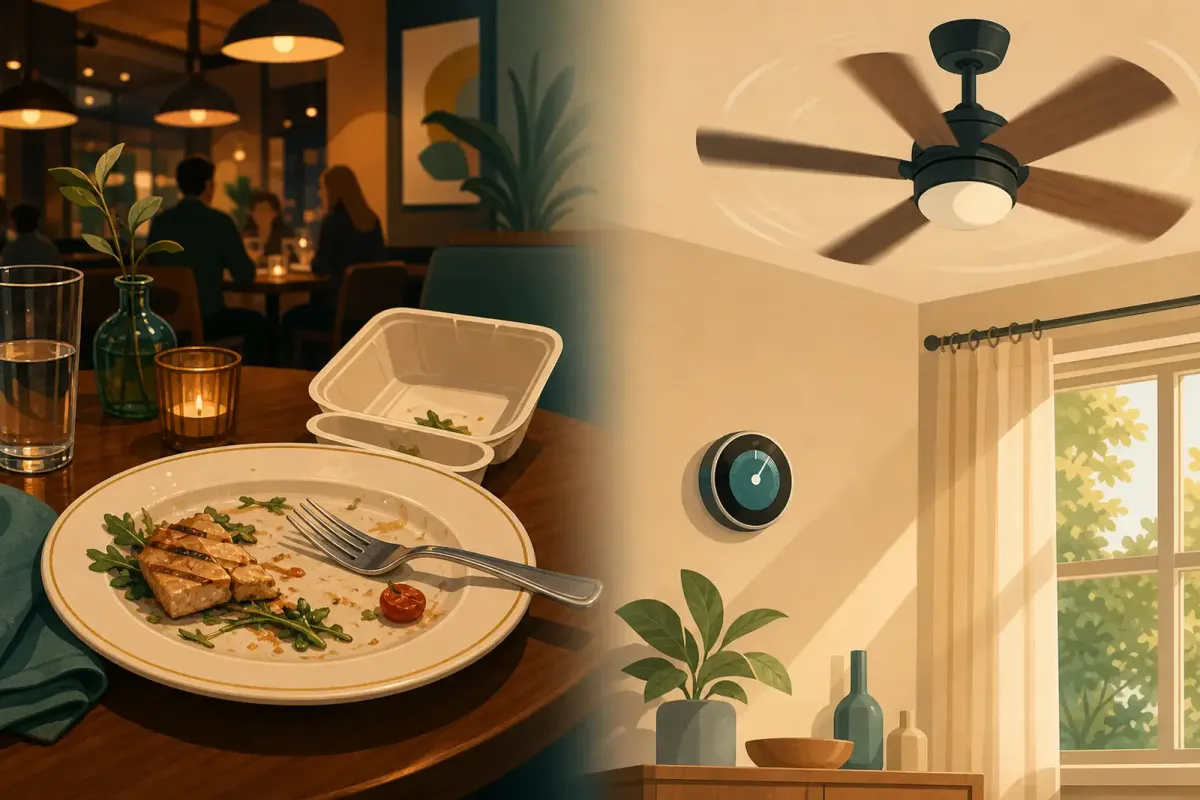
Summer budgets don’t usually fail because of one big purchase. They fail because of two quiet, repeating costs that most people underestimate: restaurant meals and energy bills. Together, they can easily swallow an extra $300 to $500 a month between June and September — more than most people spend on their actual summer vacation.
The good news is that both of these budget leaks have straightforward fixes. None of them require canceling plans or sweating through August without air conditioning. They’re adjustments to how you order, when you cook, and how you manage what’s already in your house.
Why Restaurants Are Eating Your Budget (and Not in a Good Way)
The average American household spent just over $3,600 on food away from home in 2025, and early 2026 data suggests that number is climbing as menu prices continue to outpace grocery inflation. What makes summer particularly dangerous is the combination of heat (nobody wants to cook), social momentum (everyone wants to meet up), and spontaneity (weekend plans materialize out of nowhere).
NPR recently rounded up strategies from food writers, financial planners, and their own readers that go beyond the obvious “just cook at home” advice (NPR, June 30, 2026). The tactics that stuck out share a common theme: you don’t have to stop eating restaurant food to cut your spending by a third or more.
Split the meal before you start eating. When your plate arrives at a restaurant, put half into a to-go box right away. You prevent overeating, skip the food waste, and get a free lunch for tomorrow — all without changing what you ordered. The per-meal cost gets cut roughly in half.
Order the hard part, cook the easy part. Several NPR readers described a hybrid approach: order takeout for the centerpiece dish — pizza, stir fry, or something time-consuming — and then make the sides at home. A bagged salad, steamed rice, or roasted vegetables take five minutes of actual work and cost a fraction of what the restaurant charges for them.
Pick it up yourself. Delivery platforms charge restaurants 15 to 30 percent in commission fees, and those costs get passed to you through higher menu prices. Then you pay delivery fees and a tip on top. Picking up your own order eliminates all of that. On a $40 order, you might save $8 to $12 — enough to cover your next lunch.
Eat a snack before you go. This sounds counterproductive, but hunger hormones are bad financial advisors. When you arrive at a restaurant famished, your brain prioritizes the fastest source of fuel — usually carb-heavy starters, extra sides, and desserts — over rational spending decisions. A small protein-rich snack 30 minutes before you leave keeps the menu from manipulating you.
Try the catering tray trick. Kimberly Palmer of NerdWallet told NPR that she sometimes orders catering trays from local restaurants and invites friends over. The per-person cost comes out lower than individual entrees, you get to socialize, and leftovers fill the fridge for the rest of the week. It turns a $25-per-plate dinner into something closer to $10.
None of these tactics ask you to stop eating out. They just stop restaurants from silently upgrading your spending while you’re hungry and distracted.
Your Air Conditioner Isn’t the Only Thing Running Up Your Electric Bill
Energy costs spike every summer, but summer 2026 is shaping up to be especially expensive. Extended heat waves across the U.S. have pushed utility bills into double-digit increases in most states, and the Energy Information Administration forecasts that residential electricity prices will average 16.4 cents per kilowatt-hour this summer — up from 15.9 cents in 2025.
The New York Post collected practical advice from home improvement experts and TikTok creators in early July. The most useful strategies weren’t about buying new equipment. They were about using what’s already in your house more intelligently (NY Post, July 2, 2026).
Flip your ceiling fan direction. Most ceiling fans have a small switch on the motor housing that changes the blade rotation. In summer, the fan should spin counterclockwise to push cool air straight down. In winter, clockwise pulls warm air up and redistributes it along the ceiling. If your fan has been spinning the wrong direction all summer, you’ve been paying to cool air that wasn’t reaching you. The Department of Energy estimates that using a ceiling fan can let you raise your thermostat by 4°F without feeling any difference in comfort — which can cut cooling costs by 10 to 15 percent.
Cover your windows during the day. Home improvement expert Laura De Barra, who has built a large TikTok following around practical household advice, emphasizes that window coverings are the single most overlooked cooling tool. Sunlight streaming through uncovered windows can raise a room’s temperature by 10 to 20 degrees within an hour. Blackout curtains or thermal blinds — even the $25 versions from a home improvement store — block that heat before it enters your house. Close them on south- and west-facing windows during peak sunlight hours and you can measurably reduce how hard your AC has to work.
Hose down your outdoor AC unit. This sounds too simple to matter, but dirt and debris on your condenser coils reduce heat transfer efficiency. When the unit can’t shed heat effectively, it runs longer cycles and draws more electricity. A gentle spray from a garden hose — from the top down, not at an angle that could bend the fins — clears the buildup. Do this once a month during heavy-use season. While you’re at it, check the indoor air filter: a clogged filter restricts airflow, forcing the system to work harder and costing you money with every cycle.
Think about airflow, not just temperature. In homes with open floor plans, a single ceiling fan over the living room doesn’t necessarily reach the kitchen or dining area. Position a second fan at the boundary between zones, or use a small portable fan to push cool air from the air-conditioned zone into warmer areas. The goal is to make the thermostat reading match how every room actually feels, so you’re not overcooling one space to compensate for another.
The Compound Effect
Individually, these changes look small. Splitting a restaurant meal saves maybe $8. Picking up takeout instead of ordering delivery saves $10. Cleaning your AC filter saves a few percentage points on your electric bill. Closing the curtains before work saves another few.
Add them together over a full summer, though, and the math changes. Cutting restaurant spending by 30 percent for a household that averages $300 a month on dining out saves $270 over three months. Reducing cooling costs by 10 to 15 percent on a $200 monthly summer electric bill saves another $60 to $90 over the same period.
That’s roughly $330 to $360. For most households, that covers a weekend road trip, a new set of tires, or a month of groceries. You get it by changing a few habits that don’t affect what you eat or how comfortable your house feels. The money was already leaving your account either way. These fixes just slow the drain.



Discussion
Comments
Share a helpful tip, question, or takeaway from Your Summer Budget Has Two Giant Leaks — Here's How to Plug Them.
0 Comments
Loading comments…