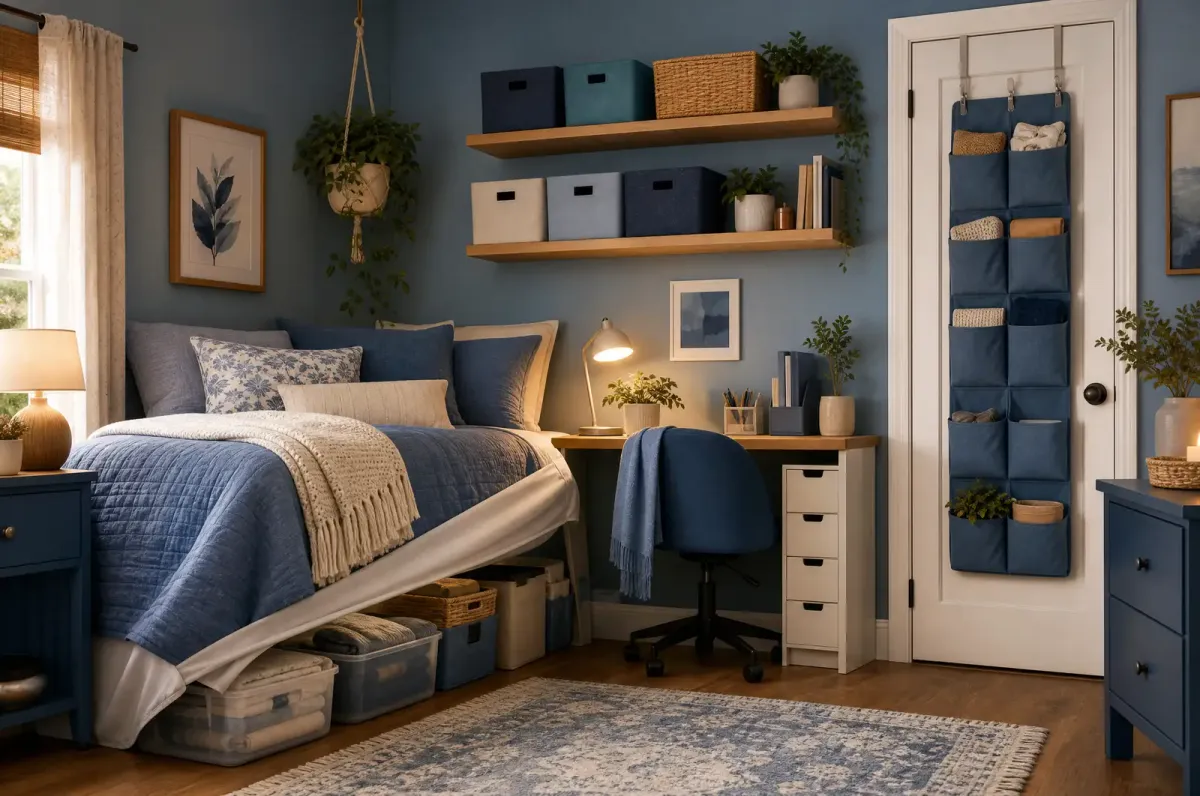
The standard advice for organizing a small space goes something like this: get some bins, label them, put things in them. It works, technically. But it also fills your floor with visible containers that make the room feel smaller than it already is.
There’s a better approach, and it costs less than a trip to The Container Store. Three zones in every room go almost completely unused, and each one can hold more than you think. The trick isn’t buying more storage. It’s finding the storage that’s already there.
Under the bed: the room’s biggest wasted asset
Most people treat the space under a bed as a graveyard for things they don’t want to look at. A few old shoeboxes, maybe a duffel bag shoved in there at the end of last summer. But the area beneath a standard bed frame creates roughly 2,400 cubic inches of usable volume. That’s enough for off-season clothes, extra linens, and holiday decorations with room to spare.
The problem is that most bed frames sit only a few inches off the floor. You can’t slide anything meaningful underneath, so the space stays empty. Bed risers solve this instantly. A set of four risers costs between $15 and $30 and lifts the frame 3 to 7 inches, creating enough clearance for rolling storage bins, flat containers, or vacuum-sealed bags of seasonal clothing. Allison Mast, Vice President of Pottery Barn Teen and Dormify, calls this “one of the most overlooked opportunities” in small-space organization, according to a 2026 LA Times report.
The numbers add up quickly. A queen bed is about 60 inches wide and 80 inches long. Even at just 4 inches of usable height underneath, that’s 19,200 cubic inches of storage — roughly the volume of 15 large storage bins. Most people leave all of it empty because they assume there’s nothing useful to do with a gap that narrow. In reality, it’s enough to clear an entire closet’s worth of seasonal items off the shelves above.
The key is using the right containers. Flimsy plastic bins crack under weight. Look for hard-sided containers with wheels or handles that slide smoothly on carpet or hardwood. Vacuum storage bags compress bulky items like comforters and winter coats to a fraction of their original size, making them ideal for the lower-profile gaps under platform beds. And if you have a bed with drawers built in, use dividers inside each drawer so you’re not stacking everything in one jumbled pile.
One rule that helps: anything under the bed should be something you don’t need daily access to. Seasonal items, backup supplies, documents in fireproof boxes. If you’re reaching under the bed every morning for your socks, the system isn’t working. Move the socks somewhere else and let the under-bed zone do what it does best: hold things quietly out of sight.
Door backs: 21 square feet per door
Every door in your home is a flat, vertical surface that faces the room. Most people use them for nothing. A single standard door is about 21 square feet of potential storage space, and when you count both sides of every door in an apartment, you’re looking at a small wall’s worth of room that’s completely untapped.
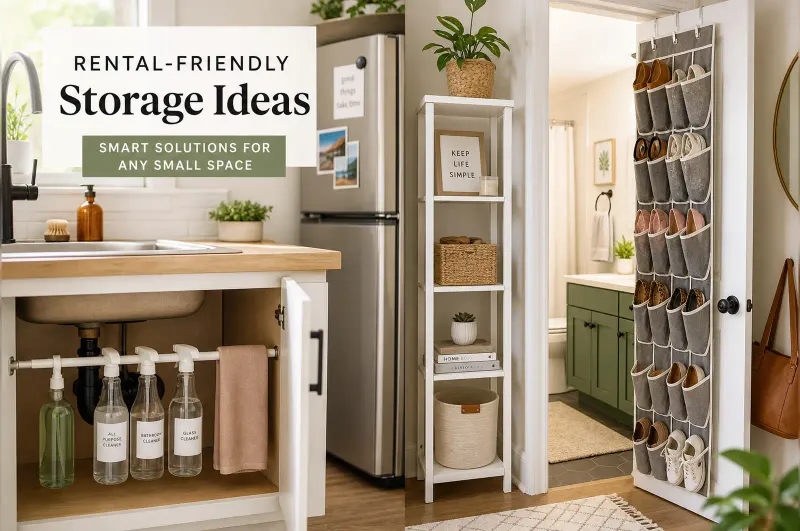
Over-door organizers are the obvious starting point. The mesh or fabric kind with pockets works well in bathrooms for toiletries, cleaning supplies, and hair tools. In closets, an over-door shoe organizer holds more than shoes — it works for cleaning supplies, craft materials, scarves, belts, and small electronics that tend to disappear into junk drawers. A well-designed over-door system can hold 12 to 20 items without touching the floor.
But doors aren’t just for hanging organizers. Hooks are underused in almost every room. A row of three to five hooks on the back of a bedroom door creates a spot for tomorrow’s outfit, a towel, or a bag you grab every morning. In the kitchen, the back of a pantry door can hold a spice rack, a foil-and-wrap dispenser, or a slim broom holder. In the bathroom, hooks behind the door keep towels off the floor and let them dry faster than if they’re bunched on a bar.
The bathroom door in particular is a surface most people forget about. Most bathrooms have one door, and it’s usually the last surface anyone thinks about organizing. An over-door caddy designed for the bathroom can hold shampoo bottles, razors, cotton swabs, and backup toiletries that otherwise crowd the shower ledge or the medicine cabinet. If you rent and can’t drill into walls, over-door storage is one of the few options that doesn’t damage anything.
Vertical wall space: the zone above your furniture
Walk into most small rooms and look at the walls above the furniture. There’s typically 4 to 6 feet of unused vertical space between the top of a bookshelf or desk and the ceiling. That gap does nothing. It holds air. Meanwhile, the desk surface is covered in stuff because there’s nowhere else to put it.
Floating shelves are the most accessible way to reclaim that space. A set of two or three floating shelves above a desk or entryway table gives you room for books, plants, keys, and the random items that end up scattered across every flat surface in the house. The key is mounting them at heights that make sense for daily use. The lowest shelf should be reachable without a stool, and the spacing between shelves should match what you’re storing — wider gaps for plants and picture frames, narrower ones for books.
Pegboards work differently but solve the same problem. A pegboard panel mounted on a wall becomes a customizable grid where you can hang tools, kitchen utensils, art supplies, headphones, or anything with a loop or hook. The advantage over fixed shelves is flexibility. You can rearrange the hooks and accessories whenever your needs change. For home offices and craft rooms, pegboards are especially useful because the items you store there tend to shift frequently.
Wall-mounted rail systems take this a step further. A rail with S-hooks, baskets, and shelves lets you build a vertical storage layout that adapts to whatever room you put it in. In a kitchen, a rail under the upper cabinets holds mugs and cooking utensils. In a laundry room, it holds spray bottles and lint rollers. In a kids’ room, it holds art supplies and small toys. The rail itself is usually a single screw or adhesive installation, making it rental-friendly.
One thing to keep in mind: vertical storage works best when the items at the top are things you use less often. Put daily-use items at eye level and below, and reserve the upper shelves for things you reach for once a week or less. You don’t want to be pulling out a step stool every time you need a pen.
If you’re dealing with really narrow walls — the strip between a window and a corner, or the space beside a door frame — slim wall-mounted magazine racks or single narrow shelves can turn an awkward gap into a spot for keys, mail, or a small plant. The point is that almost any flat vertical surface can hold something. The question is whether you’ve asked it to.
Multi-function furniture: storage that doesn’t look like storage
The three hidden zones above are all about space that already exists in your room. Multi-function furniture takes a different approach: it hides storage inside pieces you’d buy anyway. A storage ottoman works as a footrest, extra seating when guests come over, and a place to store blankets or magazines inside. A hall tree with a built-in bench gives you coat hooks, a seat to put on shoes, and a compartment underneath for bags or boots. These pieces don’t add clutter because they’re doing double duty.
The trade-off is cost. A basic ottoman runs $30 to $80. A hall tree with storage can go over $200. But if you compare that to the cost of buying a bench, a coat rack, a shoe organizer, and a storage bin separately, the multi-function piece often comes out ahead — and it takes up less floor space than all those individual items combined.
Folding and collapsible furniture follows the same principle. A folding desk that mounts to the wall gives you a workspace when you need it and frees up the entire floor area when you don’t. Foldable storage chairs — the kind with cushioned seats that lift to reveal storage compartments — work in living rooms and bedrooms where you need both seating and a place to tuck away items you don’t want visible.
When shopping for multi-function pieces, test the storage compartment. Some ottomans and benches have lids that are hard to open, compartments that are too shallow to hold anything useful, or hinges that squeak after a few weeks. The furniture should work as furniture first. If the storage part is an afterthought that makes the piece uncomfortable or awkward to use, it’s not worth the trade-off.
One approach that works well is mixing styles. You don’t need every piece of furniture to have hidden storage. One storage ottoman in the living room, a bed with risers in the bedroom, and an over-door organizer in the bathroom covers most of what you need. The goal is to match the solution to the problem. Bulky items like blankets and pillows go in large compartments under seating. Daily-use items like bags and shoes go on hooks and door organizers. Paperwork and small electronics go on shelves. Each type of clutter has a home that fits its size and how often you reach for it.
Starting small: what to do this weekend
You don’t need to overhaul every room at once. Pick one room, identify which of the three hidden zones is the most wasted, and tackle it first. For most people, under the bed is the easiest win — it takes less than an hour and costs under $30 for risers and containers.
Walk through your home and count the doors. Then look at the walls above your largest pieces of furniture. You’ll probably find more unused space than you expected. The goal isn’t to fill every inch. It’s to make the space you have work harder so the room feels less crowded without adding visible clutter.
Small-space living isn’t about owning less. It’s about storing smarter. And the best storage solutions are the ones you don’t see when you walk into the room.
Discussion
Comments
Share a helpful tip, question, or takeaway from 3 Hidden Storage Zones You're Probably Ignoring in Every Room.
0 Comments
Loading comments…