On November 19, 2026, the U.S. Consumer Product Safety Commission posted two household notices that do not belong in the same drawer. One covers a Kidsview infant bouncer that can collapse while a baby is in it. The other covers Qpancy children’s pajama sets that the notice says violate the mandatory safety standards for children’s sleepwear. A date code sewn to a fabric seat will not identify a pajama. A neck label on a shirt will not identify a bouncer. A home that checks only the nursery, or only the pajama drawer, can miss the other product.
@USCPSC posted the bouncer recall on November 19, 2026. The post tells people to get a refund in the form of a gift card, and it links the Kidsview infant bouncer announcement. Later the same day, the same account posted the pajama recall, with the short instruction to get a refund, and linked the Qpancy pajama announcement. The short posts are the alert. The pages carry the labels, the sale windows, the unit counts, and the photo rules.
This is not medical advice. The incident lines below are the firms’ reports as printed on the CPSC pages. A household article is not a care plan. If an infant was hurt when a bouncer collapsed, or if a child has a burn after wearing recalled sleepwear, contact a clinician or emergency services.
CPSC’s own note, printed on both pages, sits under the product details. The agency says it is charged with protecting the public from unreasonable risk of injury associated with the use of thousands of types of consumer products. The same pages say deaths, injuries, and property damage from consumer product-related incidents cost the nation more than $1 trillion annually. That figure is the agency’s general statement. It is not a cost assigned to these two recalls. The pages also say the Commission was established more than 50 years ago. Federal law, as printed on both notices, prohibits any person from selling products subject to a Commission-ordered recall or a voluntary recall undertaken in consultation with CPSC. The emails and refund language below are the remedy text on those pages. They are not a shopping list. The printed prices are the sale ranges on the notices, not a bid for a replacement bouncer or a replacement pajama set.
What the two notices cover
The bouncer notice is recall number 27-092. CPSC dates it November 19, 2026. The product name is Kidsview Infant Bouncer. The remedy line is Refund. The unit line is about 412. The retailer named on the page is Zhongshan Haimao Cross-border Information Technology Co., Ltd., doing business as Kidsview, of China. The page says the bouncers were manufactured in China. The consumer contact line gives one email, [email protected]. The notice does not print a phone number for the firm.
The pajama notice is recall number 27-094, with the same recall date. The product name is Qpancy Children’s Pajama Sets. The remedy line is also Refund. The unit line is about 1,309. The retailer named on the page is Shanghai Shengkailong Trading Co., Ltd., doing business as Qpancy, of China. The page says the sets were manufactured in China. The consumer contact line gives one email, [email protected]. That notice also does not print a phone number for the firm.
The two unit lines are not interchangeable. About 412 bouncers is a small sold count next to about 1,309 pajama sets, and a small count next to many other household recalls. A small count is not a reason to skip the label check. The page still asks owners of the described bouncers to stop using them. The pajama page asks the same of owners of the described sets. Neither page says the other firm’s product is included.
How the short posts differ from the pages
The bouncer post says the bouncers can collapse while in use, posing a risk of impact injury to infants in the bouncer, and it says to get a refund in the form of a gift card. The page uses the same hazard sentence. It then names the gift card as an Amazon gift card, and it adds the date-code check, the marker instruction, and the photo rule. A person who stops at the post will know the hazard and the general remedy. That person will not yet know which khaki seat is in the recall, or what the photo must show.
The pajama post says the recalled children’s pajama sets violate the mandatory safety standards for children’s sleepwear, and it says to get a refund. The page repeats that hazard and links CPSC’s children’s sleepwear guidance under the Flammable Fabrics Act. The page then says the refund is a full refund, and it adds the cut-in-half step, the patterns, the sizes, and the sale window. The post does not list those patterns. A cat print alone is not the identification rule.
The pages do not spell out the laboratory test that a sleepwear fabric must pass. They say the sets violate the mandatory standards and that the violation poses a risk of serious burn injuries. This article will not invent a thread count, a flame-spread number, or a fiber blend. Those details are not on the notice that was opened.
How to tell if the bouncer is in the recall
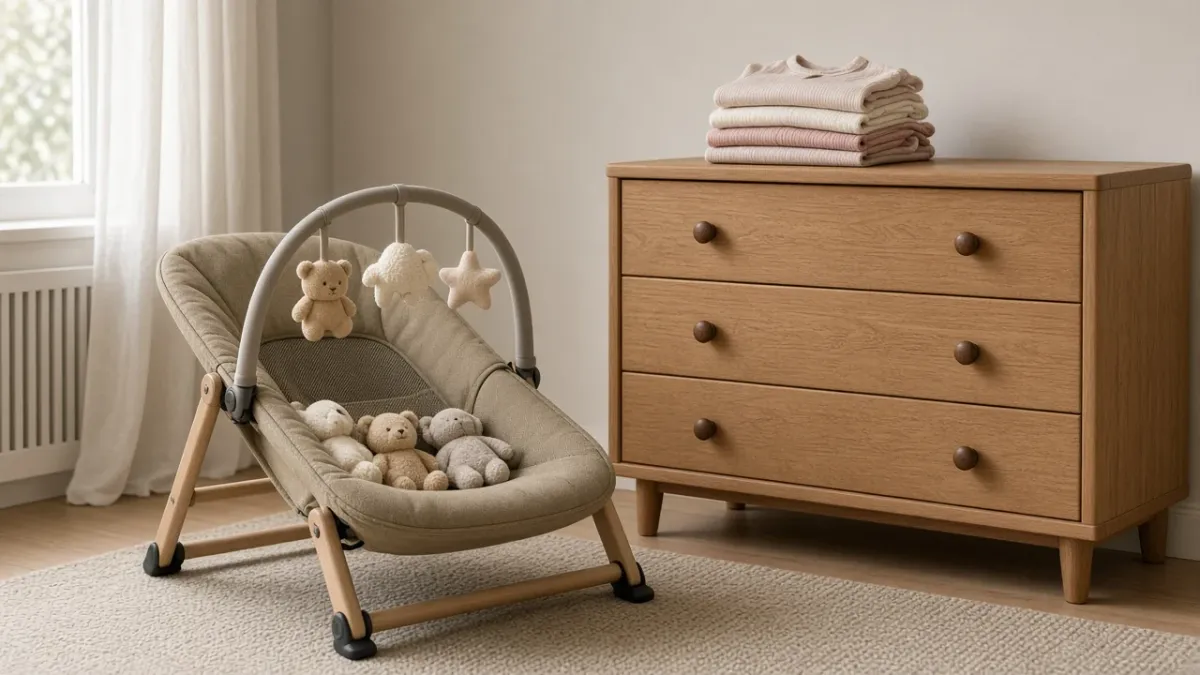
The bouncer description is narrow. The page says the recall involves Kidsview infant bouncers manufactured in August, September, or October 2022. The recalled bouncers have date codes beginning with 2022/08, 2022/09, or 2022/10. That code is on a label sewn on the back of the fabric seat. The bouncers were sold in khaki. They include an accessory bar with animal toys hanging from the bar.
A household check starts with the seat, not with the toy bar. Turn the seat and look for the sewn label. Read the start of the date code. A code that begins with 2022/08, 2022/09, or 2022/10 is the code the notice names. The page does not say that every khaki infant seat is recalled. It does not say that a Kidsview bouncer with a different date code is included. It does not print a list of colors beyond khaki. If the seat is not khaki, or if there is no accessory bar with animal toys, the printed description does not match. If the label is missing, the notice does not give a second identification method such as a serial number on the frame. The contact email on the page is the route the notice gives for questions about a specific seat.
The sale line is also part of the check. The page says the bouncers were sold online at Amazon.com from August 2022 through November 2023 for between $60 and $170. An order in that window is a reason to find the seat and read the label. An order outside that window is not, by itself, proof that a seat is outside the recall. The identification rule on the page is the date code on the sewn label, together with the khaki fabric and the toy bar. The price range is the range printed on the notice. It is not a current price, and it is not a quote for a different bouncer.
What the bouncer notice asks owners to do
The remedy paragraph is more specific than the word Refund at the top of the page. Consumers should stop using the recalled infant bouncers immediately and contact Kidsview for an Amazon gift card. Consumers will be asked to check whether the bouncer is recalled by viewing the date code on the label on the back of the seat. Consumers with recalled bouncers will be instructed to write “RECALLED” on the product’s fabric seat with a permanent marker, take a photo of it, include the label with the date code in the photo, and email that photo to [email protected].
The order of those steps matters. The photo has to show the date-code label. Writing on the seat is part of the instruction, but writing over the label would hide the code the firm asked to see. The notice says to write on the fabric seat and to include the label in the photo. It does not say to cut the seat, to throw the bouncer away before the email, or to send the bouncer back by mail. Those steps are not on this page. The pajama notice, described below, does ask for a cut garment. Using the pajama method on the bouncer is not what the bouncer page prints.
Stop using the seat before the email is sent. The hazard line is collapse while in use, with a risk of impact injury to the infant in the bouncer. Leaving the seat in the nursery “until the gift card arrives” is not the instruction on the page. The page says stop using the recalled bouncers immediately.
The notice does not say how many days the firm has to answer, what dollar amount the Amazon gift card will carry, or whether the card will match the $60 to $170 sale range. Those amounts are the prices paid at sale, as printed on the notice, not a published gift-card schedule. If the email bounces or no reply comes, the page still gives CPSC’s own reporting routes, which are listed later in this article. It does not give a second company email.
What the bouncer page says about injuries
Kidsview has received seven reports of the bouncer collapsing while in use, including two incidents in which the infant’s head struck the underlying surface. One consumer reported seeking medical attention for their infant. That is the full incident paragraph on the notice. It does not name cities, dates of the collapses, or the ages of the infants beyond the fact that they were in the bouncer. It does not say that the other five reports included a head strike. It does not say that no injury occurred in those five reports. It says seven reports of collapse, including two in which the head struck the surface, and one report of seeking medical attention.
The medical-attention line is a consumer report printed by CPSC. It is not a diagnosis, and it is not a reason to wait for a gift card before getting care. If a child was hurt, care comes first. The recall email is for the product remedy.
How to tell if the pajama set is in the recall
The pajama description is also narrow, and it is a different kind of narrow. The page says this recall involves Qpancy-branded matching pajama sets. They include children’s pajamas that consist of a long-sleeve, button-front top with a front pocket and shorts, and matching pajamas for dolls. The sets were sold in multicolored cat, pink bow, pink and white striped bow, and pink and white stripes. Sizes run from 120, marked 4-5T, through 150, marked 10-11Y. The brand is printed on a neck label. The size is on a sewn-in side-seam label.
Read the neck label before judging the print. A pink bow on a shirt from another brand is not what the notice names. A cat print without the Qpancy neck label is not what the notice names. The page lists four looks: multicolored cat, pink bow, pink and white striped bow, and pink and white stripes. It does not say that every Qpancy garment is recalled. It describes matching sets with a long-sleeve button-front top, a front pocket, shorts, and matching doll pajamas, in those looks and in those sizes.
The doll pajamas are part of the set description. The notice does not say the doll clothes are a separate recall with a separate number. It says the sets include children’s pajamas and matching pajamas for dolls. A drawer check that finds only the doll outfit should still look for the child’s set, and the other way around. The remedy paragraph says to cut “the pajama” and to photograph the destroyed pajamas. It does not print a separate instruction that leaves the doll clothes in use. The safer reading of the set description is to stop using the matching pieces that carry the recalled branding and to follow the contact step for the set. The page does not say a doll-only leftover is exempt.
The size label is on a sewn-in side seam, not only on a hangtag. A hangtag can be thrown away on the day of purchase. The side-seam label is the one the notice names. Sizes 120 through 150, with the 4-5T through 10-11Y marks, are the range on the page. The notice does not list adult sizes. It does not list infant onesies. A long-sleeve button-front top with a front pocket and shorts, in that size band, with the Qpancy neck label, is the garment to photograph for the refund request.
What the pajama notice asks owners to do
Consumers should stop using the recalled pajama sets immediately and contact Qpancy for a full refund. Consumers will be asked to cut the pajama in half and send a photo of the destroyed pajamas to [email protected]. Consumers should then dispose of the destroyed product.
That sequence is the opposite of a keep-it-for-proof habit. The photo comes after the cut. The disposal comes after the photo is sent. Cutting first, then losing the pieces before the photo, would leave the household without the image the notice asks for. Disposing of an uncut set before the email would also miss the printed step. The page does not say to mail the fabric back. It says to send a photo, then dispose of the destroyed product.
The refund line says full refund. The sale line says the sets were sold at Amazon.com from March 2026 through August 2026 for about $20. “About $20” is the price on the notice. The page does not print a refund table, a tax line, or a shipping deduction. It does not say the refund will be an Amazon gift card. The bouncer notice does say Amazon gift card. The pajama notice says full refund. Treating the two remedies as the same paperwork is how a household follows neither page.
Stop using the set before the photo step, including overnight. The hazard is a burn risk tied to sleepwear that fails the mandatory standard. The notice does not say the risk appears only near a stove, or only in a dryer, or only if a tag was removed. It says the sets violate the standard and pose a risk of serious burn injuries. Wearing them “one more night” is not an instruction on the page.
The incident line is short. The page says none reported. That sentence does not mean the standard violation is theoretical in the sense of a paperwork error with no safety meaning. The hazard paragraph still says the violation poses a risk of serious burn injuries. “None reported” means the notice does not list an injury report. It does not mean a household should keep wearing the set until an injury is printed.
Sale windows, and why they are not the whole check
The bouncer sale window on the page is Amazon.com from August 2022 through November 2023, between $60 and $170. The pajama sale window is Amazon.com from March 2026 through August 2026, for about $20. Both notices name online sale at Amazon.com. Neither notice, in the text that was opened, says the product was sold in a named physical store. A gift from a relative, a hand-me-down, or a resale purchase can still match the product description. The identification rules are the labels and the physical description, not a requirement that the current owner still have the Amazon order email.
An order email can still help a household find the item. A 2022 or 2023 Amazon order for a Kidsview bouncer in the printed price band is a reason to look at the seat label. A March through August 2026 Amazon order for a Qpancy pajama set near $20 is a reason to look at the neck label and the side seam. The absence of an order email does not end the check if the product is in the house and matches the description.
The two sale windows do not overlap. A 2026 pajama order is not evidence about a 2022 bouncer, and a 2023 bouncer order is not evidence about a 2026 pajama set. Homes that bought both, years apart, have two checks. Homes that bought one have one check, plus a look through gifts and hand-me-downs that might match the other description.
The remedies are not interchangeable
The two short posts both use the word refund. The pages do not describe the same refund, and they do not ask for the same proof. That difference is the practical point of reading both notices instead of treating “recall” as one household chore.
The bouncer page asks for a photo that still shows the date-code label after the word RECALLED is written on the fabric. The proof is a marked seat with the code still readable. The pajama page asks for the garment to be cut in half before the photo, and then thrown away. The proof is a destroyed set. A parent who uses the pajama method on the bouncer can hide or destroy the date code the gift-card request needs. A parent who only writes on the pajamas and keeps them has not followed the pajama notice, which says to cut the pajama, send the photo, and dispose of the destroyed product.
The payment form differs too. The bouncer post says the refund is in the form of a gift card, and the page names an Amazon gift card. The pajama post says get a refund, and the page says a full refund. Nothing on the pajama page says to expect an Amazon gift card. Nothing on the bouncer page says the firm will return the original purchase price in cash to a bank account. Following the sentence that happens to be on the other notice is a good way to send the wrong photo to the wrong email.
The emails are also product-specific. [email protected] is the Kidsview contact on the bouncer page. [email protected] is the Qpancy contact on the pajama page. The posts do not print those addresses. They appear in the consumer-contact and remedy paragraphs of the notices. Sending a bouncer photo to the pajama address, or a cut pajama photo to the bouncer address, is not a step on either page.
Two other posts from the same afternoon
The same account posted two further recall lines on November 19, 2026, between the bouncer post and the pajama post. They are not the bouncer notice and they are not the pajama notice. A seat-label check will not answer them.
@USCPSC posted that CHE-US recalled magnetic robot toys. The post says the recalled magnetic stick figures violate the mandatory standard for toys because, when pulled apart, the figures’ arms and legs liberate high-powered magnets. The remedy line on that post is a refund. The post does not list colors, ages, or a sale price. Those details are not in the post text, so they are not repeated here.
@USCPSC posted that Cipton recalled bicycle helmets. The post says the recalled helmets violate the mandatory safety standard for bicycle helmets, and that the remedy is a refund. The post does not name a model number or a sale window. A helmet in a hall closet is a separate look from the khaki seat and from the Qpancy neck label.
Those two posts are listed so a household that saw several recall lines on the same day does not fold them into the bouncer email or the pajama email. Each post points at its own notice. This article’s label rules and photo rules come from the bouncer page and the pajama page only.
Selling, giving away, and reporting
Both pages print the same legal line. Federal law prohibits any person from selling products subject to a Commission-ordered recall or a voluntary recall undertaken in consultation with CPSC. A recalled bouncer and a recalled pajama set are not garage-sale stock, and they are not a hand-me-down to send to another household still in use. The remedy pages tell owners to stop using the products and to follow the photo steps. They do not offer a “donate it” option.
Reporting sits on the same pages, separate from the company emails. CPSC tells readers to report a dangerous product or a product-related injury at SaferProducts.gov. The hotline printed on both notices is 800-638-2772, with TTY 800-638-8270. The pages also point readers to CPSC email alerts. Those routes are for the agency. They do not replace the company email if the goal is the gift card or the full refund described on the notice. A household can do both: send the photo the firm asked for, and report an injury to CPSC if one occurred.
The bouncer page already includes the firm’s report of seven collapses and one consumer who sought medical attention. A new injury is not “already counted” by that paragraph. The reporting link is on the page for a reason. The pajama page says none reported. A later burn would be new information, not a contradiction a household has to solve before getting care.
A two-drawer check for this week
The work fits in one sitting if the products are in the house, and it fits in a few minutes if they are not.
Start with the nursery or the room where an infant seat is kept. Look for a khaki Kidsview bouncer with a bar of hanging animal toys. Turn the fabric seat. Read the sewn label. If the date code begins with 2022/08, 2022/09, or 2022/10, stop using the bouncer. Write RECALLED on the fabric seat with a permanent marker, without covering the date-code label. Photograph the seat so the label and the written word are both in the frame. Email that photo to [email protected] and ask for the Amazon gift card described on recall 27-092. If the label does not begin with those codes, the notice does not call that seat a recalled unit. Keep the seat out of the pajama email.
Then open the sleepwear drawer. Look for a Qpancy neck label on a long-sleeve button-front top with a front pocket, sold with shorts and with matching doll pajamas. Check the side-seam size label for sizes 120 through 150, marked 4-5T through 10-11Y. Check the print against the four looks on the notice: multicolored cat, pink bow, pink and white striped bow, and pink and white stripes. If the set matches, stop using it, including the matching doll pieces that are part of the set description. Cut the pajama in half, photograph the destroyed pajamas, email the photo to [email protected], and then dispose of the destroyed product. That is the full-refund path printed on recall 27-094. Do not send that photo to the bouncer address.
If a child was injured, get care. Then use SaferProducts.gov or the hotline 800-638-2772 if you want the injury on the agency’s record. Do not wait on a gift card or a refund reply before that care.
If neither product is in the house, the check is done. The notices do not ask households to buy a replacement from a named brand, and they do not name a “safe” model to shop for this week. They ask owners of the described units to stop using them and to follow the photo rules. A home without those units has nothing to email to either address.
What these notices do not establish
The bouncer notice does not say every infant bouncer sold in 2022 is unsafe. It names one brand, one color, one toy-bar description, three date-code prefixes, one retailer name, and one sale channel with a date range. A different brand’s bouncer is outside this recall number. The pajama notice does not say every children’s pajama with a cat or a bow fails the sleepwear standard. It names Qpancy matching sets in four looks, a size band, a construction (long-sleeve button-front top, front pocket, shorts, matching doll pajamas), one retailer name, and one sale window. Other sleepwear recalls exist on other days. They are not recall 27-094, and their remedy emails are not [email protected].
Neither page prints Amazon order numbers, lot codes beyond the bouncer date codes, or a store list. Neither page says the products were sold only to one state. The retailer lines place both firms in China, and the manufactured-in lines say China. That origin line does not tell a household whether a particular seat or shirt in a U.S. closet matches. The labels do.
The $1 trillion sentence is not a bill for these recalls. The $60 to $170 range is not the Amazon gift-card amount. The “about $20” line is not a promise that a full refund will post as $20.00. Those numbers are what the notices print about scale, sale price, and the agency’s general injury cost. The action on the pages is narrower: stop using the described products, send the photo each notice describes, to the email each notice prints, and do not sell the recalled units.
A home can finish this without mixing the two chores. The khaki seat has a date code and a marker step. The Qpancy set has a neck label, a cut step, and a different inbox. Recall 27-092 and recall 27-094 were posted the same day. They are not the same product, and they are not the same photograph.
Discussion
Comments
Share a helpful tip, question, or takeaway from November 19 CPSC Recalls: Kidsview Infant Bouncers and Qpancy Pajama Sets.
0 Comments
Loading comments…