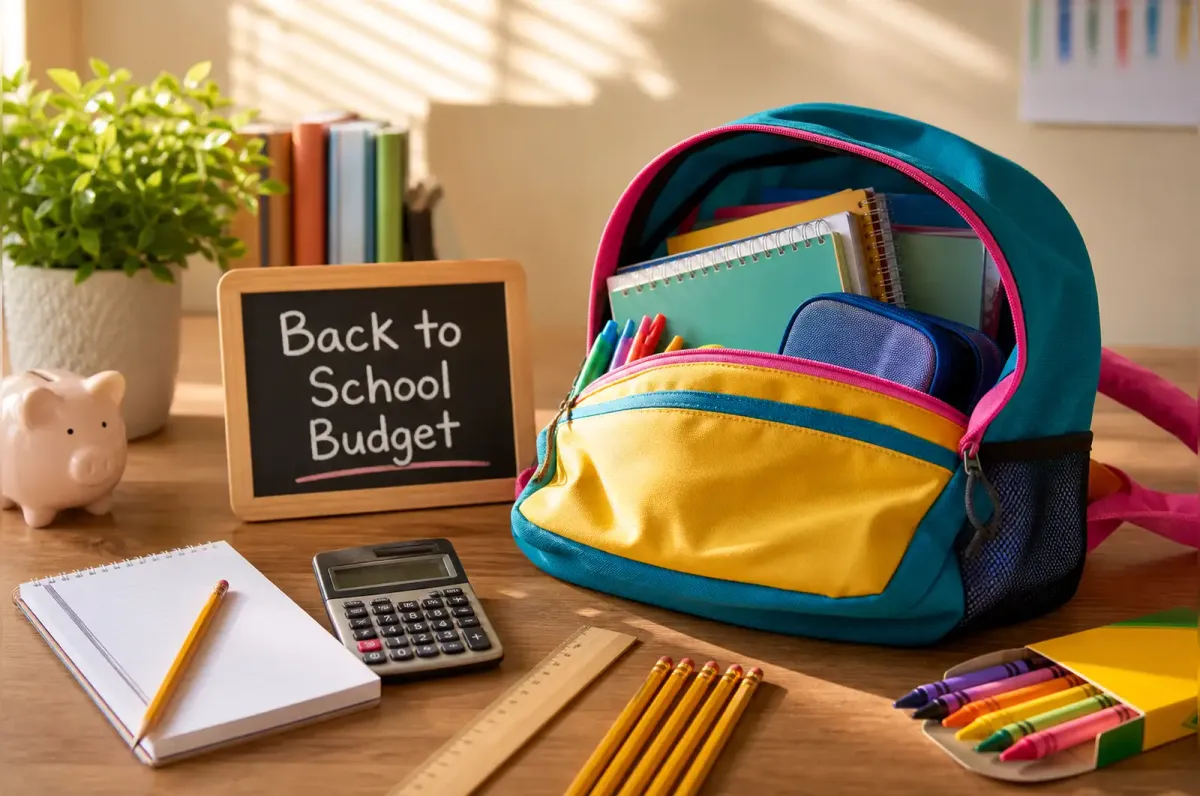
Back-to-school shopping has a way of sneaking up on you. One minute it’s mid-July and you’re still thinking about pool days; the next, you’re staring at a supply list that runs two pages and a price tag that makes your stomach drop.
The numbers this year aren’t pretty. NerdWallet’s annual survey puts the average family’s expected spend at $611 — and that’s actually down about $130 from last year, not because things got cheaper, but because families are pulling back on what they buy. A separate Chain Store Age survey pegs it at roughly $250 per child. Either way, it’s real money, and it hits right when summer utility bills are peaking and vacation spending is still fresh on the credit card statement.
You can cut that number by a lot without sending your kid to school with half a pencil and a grocery bag for a backpack. Here’s how — including the tricks retailers would rather you skip.
Know Your State’s Tax Holiday Dates
About 20 states run sales tax holidays specifically for back-to-school shopping, according to the Tax Foundation. The discount varies by state, but it’s essentially free money — you just have to shop on the right days.
Illinois drops its sales tax from 6.25% to 1.25% on qualifying items between August 7 and 16. Qualifying items include the basics: crayons, pencils, shoes, socks, binders. On a $600 spend, that’s about $30 back in your pocket. Not life-changing, but it covers lunch money for a couple of weeks.
Texas runs its holiday August 7 through 9 with an unusually generous setup: most clothing, backpacks, and school supplies priced under $100 are exempt from the state’s 6.25% sales tax entirely. No dollar cap on the number of items, either. A family buying $500 worth of supplies and clothes saves about $31 — not enormous, but it stacks with whatever store discounts you’re already getting.
Florida’s holiday runs July 26 through August 8 this year, covering clothing under $100, school supplies under $50, and even computers under $1,500. Missouri does a weekend in early August. Ohio’s runs August 1-7.
Dates shift year to year and qualifying item lists change. Assuming it’s “the same weekend as last year” is how people miss it. Your state’s Department of Revenue website has the current rules — searching “[your state] sales tax holiday 2026” takes 30 seconds.
If your state doesn’t offer one or you miss the window, price-match policies can claw back some of the difference. Target and Walmart both match select competitors’ prices year-round, and during back-to-school season customer service desks tend to be more flexible about it. Bring the competitor’s ad or have the website pulled up on your phone — they’ll usually honor it without much fuss.
Split the List Into “Buy Now” and “Buy Later”
Stores want you to buy everything at once. That’s how they win — you’re already in the aisle, already committed, and the mental math of “I’ll come back later” rarely holds up in practice. But some items genuinely get cheaper after school starts.
Things to buy before the first day: backpacks, lunch boxes, shoes, and anything your kid needs on day one. These have steady demand through August and the best deals cluster in late July and early August when retailers are competing with each other. Right now Target has select backpacks at up to 76% off, and Fox News’s deal roundup flagged JanSport backpacks at their lowest prices of the season.
Things to wait on: extra folders, replacement glue sticks, backup notebooks, and anything with a cartoon character on it. These get marked down 40-60% within two weeks of school starting. By mid-September, the character-branded folder your kid “had to have” in August is sitting in a clearance bin for $1.50 — and your kid may have already moved on to a new obsession anyway.
Clothing follows its own timeline. August is when retailers push full-price fall lines with confidence. September and October bring the real markdowns — 30% to 50% off as stores clear inventory for holiday merchandise. Buy one first-week outfit, one pair of shoes, and hold the rest. Waiting two months on a $200 clothing budget saves roughly $60-100, and your kid won’t notice they’re wearing last year’s hoodie until it actually gets cold.
Compare Prices With Your Phone, Not Your Memory
The price difference between identical items at different stores is larger than most people realize — and it’s gotten worse as retailers have shifted to algorithmic pricing that changes daily.
A 24-count box of Crayola crayons costs roughly $2.50 at Walmart, $3.29 at Target, and $4.99 at Walgreens. Same product, same count, same brand. Across a full supply list with 15-20 items, those $0.50-2.00 gaps add up to $30-50 in overpayment — entirely avoidable with five minutes of checking prices before you leave the house.
The Google Shopping tab and the Amazon app’s barcode scanner both let you check prices across multiple retailers in seconds. Walmart’s app has a “Savings Catcher” feature that automatically refunds the difference if a competitor advertises a lower price after you buy. If your kid’s school uses a standardized supply list, some stores even post pre-built shopping carts online — drop the list in, compare the cart totals across two or three stores, and go with the cheapest one.
Dollar stores are worth mentioning because the advice around them is usually wrong. For basics like rulers, pencil sharpeners, and generic folders, they’re genuinely cheaper than big-box stores. For anything involving glue, markers, or colored pencils, the quality gap is real — a Dollar Tree marker that dries out in two weeks costs more in replacements than buying the Crayola pack once.
The Bulk-Buy Trap
It’s tempting to grab the 24-pack of glue sticks because the per-unit price looks better. Sometimes it is. More often, you’re paying extra for quantities you’ll never use — especially if you have one kid and one teacher who specifically asked for two glue sticks.
The math: a 6-pack of Elmer’s glue sticks runs about $4.50 on Amazon right now, or $0.75 each. The 30-pack is $14, or $0.47 each. If your kid needs two, the small pack costs $9 for the year and you donate the extras. The bulk pack costs $14 and you’re storing 28 glue sticks until they dry out in 2028.
Bulk only wins when all three of these are true: you have multiple kids using the same items, the item doesn’t expire or dry out, and you have a place to store it where you’ll actually remember it exists next August. Pencils and loose-leaf paper clear all three. Glue sticks and markers fail at least one.
If you can split a bulk order with two or three other families, the math flips. Three families each paying $4.67 for a share of that 30-pack of glue sticks gets exactly what they need at a lower per-unit price than any small pack. School parent Facebook groups and neighborhood listservs are full of people trying to do exactly this — and if yours isn’t, you can start the thread yourself in two minutes.
The Supply List Nobody Audits
Schools send home lists that mix genuine requirements with aspirational suggestions. A “pencil box” might actually mean “something to hold pencils” — not the $12 character-branded version your kid spotted in aisle seven. A request for “four glue sticks” might be the teacher’s educated guess about what the class will need, not a per-student minimum.
Before you buy anything, go through the list and mark everything your kid can reuse from last year. Scissors don’t wear out in nine months. Rulers don’t either. That half-used pack of colored pencils from May is probably still fine. The backpack from last year might need a wash and a zipper check, not a replacement.
One middle school teacher in Ohio told us she starts every year by telling parents: “If the choice is between the $20 calculator on the list and food, buy food. Someone will have an extra calculator.” Teachers across grade levels consistently say they’d rather see a kid show up with plain, functional supplies than nothing at all because the full list felt impossible.
Some districts now post supply lists online months in advance, partly to give parents time to spread purchases across multiple paychecks. If yours does, use it. Buying a few items each week starting in mid-July is easier on cash flow than one $600 Target run the weekend before school starts.
Turn the Trip Into a Money Lesson
If your kids are old enough to read price tags, bring them into the process. Give them a cash budget for their “fun” supplies — the folder with the dinosaur on it, the glitter pens, the lunch box shaped like a shark — and let them make choices within it.
When my own kid was seven, I handed her $15 in cash at the Target school supply aisle and told her that was her budget for anything not on the required list. She spent 20 minutes comparing prices, put back a $9 notebook she’d grabbed first, and walked out with three things she genuinely wanted and $2 in change she kept. That lesson cost me $13 and taught her more about tradeoffs than any conversation we’d had before.
The point isn’t to make kids anxious about money. It’s to show them that choices exist, that “we can’t afford it” and “we’re choosing to spend on something else” are different things, and that spending on one thing means not spending on another. Most adults wish they’d learned those distinctions younger.
Even two of these strategies — shopping during a tax holiday and auditing the list for things you already own — can knock $80 to $120 off the total. Stack three or four together and a $600 spend can genuinely drop to half that. Your kid won’t notice the difference. They’ll be busy comparing dinosaur folders.

Discussion
Comments
Share a helpful tip, question, or takeaway from Back-to-School Shopping Doesn't Have to Cost $600 — 6 Ways to Cut That Number in Half.
0 Comments
Loading comments…