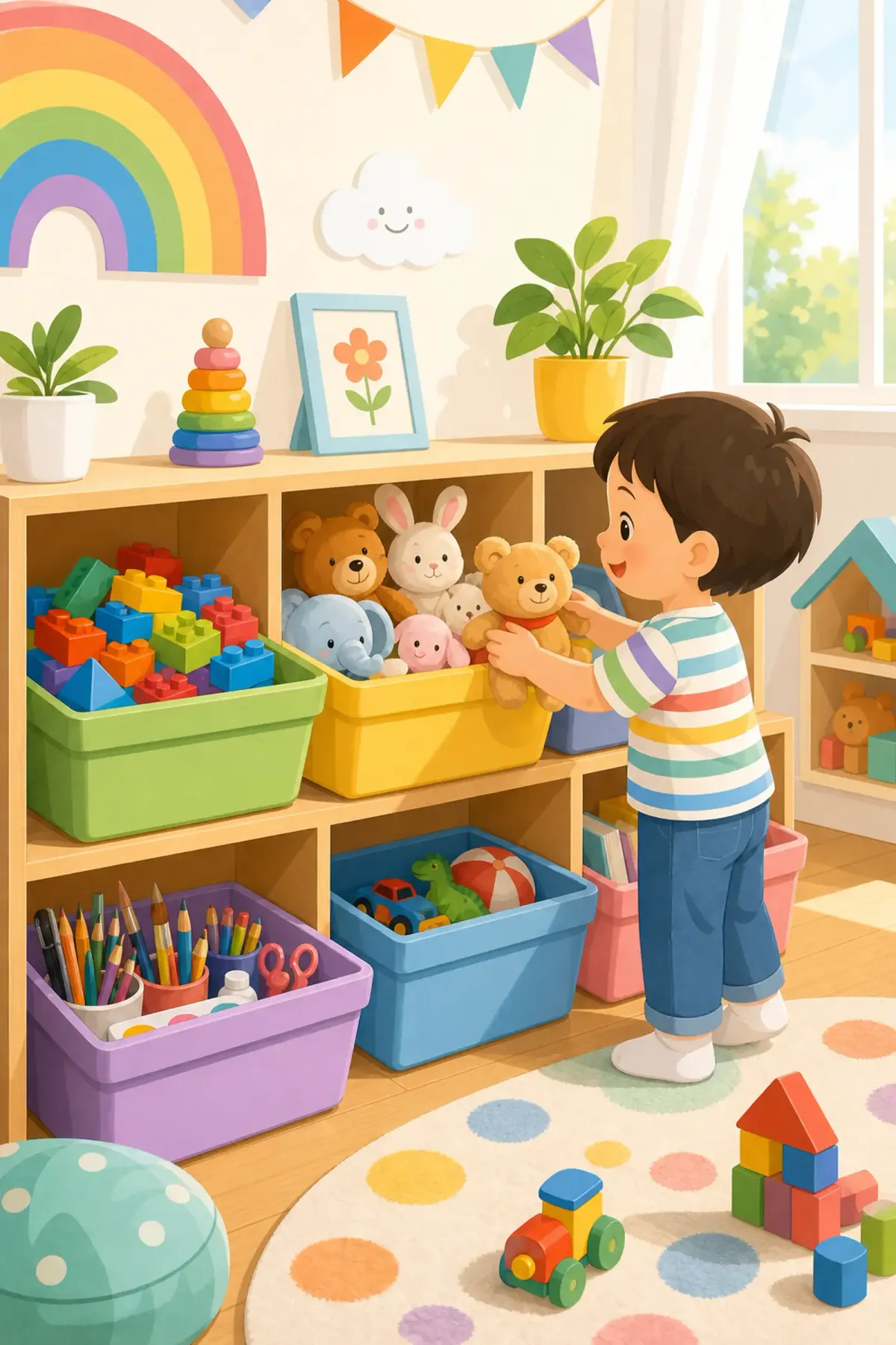
The gap between how parents want toys stored and how kids actually use them is wide. Parents want labeled bins sorted by category behind closed doors. Kids want everything visible and within reach so they can grab what they want without adult help. A storage system that works for everyone has to meet in the middle.
1. Open bins, not closed cabinets
Preschoolers and early elementary kids don’t open drawers or cabinet doors to find toys — they play with what they can see. Open bins on low shelves let them see what’s available and put things back without fine motor skills. One bin per category: building blocks, cars, dolls, art supplies. Label each bin with a picture and a word so pre-readers can use the system.
2. The rotation system
You don’t need to store every toy at once. Divide toys into three groups: out and accessible, stored in a closet, and stored in the garage or basement. Rotate every 2-4 weeks. Toys that have been “gone” for a month feel new when they come back out, and you have fewer items to manage daily. This also gives you a natural opportunity to identify toys that aren’t missed — and donate them.
3. One category per container
Mixed bins are death. When Legos, action figures, and puzzle pieces share a bin, finding anything requires dumping the whole thing on the floor. One container per type. Clear containers are worth the extra cost because kids can see inside. If you use opaque bins, photo labels on the front are essential.
4. Art supply containment
Art supplies multiply: crayons, markers, colored pencils, scissors, glue sticks, sticker sheets, construction paper, paint. A dedicated art cart (IKEA’s RÅSKOG is the classic) keeps everything mobile — roll it to the kitchen table for art time, roll it back to the corner when done. Separate supplies by type into the cart’s tiers.
5. The “books face out” shelf
Traditional bookshelves show spines, which doesn’t work for kids who choose books by cover. Forward-facing book ledges (wall-mounted rain gutters work surprisingly well as budget ledges) let kids see the covers and select books independently. Rotate the display based on season, interest, or just to keep things fresh.
6. Stuffed animal containment
Stuffed animals multiply and take up disproportionate space. A stuffed animal “zoo” — elastic cords or bungees stretched between two points on a wall at kid height — holds them visibly without consuming floor space. Kids can pull one out and stuff it back in. Alternative: a large floor basket or hammock in a corner.
7. Lego storage by color or by set
Two approaches, both valid: sort by color in clear bins (fast cleanup, kids can build freely) or keep sets in labeled zip-top bags with instructions (maintains set integrity, takes longer to clean up). Pick one and commit. The hybrid approach — trying to do both — results in everything getting dumped together.
8. The 10-minute family reset
Set a timer for 10 minutes at the end of the day. Everyone — parents included — picks up and returns items to their bins. The timer makes it a game and a defined, bearable window. Without a daily reset, toy organization systems degrade within 72 hours.
9. The “one in, one out” policy for birthdays and holidays
Before birthdays and major holidays, have your kids choose toys to donate — roughly equal to what they’ll receive. Frame it as making space for new things rather than giving things away. Many kids are surprisingly willing to part with toys they’ve outgrown when they understand the trade-off.
For more family organization strategies, see our small closet organization guide and decluttering methods.
Discussion
Comments
Share a helpful tip, question, or takeaway from Kids Toy Storage That Actually Works: 9 Systems That Kids Will Use (Really).
0 Comments
Loading comments…