Kitchen counters have a way of turning into the family junk drawer the moment you stop watching. The mail lands there. The kids’ homework lands there. The blender you used once and will “totally use again someday” lives there. And now there’s a survey that actually puts a number on why it keeps happening.
IKEA’s 2026 Store & Organize Report surveyed more than 31,000 people across 31 markets about the way they live with their stuff. It found kitchen countertops are the single biggest clutter hotspot in the home, named by 24% of respondents. The same report found 37% of people say the counter is also the messy spot most likely to start an argument. So this is not a “you just need a tidier kitchen” problem. It’s the hardest working surface in the house fighting for space with everything you don’t know where else to put.
The good news is that professional organizers treat this as a design problem, not a discipline problem. Most of their fixes take one afternoon and zero fancy storage.
Why your counter becomes the junk zone
Counters aren’t messy because people are lazy. They’re messy because a flat, high-visibility surface at eye level is the path of least resistance. Things land there because it’s the natural place to set something down on the way through the house, and once it’s there, it has a job: it holds your keys, your wallet, the stack of bills, the charging cable.
The problem is that pile snowballs. Amy Berryhill, a professional organizer and the owner of Spiffy Chicks, points out that hidden clutter quietly drives over-buying. Her line is: if you can’t find something, it can feel easier to order another one than to spend 20 minutes searching. That’s why your counter holds three nearly identical phone chargers and two bottles of the same hot sauce. You bought replacements for things you already owned but couldn’t find.
Michele Vig, a professional organizer, founder of Neat Little Nest, and author of The Holistic Guide to Decluttering, puts the counter in the same category as the “for now” pile. We stash things “for now,” and then the closets and cabinets fill up until we can’t see what we own. When that happens, the counter becomes the visible overflow. It’s the spillway.
So the goal isn’t to scold yourself into tidiness. It’s to give the stuff a designated home that is not the countertop.
Build around one big piece of storage
Vig’s biggest advice for a small, cluttered room is counterintuitive: don’t buy a bunch of little organizers. Build the room around the largest single piece of storage you can fit.
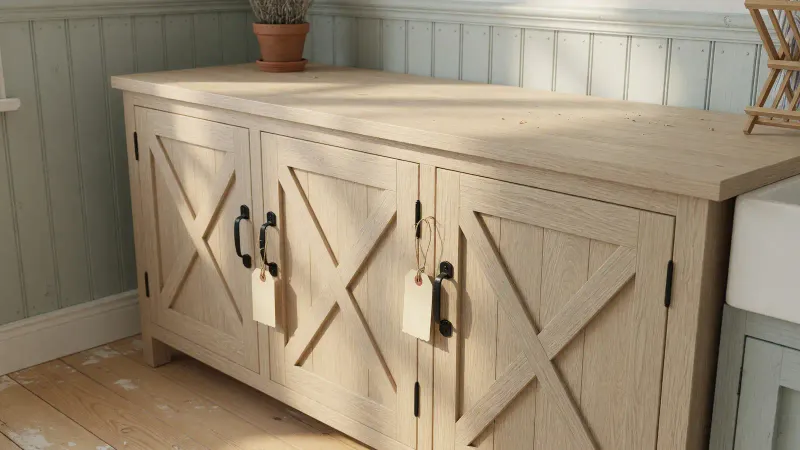
Her reasoning is that too many small storage pieces in a small space make the room look broken up and messy. One larger piece can be both the storage you need and the design anchor. It’s the same logic that makes a chunky sideboard work better than five scattered baskets in a hallway.
Apply this to the counter and it changes the conversation. Instead of asking “where do I put the mail?”, you ask “what’s the big piece of furniture that will absorb most of this?” For a counter-adjacent space, that’s often a proper console table, a shallow sideboard, or one substantial cabinet that can take the mail, the charger, the keys, and the cookbooks in a single place.
Scheck, an organizer quoted in the same Guardian piece, adds that the furniture should do more than one job. A bench or ottoman with built-in storage, for example, clears space while giving you a place to sit. If the piece in your kitchen serves as a coffee station or a pantry shelf too, so much the better.
Decant and go see-through
Once you’ve freed the background, the counter clutter you actually need to keep around should become visible. That sounds backwards, but it’s the trick that keeps surfaces clear.
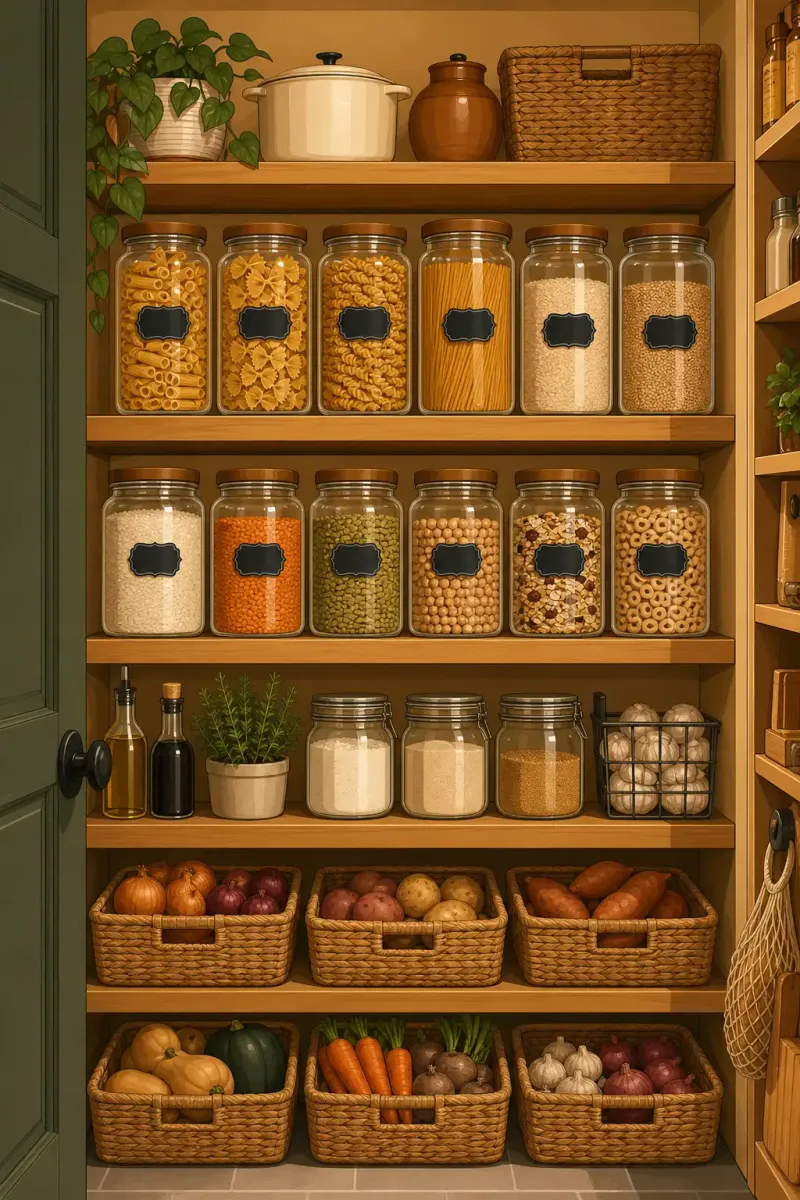
Vig recommends decanting spices into glass bottles so you can buy in bulk more easily and actually see what you have. Berryhill makes the same case for baking ingredients and snacks: a clear canister means you know you have flour before you start a recipe, instead of discovering the empty bag mid-bake. The payoff is that you stop buying duplicates, because you can see the one you already own.
The see-through rule applies in the pantry and on the counter alike. Scheck says wire storage baskets are a favorite for pantry organization because they keep food contained while still being easy to see and grab. Vig uses metal bins with magnetic labels on the front to finish the look, so you know at a glance where the rice lives.
You don’t need matching $29 jars everywhere. The principle is just: if you can’t see it, you will re-buy it, and if you re-buy it at a rate faster than you use it, the overflow inevitably ends up on the counter. See-through containers stop the cycle at the source.
Give everything a category and a boundary
Visible storage only works if the stuff inside has a defined job. That’s where the category idea comes in, and it’s cheaper than you think.
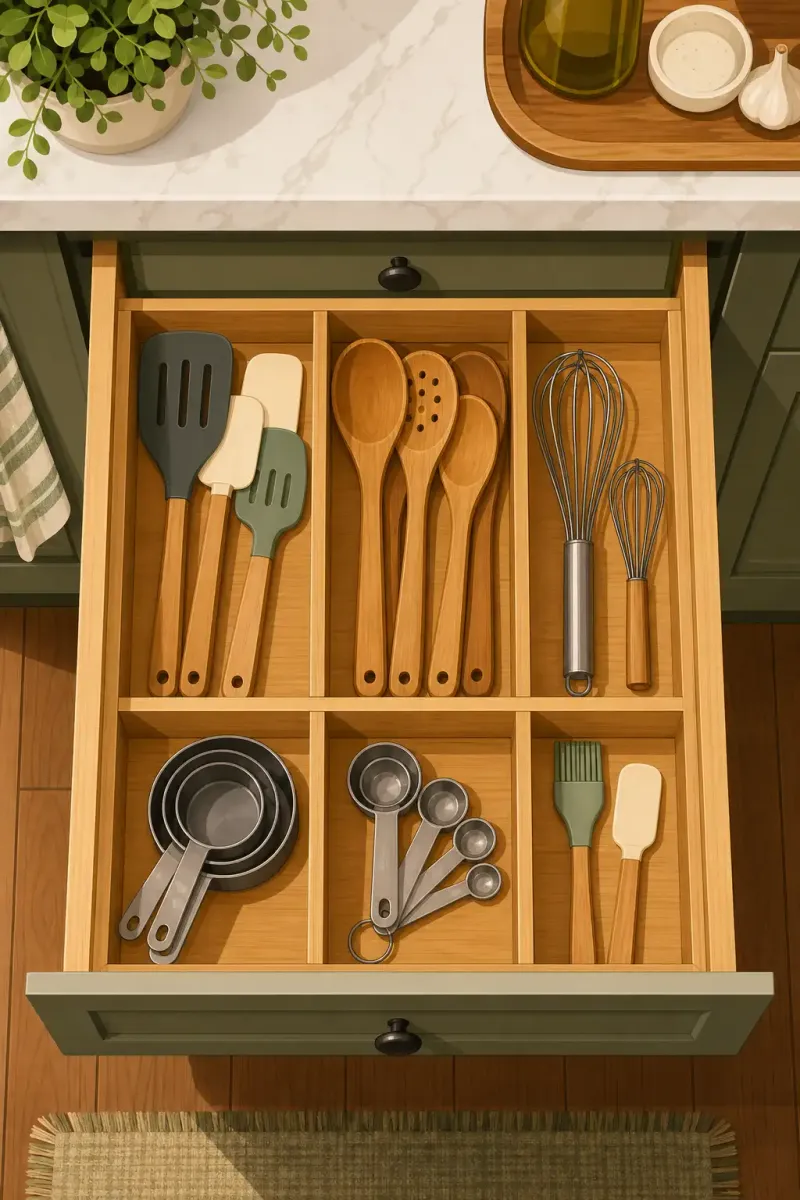
Organizers keep pointing out that plain drawer organizers do the job fine and cost less than the marketed ones. They create categories and clear boundaries. A catch-all tray does something similar in miniature. Richards, quoted in the Guardian piece, recommends a marble catchall or tray on a console table or countertop. It pulls the tangle of headphones, sunglasses, and purse contents into one contained spot that can look intentional rather than scattered.
So instead of trying to keep the entire counter empty, give it one or two clearly marked homes. A tray for the everyday carry. A bin for the mail waiting to be dealt with. A spot for the mixer you genuinely use weekly. When each thing has a boundary, the pile stops expanding into everyone else’s space.
The IKEA finding that 37% of people argue about the counter makes sense when you see it this way. A counter without boundaries is a shared surface with no owner. A counter with a tray, a bin, and a clear spot for the coffee maker is a surface with a system, and a system is a lot harder to fight over.
Clear the big offenders off the counter
Before you buy a single organizer, take stock of what’s actually taking up the counter space. In most kitchens it comes down to two things: appliances you don’t use as often as you think, and paper you haven’t dealt with.
Countertop appliances are the biggest square-footage stealers you own. The test is simple: do you use it weekly, or monthly? A coffee maker you run every morning has earned its spot. The waffle maker you pulled out twice last spring has not. The rule a lot of organizers use is to keep on the counter only what you use at least a few times a week, and to put the rest in a cabinet. Yes, that means fetching it from the pantry when you need it. The ten seconds of reaching beats giving up permanent counter space to a machine that mostly collects dust.
Air fryers deserve a callout here since they’ve colonized a lot of counters in recent years. They’re great, but they’re also big. If yours lives on the counter full time, ask whether that trade is worth it. A lot of people find the air fryer earns the counter, and the toaster does not. Pick one.
Paper and mail are the other silent counter colonists. Mail should not land in a pile. Give it a landing spot with two bins: one for “to do” and one for “shred.” A clear-binned spot next to the front door or the kitchen edge works. Then schedule a short weekly slot to process the to-do bin, because a stack of unopened mail turns into a guilt pile that spills off the counter.
The fix for appliances and paper is the same as the fix for everything else on this list: a decision, not a storage gadget. Each item either earns its counter spot by getting used, or it moves into a contained home elsewhere.
The 15-minute daily reset
You cannot empty a counter and expect it to stay empty. The organizers know this. The realistic fix is a short reset that runs every day, and it takes about a quarter of an hour.
Here’s the routine: start at one end of the counter and work to the other. Pick up anything that belongs to another room and put it in a basket to cart away. Put away the clean dishes that dried in the drying rack. Wipe the surface. Then put back only the things that earn a permanent place on the counter, and give the rest of a home.
The trick is to timebox it. Fifteen minutes, or you stop. The goal is not a magazine-perfect counter. It’s a surface that never reaches the point where the argument starts. And when that reset runs daily, the counter stops being the family junk drawer and starts being the workspace it was always meant to be.
What to actually do first
If you take one thing from all this, make it the see-through rule. Buy fewer, clearer containers, decant what you buy in bulk, and give the everyday items a tray and a bin with boundaries.
If your counter has been a landfill for years, start with the larger storage piece idea, because that’s what absorbs the bulk. Then set the daily 15-minute reset so it never snowballs again.
The counter will never be empty. That’s not the point. The point is that 37% of households argue over this surface, and the fix is mostly about giving things a home and a boundary instead of relying on willpower you don’t have after a long day.
A clear counter is a small thing, but it’s a small thing you see every time you walk into the kitchen. That adds up.
Past organizing fixes from us: if you want to shrink the clutter at the source, start with the one-in-one-out rule, or hunt down the hidden storage zones you keep overlooking. And if you live in a tight space, these small-apartment storage solutions fit in a home that doesn’t have room to spare.
Discussion
Comments
Share a helpful tip, question, or takeaway from Kitchen Counters Are the #1 Clutter Hotspot in Your Home. Here's the Fix..
0 Comments
Loading comments…